Stephen Weinberg

While working on a project at MIT, I met Stephen Weinberg for the first time in his office at Jefferson Labs at Harvard University. That was back in 1979, just before it was announced that he, Abdus Salam, and Sheldon Glashow would share the Nobel Prize for their work on electroweak unification based on spontaneous symmetry breaking.  Weinberg’s work includes defining the  Z boson and “the amount of parity violation when mixing with electromagnetic interactions.” For more, see the Standard ModelAnd, even more…


Thu, Jan 1, 2015 at 3:42 PM
Subject: Planck’s Time & Length,
The First Three Minutes, and your
preface in Time in Powers of Ten

Dear Prof. Dr. Weinberg:

Unwittingly we have begun working with Planck Time.
We started with the Planck Length in 2011.

Our high school geometry classes over here in New Orleans
backed into a model of the universe using base-2 exponential
notation.  We multiplied the Planck Length and Planck Time
by 2 until we got out to the Observable Universe  and the<
Age of the Universe respectively.

Here is a link within our work on a science fair project:

https://bblu.org/

It took just 202+ notations  or doublings and it all started

because we went inside a tetrahedron, halving the edges,
connecting those vertices to discover the four half-sized
tetrahedrons in each corner and an octahedron in the middle.
We did the same with the octahedron (finding the six half-
sized octahedrons in the corners in eight tetrahedrons in
each of the faces) and we didn’t stop until we were some-

where around the Planck Length.

The fascinating thing we discovered along the way is what
we are calling “the really-real small-scale universe.” It has
a geometry and a systemic order (numbers and symmetries).
Nobody seems to know much about it although analyzed
throughout human history and called the aether (ether),
vinculum, plenum, matrix, grid, continuum, firmament and
hypostases.

If we divide this little mathematical-geometric
universe into “thirds” as the small-human-large scale,
the small-scale universe finally has some definition but
now it only takes us up to size of the fermions and protons.

What do you think? Just poppycock?   Nonsense?

If it is nonsense, please, please tell us why and we can go back to
normal and get on with our life.  If not…

Thank you.

Most sincerely,
Bruce

——————-
Bruce Camber
New Orleans

Stephen Hawking

Stephen Hawking has been the world’s leading advocate for the big bang theory. In 2012 we were just starting our rather idiosyncratic studies within this domain. Notwithstanding, if and only if the simplicity of our work begins to resonate, we would hope to receive some acknowledgement from the University of Cambridge, Department of Applied Mathematics and Theoretical Physics (DAMPT). Here is our most recent email to Prof. Dr. Stephen Hawking through his personal assistant, a graduate student, Jonathan Wood:

June 30, 2016 at 5:18 PM
References: Is is possible that a quiet expansion defuses the big bang?

Dear Jonathan (and Prof. Dr. Stephen Hawking):

On July 4 that article (link above) to which I referred you earlier this month will finally be considered a “first draft.” This model, based on a rather quiet expansion of the Planck base units using base-2 exponential notation, begins to redefine the first four epochs that define the start of the big bang theory. The Planck Epoch has become the Planck Moment; the Grand Unification Epoch has become a process and your Inflationary and Electroweak Epochs have also become processes.

Just below, I will insert our introduction from our quite-large, horizontally-scrolled chart and I will post this email within our “Letters” for our 3000+ scholars with whom we communicate around the globe.

Of course, we will inform you and the people of the DAMPT of our progress or lack of it.

I send you our best wishes for your well-being and that of all the DAMPT people,

Most sincerely,

Bruce
*************
Bruce Camber
New Orleans
http://bblu.org
************

Redefining the big bang theory through this quiet expansion of 201+ notations:
The following three questions need to be addressed by this simple mathematical model of the universe called Quiet Expansion (QE):
1. Can this quiet expansion defuse the big bang theory? The math within the QE model redefines the first four and most-key elements of the big bang theory (bbt). If it is defused and becomes an historic statement, From Lemaître to Hawking, science can move on within well-prescribed boundary conditions and known parameters. The first four “epochs” of the big bang theory can readily be subjected to redefinition. These “epochs” amount to less than a trillionth-of-a-trillionth a second.
2. Are ethics and values built into the fabric of the universe? The QE model establishes a simple continuity equation from the first moment in time through the Age of the Universe to this day and this moment. These simple mathematical constructions quickly evolve as geometrical constructions and symmetry groups. These become dynamic and harmonic. Continuity, symmetry and harmony are the foundations for a natural value equation deep-seated within the universe. Most every flavor of ethics, morals, and values can be appreciated for what they do and don’t do, and for why they are.
3. How can we more fully understand the finite-infinite relation? This finite-infinite relation is perhaps best described as a study of perfection and moments of perfection and that the geometries and mathematics of imperfection are also better defined and understood as a result.

Planck Moment: The finite-infinite relation most intimately defines the first notation and is necessarily within all notations building from the first. An infinitesimally short duration, it is the beginning that creates space and time and then extends within space and time much like the birthing process. The Planck base units are our simplest-deepest-best description of this moment as of today.

Grand Unification and the Electroweak Processes: Based on the fact that entities and things require a necessary amount of space that only becomes available from the 67th notation and above, the first 60 to 66 notations are foundational to all notations. Using the analogy of the birthing process, all the forms-and-functions, then processes-and-procedures, and then relations-and-systems prior to the actual birthing event, are the first 60 or so notations. Here that finite-infinite relation creates the foundational order, the most basic relations, and many dynamical systems prior to the uniqueness of every reasonable analogue to the birthing event.

The Grand Unification processes continue beyond the 67th notation as specific Unification processes. The electroweak processes now begin to manifest and the measurements given by the big bang theorists can be tweaked and integrated within the quiet expansion model.

Inflationary Processes: Just as there are still many many questions about cellular division, there are even more open questions within this model. However, the force, the infinitesimal amount of energy, available to this process are working ratios of the Planck base units whereby order, relations, and dynamics evolve with a perfect continuity, perfect symmetry, and a deep harmony within every sphere and basic structure. This concept was initially put forth as a philosophical orientation to life, and then it was explored in a post about numbers called,  On Constructing the Universe From Scratch (pp.5f).

Lawrence, Hannah

Emails and Letters
College & University scholars
Editors and Writers

§Hannah Lawrence is the Deputy Editor of Branded Content at Romper (Bustle.com).

Friday, September 16, 2016

Hi Hannah,
There is a simple model of the universe, and to grasp it requires nothing more than second-and-third grade math and a suspension of any current model (such as the big bang).  This simple model is based on simple logic and simple math.
Please bear with me as I attempt to describe it quickly and easily.
1. The smallest-scale measurements of the universe are called the Planck units. The largest measurements we know are the Observable Universe (space or length) and the Age of the Universe (time).  If you double the Planck Length and Planck Time just 67 times, you are up to the smallest particles like the fermion and proton and the universe is a trillionth of a second old.  In another 67 steps you are just over 351.97.km (218.70 miles) and still less than a second old!  In the next 67 steps, up to just over 200 notations, you are up to the Observable Universe and Age of the Universe (13.81 billion years). You just multiplied those infinitesimally small Planck units by 2 over and over again and you end up with a model of the universe that is highly-ordered and in a  well-defined box.
Hard to believe.  Take a look at the actual numbers.  The biggest discussion is about what it means.
2.  We started this work in a New Orleans high school back in December 2011. We’ve been writing about it:
Now, if you are having trouble with the numbers, please take a look at the checkerboard-wheat story . Multiplying by 2 is called exponential notation.  It is what cells do.  It is what nature does.  We call the earth, Gaia, the ancestral mother, and though science has attempted to marginalize the earth and its people, this model is sensitivity training taken to the highest degree.  It suggests that everything that has ever been done in the universe is registered, noted, and imprinted.  Though we might call it history, in this model it is all living history.  Nothing is past; it is all right now. 
 
Interesting? Thanks.

Most sincerely, 

Bruce
* * * * *
Bruce Camber
New Orleans
 
PS.  Here are two of my current emails, one to editors and the other to scholars.


****

July 8, 2016

Within the Quiet Expansion, what is mass and what is charge?

Next edits: November 2017
WORK-IN PROGRESS – NOT A FIRST DRAFT (rough notes)

Notes: Under construction. This post is needed to support our comparison of the big bang theory to our Quiet Expansion model. One of those comparisons is for the general public. The other is for the academic-scientific community. To incorporate this question within those two working posts would make both altogether too long. This posting is also a sequel to these two open, working documents:
·   Dark Matter, Dark Energy, Cosmology and the Large-scale universe (2015)
·   Wrong: There is a possibility (December 2015)

The question
BangerQuestions about the nature of mass and charge have been addressed by the most highly-respected scientists over the centuries. Both mass and charge are manifestations of fundamental faces of reality.  Both have necessarily-related concepts.  Mass has density, weight, force and the mass-energy equivalence . And charge has electric charge (Coulombs, ampere, time and force) and color charge  (generating set of a group, symmetry groups, and Hamiltonian). All these concepts have been reviewed thousands-upon-thousands of times. However, to our knowledge, never have these concepts been reviewed within the framework of the first 65 or so notations of the Quiet Expansion model. Here, within each notation, we are using a most-simple mathematical formulation to ask the question, “What are these numbers saying about the nature of reality?”

A possible answer
It seems that the mathematics, particularly those ratios rendered within each doubling of the Planck base units, defines mass (weight, density, force, mass-energy equivalence) and charge (both electric and color) as a derivative of the other base units and all of the constants such as light, gravity, and the reduced Planck constant that define them.

To research what that means and to prepare to write this document, the very creative work of several  PhD research physicists came to our attention. It is all truly amazing work. These are scholars who are attempting to push through some of the well-known problems with the Standard Model. Some have posited exciting new theories and ideas. We could easily get lost in that sea of ideation. We can’t.  It is all very encouraging to feel their creativity, however, our model is based on simplicity — simple concepts and simple mathematics. So, we won’t stray too-too far from where we are as we attempt to impute meaning to our simple doublings of the five basic Planck units.

To establish a basic platform, we did return to the work of Prof. Dr. Frank Wilczek of MIT and his August 2012 work titled, The Origins of Mass (PDF), MIT Physics Annual, 2003, and the more recent  Origins of Mass,  ArXiv, Cornell University, August 2012.  We also recommend his 2004 lecture video,  The Origin of ^Most Mass and the Feebleness of Gravity. He addresses “regular mass” and readily acknowledges that mysteries remain within dark matter and dark energy. Over the past 20 years Wilczek has written many articles and books about the nature of mass and matter.

Notwithstanding, within the first 60 or so notations, mass, time, space, charge, and temperature take on a very different meaning. These five are so inextricably related, they can not be pulled apart and each truly exists in reality, but prior to the 65th notation can only be known by their ratios .These ratios are real, and a real definition of a very real reality. Each notation builds upon the prior notations. All notations continue their prior notation’s more fine doubling as well as what I’ll call their archetypal doubling; that is the doubling into the next notation. With each doubling our universe is increasingly networked and related. Within the gross doublings, these networks begin systematizing sets and groups, given the definitions within and between each notation, and begin to emerge as cells within the cells notation, as people within the “people” notations, as solar systems within the solar system notations, as galaxies within the galaxy notations, and so on.

Let’s work on some conclusions.
Is that clear?  Yes, I hear, “Clear as mud.”  Well, if it is a little clear, help us to make it more clear! This is just Day 2 for this document! We are in need of mentors! Help. So, we are asking for help from people around the world and throughout the scientific-academic communities. You could become the author or co-author of this page and/or any other page on these related sites.

Perhaps we are not doing any worse than the big bang theory according to Stephen Hawking and his cohort. They completely ignored Planck charge and then give rather bubbly notions as to how the universe went into its supercooling state.  At least our mathematics has a simple logic and rationale.  -Bruce

On building bridges between all things divisive…

Is it possible to extend our first principles for those who harbor hostility?

Taking our very first statement (this link goes to it) used for the first principles of the television series, Small Business School, we attempt to extend it here to engage all things divisive, especially religious language and those who oppose religious language.

Divisiveness in business, family life, culture and ethics,, political life, religion, and even the sciences actually hurts all business. Divisiveness includes lying, stealing and cheating as well as waste, greed, and corruption.

What makes us human? … ethical? What gives us hope, depth, perspective?

Deep within the fabric of life there is an abiding thrust to make things better, more perfect. Though a cornerstone of business (value creation and exchange), there is much more.

There are three forms within functions that define an increasingly perfected state within every experience:

• The first form that defines our humanity is continuity, and its most basic function, a simple perfection, is to create order. In the traditions of the Abrahamic faiths — Judaism, Christianity, and Islam — this is the Creator-Sustainer God. Any order, that creates continuity, is a metaphor as well as a direct expression for the Creator-Sustainer God.

• The second form is symmetry and in its perfection functions to create relations. In the Abrahamic tradition the perfection of that symmetry is the love doctrine, i.e., to love God with all one’s heart, soul, mind and strength, and one’s neighbor as oneself. Any symmetry that creates real relations is a metaphor and a direct expression of the presence of the Love of God.

• The third form is dynamics and its perfection, a complex symmetry extended within time, is harmony. Again, in the Abrahamic tradition, the gift of the Holy Spirit is God transcending a moment in space and time to create a profound joy, deep insight, compelling love… simply a moment of perfection. Any dynamic experienced as a harmony is a metaphor, albeit the real presence, of God’s Holy Spirit within that moment.

Every scientific and religious assertion, both seeking to understand and define the universal, begins with the same first principle and evolves within its own understanding to the second and third. Therefore we have a diversity of faith statements which includes all of the sciences.

This is also the basis of the value chain. The more perfect a moment or an experience is, OR the more perfected a thing or system is, the more valuable it becomes. Thus, we have the beginnings of business. Here is the baseline beginning of value and values.

Any assertion that counters life’s evolving perfections is not religion (at best, it’s a cult*); it is also not business (it’s exploitation or a bad company); certainly it is not good government; and most often, it is not even good science.

There are scientific endeavors that observe, quantify and qualify that which is fundamentally based on discontinuities or chaos, but these studies require the inherent continuities of mathematics and other universal-and-constants to even grasp the nature of that discontinuity.

* Extremism (also, a radical elitism) in any form is not religion; it is a cult. Those groups that condone killing could readily be labeled a cult of death that respects only their own, self-defined principles of continuity that inherently create discontinuities. Although there is a lot of attention being focused on the extremists within all religions, Islamic extremists demand the most attention. These people have not grasped the fullness of Allah, and the distinction between the historic revelations and the universal revelations. They also fail to grasp and integrate the necessary universals that extend from the sciences through Allah. And for those of us who do not know Arabic, Allah is the Arabic word for God, yet without question the many different “takes” on God could be more readily integrated if all religions were to ask, “What is God’s perfection? How can we know anything about it?”


***

Even between atheists and believers

Perhaps all it comes down to is an answer to the question, “Whose metaphor is more meaningful?”   You will not find many atheists who deny science.  They do not deny the constants and universals that are always in the back of the science textbooks.

There are three constants within the sciences that remain clear, in spite of quantum mechanics.  The first is that there is order and continuity in the world.  It is the basis of knowing.  In every discipline there are multiple parameter sets where this is true.  Beginning in mathematics, a rather pure form of thought, abstraction and representation, we then move into physics.  It has multiple parameter sets as well.  There is one for Newtonian mechanics, another for General Relativity and Special Relativity and yet another for quantum mechanics.  Then chemistry and biology have their own parameter sets.  All these parameters simply establish the boundary conditions of what is being measured within them.

Each has a formalized language.  And, each has a metaphorical language that pushes into the edges of the unknown.

The sciences all embrace varying definitions of relations yet all of these definitions are understood by a symmetry function.

Specialized disciplines with each of the sciences hypothesize about the nature of the unknown, just beyond their limits of knowledge, and all these hypotheses are a study of the deepest dynamics of their discipline.  The experience of insight, the “ah-ha” of the creative surge, is experienced as a concrescence of symmetries or harmony.

The atheists mostly object to the use of specialized language.  They understand rules, mores, and societal law and order  even though many are nihilistic, others narcissistic, and many both.

Yet, change will come.  Some of  these folks will begin to realize that time is not a fundamental frame of reference and that there are qualities of life that permeate everything in every way, and that these qualities empower order, relations, and dynamics, and that these three scientific functions with the faces of continuity, symmetry and harmony just might also be understood with very personal language.  When and if they do, they are on their way to create a personal bridge to religion and some of the brave among them just may cross it.

Does this quiet expansion challenge the big bang?

Although our naive answer seems the answer is “Yes,” surely more reflection is required. Here is where we are now (most recent postings first):

  1. How did it all begin? And, what does it mean? (June 2016)
    https://bbludata.wordpress.com/2016/05/25/timeline/
  2. Quiet Expansion of the Universe (June 2016)
    https://bbludata.wordpress.com/2016/06/18/quiet/
  3. Notations 1-204: A most-simple, integrated model of the universe. This project began in 2011. This page uses horizontal scrolling (a test started in April 2016) to provide a quick overview to all the numbers.
    https://bbludata.wordpress.com/1-204/
  4. Planck base units from 0 at the beginning to today: https://planckbaseunits.wordpress.com/

More…

Tetrahedron & Octahedron: Simplest Interior Structures

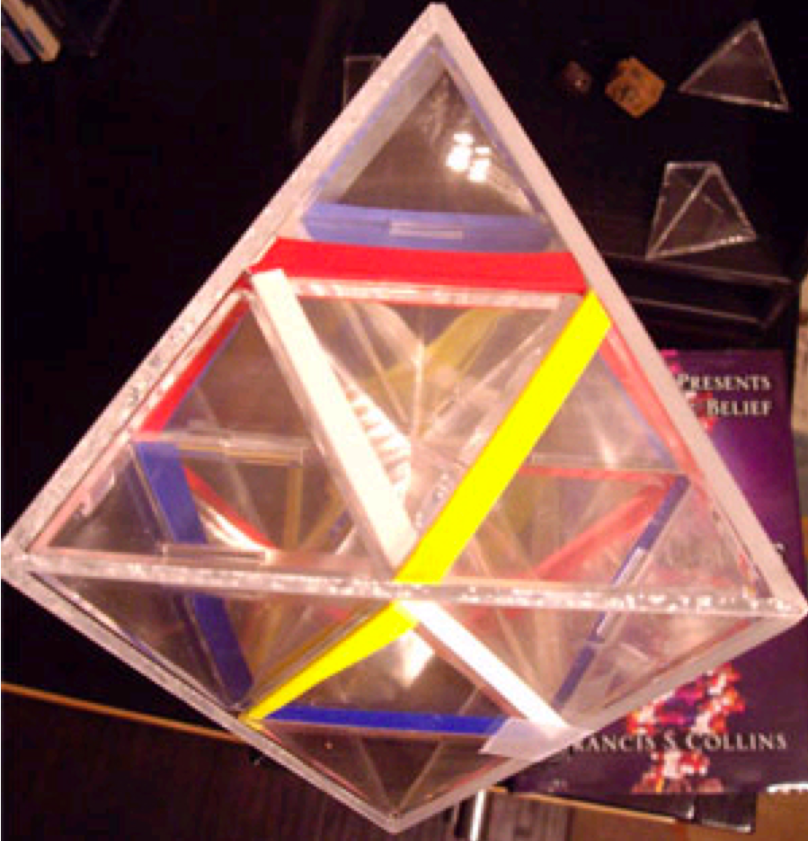
tetrahedronThe simple octahedron is inscribed with the center of every tetrahedron. In the image on the right, the yellow face of octahedron is exposed; the central triangle in the three other faces are part of the octahedron.  The other four faces are internal, facing an abutting tetrahedron.

There are six half-sized octahedrons in each corner of the octahedron and a tetrahedron in each face. There are many two-dimensional internal plates. Outlined in colored tape, the white, red, yellow and blue hexagons are outlined. There are also plates of squares and triangles.

Screen Shot 2016-05-20 at 5.19.17 PM

Tweety


Can you discern at least one unique formula within the 201+ notations? There are many to develop.

The challenge:  Come up with a formula based on the array of numbers within  the Big Board – little universe Project.  But, please be aware that all of the charts are now being fine tuned based on our recent work to develop a very large horizontal board with all five Planck base units in the progression from Planck Time to the Age of the Universe in just over 200 notations.

The horizontal board was initiated on April 10 and posted for insiders on April 25th. Those of you among my LinkedIn family are considered “insiders” (and you are most welcomed to join us).

We have been developing what we are increasingly thinking could become an alternative to the Big Bang theory. That’s a ridiculous statement to make, but now with well-over four years of looking at these numbers, it seems that our little model could have a place in the universe of academia. It may go through several versions, even transformations, but that struggle will be well worth the time and effort. There is real information within this “little” nascent model.

My special challenge to graduate students and post-docs. Take the five basic Planck units at one of the notations between 1 and 201 — and work out new formulas integrating any and all formulas used within the big bang theory. There is a place for every formula within at least one notation along this scale of the universe.

If nothing else, this project should get us thinking about number theory, the finite-infinite relation, the discrete-and-finite nature of space and time,  and the correspondence between the five Planck base units, space-time-mass-energy-temperature.

The very first  formula that I developed on May 1.  It is simple and it will be further developed. The next formula that we receive that is mathematically coherent will be given the designation: Formula #2.  Each subsequent formula will be numbered accordingly.  Each will become that student-or-professor’s formula and we will track the continued development and implications of each formula well-beyond this early-stage development and hopefully well-into an academic-development phase of The Big Board-little universe Project.

Thank you.   – Bruce 

PS.  Send your formula to me at camber (at) bblu.org

Related articles:

formulas.png

Flooding the big bang theory

Although the big bang is the dominant theory of our day (and since about 1975), support for the big bang theory is not unanimous. Here we will aggregate articles, most-recent first, by people who raise questions about the theory.

August 2016: How did the universe begin? And, what does it mean? Could a Quiet Expansion impact the Big Bang?” by Bruce Camber

January 2016Are Cosmologists Fooling Themselves About The Big Bang, Dark Matter And More?” by Ethan Siegel, Brian Koberlein, Forbes Magazine, Jan 20, 2016

Feb 10, 2015  Is “Big Bang” a Big Bust? New physics theory says Yes! Lisa Zyga writing about the work of Ahmed Farag Ali and  Saurya Das.

January, 2015 “New origin of universe model pours water on Big Bang theory” Ahmed Farag Ali, a physicist at Zewail City of Science and Technology (Egypt) and Saurya Das (University of Lethbridge, Alberta Canada) reported by Zeeya MeralarXiv:1404.3093 (2014).

May 2015:  The Big Bang’s Identity Crisis, PBS-TV, Paul Halpern (homepage)

June 2004:   Big Bang Theory Busted By 33 Top Scientists, Open letter reported by was signed by:

  • Halton Arp, (died, 2013) Max-Planck-Institute Fur Astrophysik (Germany)
  • Andre Koch Torres Assis, State University of Campinas (Brazil)
  • Yuri Baryshev, Astronomical Institute, St. Petersburg State University
    (Russia)
  • Ari Brynjolfsson, (died: 2013) Applied Radiation Industries (USA)
  • Hermann Bondi, (died, 2005) Churchill College, University of Cambridge (UK)
  • Timothy Eastman, Plasmas International (USA)
  • Chuck Gallo, Superconix, Inc.(USA)
  • Thomas Gold, Cornell University (emeritus) (USA)
  • Amitabha Ghosh, Indian Institute of Technology, Kanpur (India)
  • Walter J. Heikkila, University of Texas at Dallas (USA)
  • Michael Ibison, Institute for Advanced Studies at Austin, Texas
    Earthtech.org   http://xxx.lanl.gov/abs/astro-ph/0302273
    PDF: http://supernova.lbl.gov/
  • Thomas Jarboe, University of Washington (USA)
  • Jerry W. Jensen, ATK Propulsion (USA)
  • Menas Kafatos, George Mason University (USA)
  • Eric J. Lerner, Lawrenceville Plasma Physics (USA)
  • Paul Marmet, Herzberg Institute of Astrophysics (retired) (Canada)
  • Paola Marziani, Istituto Nazionale di Astrofisica, Osservatorio, Astronomico di Padova (Italy)
  • Gregory Meholic, The Aerospace Corporation (USA)
  • Jacques Moret-Bailly, Université Dijon (retired) (France)
  • Jayant Narlikar, IUCAA(emeritus) and College de France (India, France)
  • Marcos Cesar Danhoni Neves, State University of Maringá (Brazil)
  • Charles D. Orth, Lawrence Livermore National Laboratory (USA)
  • R. David Pace, Lyon College (USA)
  • Georges Paturel, Observatoire de Lyon (France)
  • Jean-Claude Pecker, College de France (France)
  • Anthony L. Peratt, Los Alamos National Laboratory (USA)
  • Bill Peter, BAE Systems Advanced Technologies (USA)
  • David Roscoe, Sheffield University (UK)
  • Malabika Roy, George Mason University (USA)
  • Sisir Roy, George Mason University (USA)
  • Konrad Rudnicki, Jagiellonian University (Poland)
  • Domingos S.L. Soares, Federal University of Minas Gerais (Brazil)
  • John L. West, Jet Propulsion Laboratory, California Institute of
    Technology, NASA Jet Propulsion Laboratory Systems Division, Pasadena, CA 91109-8099
  • James F. Woodward, California State University, Fullerton (USA)

Additional signers:

  • Emre Isik Akdeniz University Turkey
  • Felipe de Oliveira Alves, Federal University of Minas Gerais, Brazil
  • Jean-Marc Bonnet-Bidaud, Service d’Astrophysique, CEA, France
  • Martin John Baker, Loretto School Musselburgh, UK
  • Peter J Carroll, Psychonaut Institute, UK
  • Jonathan Chambers, University of Sheffield, UK
  • Michel A. Duguay, Laval University, Canada
  • Tom van Flandern, Meta Research, USA
  • Kim George, Curtin University of Technology, Australia
  • Roger Y. Gouin, Ecole Superieure d’Electricite, France
  • R.S.Griffiths, CADAS, UK
  • D. W. Harris, L-3 Communications, USA
  • Louis Hissink, Consulting Geologist, Australia
  • Sylvan J. Hotch, The MITRE Corporation (Retired), USA
  • Lassi Hyvärinen, IBM(Ret), France
  • Joseph.B. Krieger, Brooklyn College, CUNY, USA
  • Adolf Muenker, Brane Industries, USA
  • John Murray, Sunyata Composite Ltd, UK
  • Qi Pan, Fitzwilliam College, Cambridge, UK
  • Gerald Pease, The Aerospace Corporation, USA
  • Peter F. Richiuso, NASA, KSC, USA
  • Fred Rost, University of NSW (Emeritus), Australia
  • Roger A. Rydin, University of Virginia (Emeritus), USA
  • Stefan Rydstrom, Royal Institute of Technology, Sweden
  • Hetu Sheth, Earth Sciences, Indian Institute of Technology Bombay, India
  • Eugene Sittampalam, Engineering consultant, Sri Lanka
  • Pablo Vasquez, New Jersey Institute of Technology, USA
  • Doneley Watson, IBM (ret.), USA
  • Max Whisson, University of Melbourne, Australia
  • Fred Alan Wolf, Have Brains / Will Travel, USA
  • Robert Wood, IEEE, Canada
  • Robert Zubrin, Pioneer Astronautics, USAThomas R. Love, CSU Dominguez Hills, USA
    Andrew Coles, Embedded Systems, USA
    Eit Gaastra, infinite universe researcher, The Netherlands
    Franco Selleri, Università di Bari, Dipartimento di Fisica, ItalyS.N. Arteha, Space Research Institute, Russia
    Miroslaw Kozlowski, Warsaw University (emeritus), Poland
    John Hartnett, School of Physics, University of Western Australia, AustraliaTibor Gasparik, SUNY at Stony Brook, USA
    Alexandre Losev, Bulgarian Academy of Sciences, Bulgaria
    Henry Hall, University of Manchester, UK
    José da Silva, Universidade Federal de Minas Gerais, Brazil
    Markus Rohner, Griesser AG, Switzerland
    William C. Mitchell, Institute for Advanced Cosmological Studies, USA

Also, see John G. Hartnett

July 1995 “Big Bang Bust” Andrei Linde, Stanford, reported in Wired by Rudy Rucker

1991: Is the Big Bang a Bust?  Victor J. Stenger, Colorado

1991: The Big Bang Never Happened: A Startling Refutation of the Dominant Theory of the Origin of the Universe  Eric Lerner

References:
http://www.math.columbia.edu/~woit/wordpress/?p=6921
Representation of measurements that demonstrate the contextuality-nonlocality tradeoff.
http://science.howstuffworks.com/dictionary/astronomy-terms/big-bang-theory7.htm

Since scientists first proposed the big bang theory, many people have questioned and criticized the model. Here’s a rundown on some of the most common criticisms of the big bang theory:

It violates the first law of thermodynamics, which says you can’t create or destroy matter or energy. Critics claim that the big bang theory suggests the universe began out of nothing. Proponents of the big bang theory say that such criticism is unwarranted for two reasons. The first is that the big bang doesn’t address the creation of the universe, but rather the evolution of it. The other reason is that since the laws of science break down as you approach the creation of the universe, there’s no reason to believe the first law of thermodynamics would apply.

Some critics say that the formation of stars and galaxies violates the law of entropy, which suggests systems of change become less organized over time. But if you view the early universe as completely homogeneous and isotropic, then the current universe shows signs of obeying the law of entropy.

Some astrophysicists and cosmologists argue that scientists have misinterpreted evidence like the redshift of celestial bodies and the cosmic microwave background radiation. Some cite the absence of exotic cosmic bodies that should have been the product of the big bang according to the theory.

The early inflationary period of the big bang appears to violate the rule that nothing can travel faster than the speed of light. Proponents have a few different responses to this criticism. One is that at the start of the big bang, the theory of relativity didn’t apply. As a result, there was no issue with traveling faster than the speed of light. Another related response is that space itself can expand faster than the speed of light, as space falls outside the domain of the theory of gravity.

There are several alternative models that attempt to explain the development of the universe, though none of them have as wide an acceptance as the big bang theory.

Alternative Cosmology Group, Open Letter on Cosmology, New Scientist, May 22, 2004

“The big bang today relies on a growing number of hypothetical entities, things that we have never observed — inflation, dark matter and dark energy are the most prominent examples. Without them, there would be a fatal contradiction between the observations made by astronomers and the predictions of the big bang theory. In no other field of physics would this continual recourse to new hypothetical objects be accepted as a way of bridging the gap between theory and observation. It would, at the least, raise serious questions about the validity of the underlying theory.

“But the big bang theory can’t survive without these fudge factors. Without the hypothetical inflation field, the big bang does not predict the smooth, isotropic cosmic background radiation that is observed, because there would be no way for parts of the universe that are now more than a few degrees away in the sky to come to the same temperature and thus emit the same amount of microwave radiation.

“Without some kind of dark matter, unlike any that we have observed on Earth despite 20 years of experiments, big-bang theory makes contradictory predictions for the density of matter in the universe. Inflation requires a density 20 times larger than that implied by big bang nucleosynthesis, the theory’s explanation of the origin of the light elements. And without dark energy, the theory predicts that the universe is only about 8 billion years old, which is billions of years younger than the age of many stars in our galaxy.
What is more, the big bang theory can boast of no quantitative predictions that have subsequently been validated by observation. The successes claimed by the theory’s supporters consist of its ability to retrospectively fit observations with a steadily increasing array of adjustable parameters, just as the old Earth-centered cosmology of Ptolemy needed layer upon layer of epicycles.

“Yet the big bang is not the only framework available for understanding the history of the universe. Plasma cosmology and the steady-state model both hypothesize an evolving universe without beginning or end. These and other alternative approaches can also explain the basic phenomena of the cosmos, including the abundances of light elements, the generation of large-scale structure, the cosmic background radiation, and how the redshift of far-away galaxies increases with distance. They have even predicted new phenomena that were subsequently observed, something the big bang has failed to do.

“Supporters of the big bang theory may retort that these theories do not explain every cosmological observation. But that is scarcely surprising, as their development has been severely hampered by a complete lack of funding. Indeed, such questions and alternatives cannot even now be freely discussed and examined. An open exchange of ideas is lacking in most mainstream conferences. Whereas Richard Feynman could say that “science is the culture of doubt”, in cosmology today doubt and dissent are not tolerated, and young scientists learn to remain silent if they have something negative to say about the standard big bang model. Those who doubt the big bang fear that saying so will cost them their funding.

“Even observations are now interpreted through this biased filter, judged right or wrong depending on whether or not they support the big bang. So discordant data on red shifts, lithium and helium abundances, and galaxy distribution, among other topics, are ignored or ridiculed. This reflects a growing dogmatic mindset that is alien to the spirit of free scientific inquiry.

“Today, virtually all financial and experimental resources in cosmology are devoted to big bang studies. Funding comes from only a few sources, and all the peer-review committees that control them are dominated by supporters of the big bang. As a result, the dominance of the big bang within the field has become self-sustaining, irrespective of the scientific validity of the theory.

“Giving support only to projects within the big bang framework undermines a fundamental element of the scientific method — the constant testing of theory against observation. Such a restriction makes unbiased discussion and research impossible. To redress this, we urge those agencies that fund work in cosmology to set aside a significant fraction of their funding for investigations into alternative theories and observational contradictions of the big bang. To avoid bias, the peer review committee that allocates such funds could be composed of astronomers and physicists from outside the field of cosmology.

“Allocating funding to investigations into the big bang’s validity, and its alternatives, would allow the scientific process to determine our most accurate model of the history of the universe.”

Finite time:

How old is the universe?  “13.8± billion years, within .1%”
How many seconds would that be?  435.48 quintillion seconds. Each day adds another 86,400 seconds. Each year adds approximately 31.55 million seconds