Finite-Infinite

Center for Perfection StudiesThe Big Board–Little Universe Project 

What is finite? And, what is truly infinite?

“Finite or Infinite? Is That The Question?”    (link goes to Part II)

Some of our high school students think our scientific community makes the study of Science, Technology, Engineering and Mathematics (STEM) all too difficult to understand and overly complex by defying a certain commonsense logic. (Reference #1)

We have been studying simple math and simple geometries from the smallest possible measurement of a length to the largest (Reference #2). It appeared to some of the students, based on this work, that the universe is obviously finite. They have been told that intellectually and historically, it is an open question. For them, “Make a choice and see where it takes you.”

The students with strong faith statements said, “Only God is Infinite. All things within space and time are finite.” (Reference #3) When asked about all the universals-and-constants and space-and-time, the concurrence is that these are the access paths, interconnections and transformations between the Finite and the Infinite.

For the best of these students, asking the question, “What is the Infinite?” is like asking the question, “Who is God?” And, they have answers.

Of course, as a result of a little coaching, they say, “First, God is Perfect.” When asked, “What is perfection?” they echo their coach: “Perfection is order-continuity, relations-symmetry and dynamics-harmony, all rolled into one.” (Reference #4) That amounts to an understanding of the Infinite without importing all the related history and revelation from the various faith statements within our very short history throughout our little world. The Finite is another story. We turn to many people from Euclid to Einstein for inspiration to provide the academic and religious communities with our simple observations and assumptions.

Hardly postulates and axioms, our statements are a praxis in-search-of theoria:

If these statements are taken as a given, then what kind of universe and what kind of science do we have? Should we re-examine the use of infinity throughout the ages going back to the ancient Greeks? Should we reconsider the theory of indivisibles? And, perhaps we should even reconsider the very nature of the Big Bang and its theory.

Of course, that is our agenda (Reference #8),   our current focus for the immediate future.

References:

1. One of two key general overview and working article,  Order in the Universe

2. One of the earliest reflections on all our efforts and work: Is it true that everything starts most simply?

3. Initially written in November 2012, just what is the nature of belief?

4. In light of those constants, universals and the finite-infinite relation, the nature of perfection seems to follow: http://smallbusinessschool.org/page1695.html

5. Examining basic structure in basic ways: Simple View of the Universe http://smallbusinessschool.org/page2546.html#TetraInside

6. Our first look at the progression of doublings.  This listing was written to accompany an article for Wikipedia: Written in March 2012 to support an article for Wikipedia

7. There are somewhere over 201 base-2 exponential notations (doublings, domains, layers or steps) within the Known Universe.

8. Another analysis of key points: There are 15 in this article.

Even between atheists and believers

Perhaps all it comes down to is an answer to the question, “Whose metaphor is more meaningful?” You will not find many atheists who deny science. They do not deny the constants and universals that are always in the back of the science textbooks.

There are three constants within the sciences that remain clear, in spite of quantum mechanics. The first is that there is order and continuity in the world. It is the basis of knowing. In every discipline there are multiple parameter sets where this is true. Beginning in mathematics, a rather pure form of thought, abstraction and representation, we then move into physics. It has multiple parameter sets as well. There is one for Newtonian mechanics, another for General Relativity and Special Relativity and yet another for quantum mechanics. Then chemistry and biology have their own parameter sets. All these parameters simply establish the boundary conditions of what is being measured within them.

Each has a formalized language. And, each has a metaphorical language that pushes into the edges of the unknown.

The sciences all embrace varying definitions of relations yet all of these definitions are understood by a symmetry function.

Specialized disciplines with each of the sciences hypothesize about the nature of the unknown, just beyond their limits of knowledge, and all these hypotheses are a study of the deepest dynamics of their discipline. The experience of insight, the “ah-ha” of the creative surge, is experienced as a concrescence of symmetries or harmony.

The atheists mostly object to the use of specialized language. They understand rules, mores, and societal law and order even though many are nihilistic, others narcissistic, and many both.

Yet, change will come. Some of these folks will begin to realize that time is not a fundamental frame of reference and that there are qualities of life that permeate everything in every way, and that these qualities empower order, relations, and dynamics, and that these three scientific functions with the faces of continuity, symmetry and harmony just might also be understood with very personal language. When and if they do, they are on their way to create a personal bridge to religion and some of the brave among them just may cross it.

Notations 83 down to 66 (out of 1-to-202)

Please note: Chart the five Planck base units, Planck Length & Time and Planck Length
The first number, the Notation (out of total of 202), is also the number of times the Planck Length has been doubled.
83:  .156309264 nanometers
or 1.56309264×10⁻¹⁰meters
82:  7.81546348×10⁻¹¹m
81:  3.90773174×10⁻¹¹m
80:  1.95386587×10⁻¹¹m
79:  9.76932936×10⁻¹²m
78:  4.88466468×10⁻¹²m
77: 2.44233234×10⁻¹² m
76: 1.22116×10⁻¹²m
75:  6.10583084×10⁻¹³m
74:  3.05291542×10⁻¹³m
73:  1.52645771×10⁻¹³m
72:  7.63228856×10⁻¹⁴m
71:  3.81614428×10⁻¹⁴m
70:  1.9080×10⁻¹⁴ meters
69:  9.54036072×10⁻¹⁵m
68:  4.77018036×10⁻¹⁵m
67:  2.38509018×10⁻¹⁵m
66:  1.19254509×10⁻¹⁵ m

Return to:
Big Board-little universe
Order in Universe
Universe Table

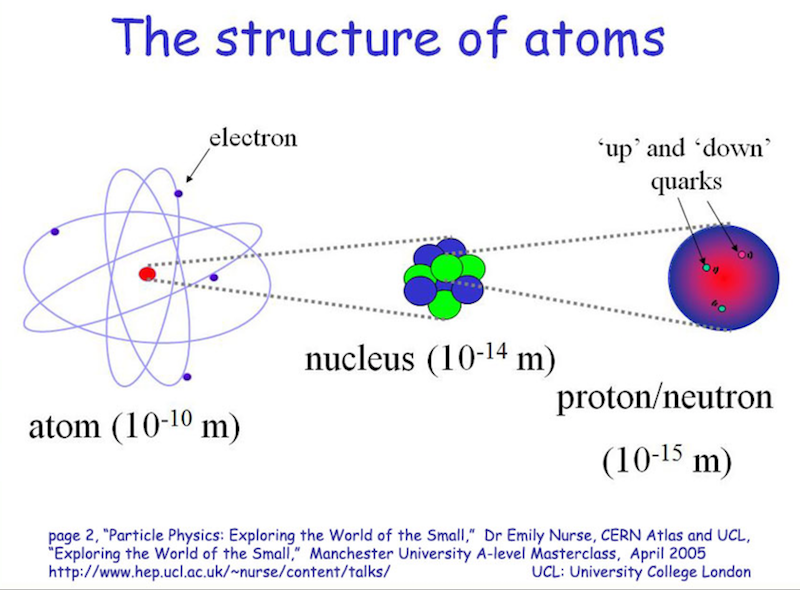
This image below is from a PPT chart, a presentation of physicist, Prof. Dr. Emily L. Nurse.  She first gave it as a Masterclass in Manchester University back in 2005Dr. Prof. Nurse is affiliated with University College London, Fermilab in Chicago, and CERN Laboratories, Atlas Project, in Geneva.Atoms


Jo Edkins Geometries

Tilings and Tessellations from Cambridge, England

A tessellation is the tiling of a plane using geometric shapes called tiles and it has no gaps or overlaps.

In our search of the web for images of tetrahedrons and tessellations or tilings of triangles, squares and hexagons, there were thousands of possibilities. Among the best were these very clean images from Jo Edkins, especially made for teachers.

Jo is from the original Cambridge in England and loves geometry. She has encouraged us in our work and, of course, we thank her and her family’s wonderful creativity and generosity of spirit.

The Edkins triangular tessellations

Jo’s square tessellations

Hexagonal tessellations

For more variations, go to Jo’s website:  http://gwydir.demon.co.uk/jo/tess/grids.htm

Just what’s happening here?

For over 100 years, the Planck Length was virtually ignored.  That length was so small, it seemed meaningless.¹  Nothing and nobody could measure it.  It was just a ratio of known constants.  Yet, it created a conceptual limit of a length which gave a New Orleans high school geometry class a goal or a boundary beyond which they did not have to go Recent measurements from the Hubble telescope provided the upper limit so this class could define the number of base-2 exponential notations from the smallest measurement of a length to the Observable Universe, the largest.

Within that continuum everything can be placed in a mathematical and geometric order.  Everything.  That is, everything in the known universe. The most remarkable discovery was that it took no more than 205.1 base-2 exponential notations.  It would be our very first view of an ordered universe. And, it readily absorbed all of our worldviews.

That was December 19, 2011.  Formally dubbed, “The Big Board – little universe,” we then asked, “What does it mean?  How do we use it?”  When we engaged the experts, they appeared a bit puzzled and seemed to be asking, “Why haven’t we seen this chart before?” Those who knew Kees Boeke’s 1957 book, Cosmic Vision,  asked, “How is it different from Boeke’s work using base-10 exponential notation?”   That was a challenge. Our best answers to date – it’s more granular, it mimics chemical bonding and cellular reproduction; it’s based on cascading, embedded, and combinatorial geometries – were not good enough.  In April 2012 even the Wikipedia  experts  (Steven Johnson,  MIT) protested.  He classified our analysis as  “original research” and within a very short time our Wikipedia article was taken down.  Others called it idiosyncratic (John Baez, UC-Riverside), but they did not tell us what was wrong with our analysis.

“Let’s just make as many observations as we can to see what can we learn?”  A NASA senior scientist and a French astrophysicist helped us with our calculations.  Their results gave us a range; the low was 202.34 notations and the high, 205.11.  We could identify many things between the 66th notation and the 199th notation.  But, there were blanks everywhere so we got busy speculating about them. The biggest group of empty notations was from 2 to about 65. We asked, “Conceptually, what could be there?”  Max Planck may have given us a clue when in 1944, in a speech in Florence, Italy; he said, “All matter originates and exists only by virtue of a force which brings the particle of an atom to vibration and holds this most minute solar system of the atom together. We must assume behind this force the existence of a conscious and intelligent mind. This mind is the matrix of all matter.” (The Nature of Matter, Archiv zur Geschichte der Max-Planck-Gesellschaft, Abt. Va, Rep. 11 Planck, Nr. 1797, 1944)  Matrix is a good word. Throughout history others have described it as the aether, continuum, firmament, grid, hypostases, plenum and vinculum.

We made two columns and within the top notations, 100-to-103, we found humanity.  That seemed politically incorrect until we discovered the cosmological principle that the universe is isotropic and homogeneous.  So, if it is true for us, it would also have to be true for “everybody” anywhere in the universe.

This is high school.  We had been following embedded geometries, particularly the tetrahedron and octahedron.  We observed a tetrahedral-octahedral-tetrahedral chain.  In no more than 206 layers everything in the universe is bound together.  We learned about tilings and could see that the four hexagonal plates we discovered within the octahedron also created tiles in every possible direction.

“What is this all about?  Just what’s happening here?”

We knew we were imposing a certain continuity and order with our mathematics (base-2 exponential notation), and we were also conveying certain simple symmetries and relations with our geometries.  That wrapped our work within a conceptual framework that was quite the opposite of the chaotic world of quantum mechanics.  Our picture of the known universe was increasingly intimate and warm; it was highly-ordered and had immediate value. And the more we looked at it, the more it seemed that all of science and life had an inherent valuation structure.   Here numbers became the container for time, and geometries the container for space.  How each was derived became our penultimate challenge. Ostensibly we had backed into a model of the universe and somehow we began to believe that if we could stick with it long enough, it just might ultimately give us some answers to the age-old question, “What is life?”

We had strayed quite far from those tedious chapters in our high school geometry textbook.  Yet, we also quickly discovered how little we knew about basic structure when we attempted to guess about the transitions from one notation to the next.  We asked, “How can we get from the most-simply defined structure, a sphere, to a sphere with a tetrahedron within it?”  We needed more perspective.

Who is doing this kind of work?”  We began our very initial study of the Langlands Program and amplituhedrons. Then, we walked back through history, all the way to the ancient Greeks and we found strange and curious things all along the way. There were the circles of Metatron that seemed to generate the five platonic solids. “How does that work? Are there experts who use it?  How?”  We still do not have a clue.  All the discussions about infinitesimals seemed to come to a crescendo with the twenty-year, rancorous debate between Thomas Hobbes and John Wallis.  It was here that we  began to understand how geometry lost ground to calculus and algorithms.

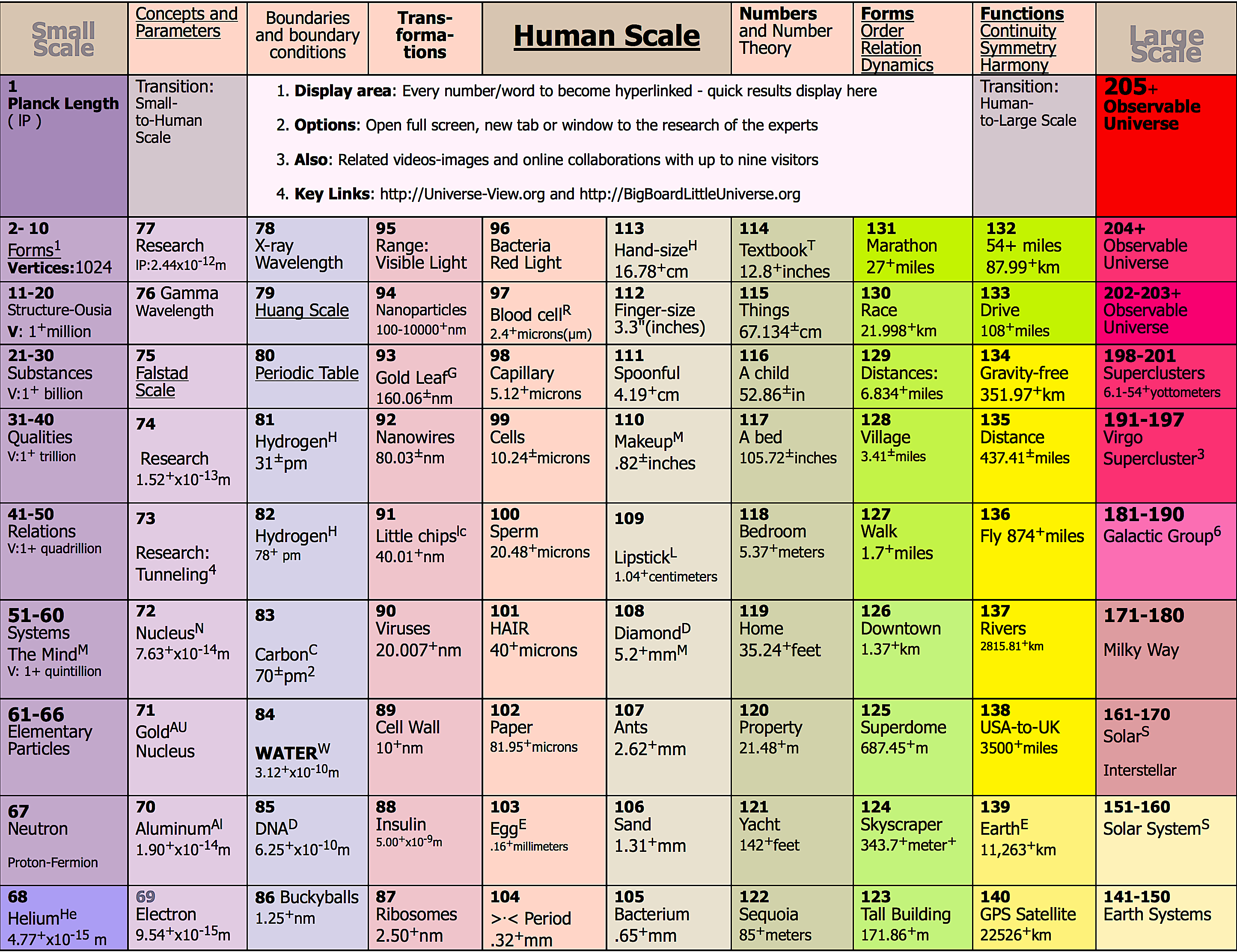
The Big Board-little universe was awkward to use.  It was five feet tall and a foot wide.  Using the Periodic Table as a model, an 8½-by-11 chart was created and quickly dubbed, The Universe Table.  It would be our Universe View into which we could hopefully incorporate any worldview.  It was an excellent ordering and valuation system.

Frank_WilczekThough the Planck Length became a natural unit of measurement, a limit based on known universal constants, it wasn’t until Frank Wilczek of MIT opened the discussion did things really begin to change. In an obscure 1965 paper by C. Aldon Mead, his use of the Planck Length was pivotal. In 2001 Wilczek’s analysis of Mead’s work and their ensuing dialogue was published in Physics Today. Wilczek, well on his way to obtaining a Nobel Prize, then began writing several provocative articles, Scaling Mt. Planck.  Even his books were helpful. In January 2013 he personally encouraged us on our journey.

In 1899 Max Planck began his quest to define natural units.  At that time he took some of the constants of science and he started figuring out natural limits based on them. There are now hundreds that have been defined. Each is a ratio and each can be related to our little chart and big board.  The very nature of a ratio seems to be a special clue. It holds a dynamic tension and suggests that the relation is primary and all else is derivative.

We have a lot of work in front of us!  And, we are up for the challenge.

Who would disagree with the observation that our world has deep and seemingly unsolvable problems?  The human future has become so problematical and complex, proposals for redirecting human energies toward basic, realizable, and global values appear simplistic.  Nevertheless, the need for such a vision is obvious. Rational people know that there is something profoundly missing. So, what is it? Is it ethics, morality, common sense, patience, virtues like charity, hope and love?  We have hundreds of thousands of books, organizations and thoughtful people who extol all of these and more.  The lists are robust.  The work is compelling, but obviously none of it is quite compelling enough.

First, it has to be simple.  Our chart is simple.

Second, it has to open up to enormous complexities. Using simple math, by the tenth notation there are 1024 vertices. We dubbed it the Forms or Eidos after Plato. The 20th notation would add a million vertices; we called it Structure. The 30th adds a billion new vertices. We ask, “Why not Substances?” The 40th adds a trillion so we think Qualities. The 50th adds a quadrillion vertices. We speculate Relations. By the 60th notation there are no less than a total of 2 quintillion vertices with which to create complexity. We speculate Systems and within Systems there could be The Mind. As if a quintillion vertices is not enough, the great physicist,  Freeman Dyson, advises us that really we should be multiplying by 8, not by 2, so potential complexity could be exponentially greater.

Three, it should be elegant.  There is nothing more elegant than complex symmetries interacting dynamically that create special harmonies.  We can feel it. And, we believe the Langlands program and amplituhedrons will help us to further open that discussion.

What is life?  Let us see if we can answer very basic questions about the essence of life for a sixth grade advanced-placement science class and for very-average, high-school students.  These are our students.  The dialogue is real.  The container for these questions and answers is base-2 exponential notation from the Planck Length to the Observable Universe.  To the best of our knowledge, December 19, 2011 was the first time base 2 exponential notation was used in a classroom as the parameter set to define the universe.  Though our study at that time was geometry, this work was then generalized to all the scientific disciplines, and more recently it was generalized to business and religion.  So, as of today, readers will see, and possibly learn, the following:

1.  See the totality of the finite, highly-ordered, profoundly inter-related, very-small universe where humanity is quite literally back in the middle of it all.

2.   Engage in speculations about the Infinite and infinity whereby the Creative and the Good take a prominent place within the universal constructs of Science.

3.   Extend the scale of the universe by redefining the Small Scale and engaging in speculations about the deep symmetries of nature, giving the Mind its key role within Systems, and demonstrating the very nature of homogeneity and isotropy.

4.   Adopt an integrated universe view based on Planck Length and Planck Time such that Science, Technology, Engineering and Mathematics are demythologized,  new domains for research are opened, and philosophies and religions are empowered to be remythologized within the constraints of universals and constants.

People ask, “Aren’t you getting ahead of yourself?  Isn’t this a bit ambitious?”  The concepts of space and time raise age-old questions about who we are, where we have come from, and where we are going.  With our little formulation, still in its infancy, we are being challenged to see life more fully and more deeply.  And so we reply, “What’s wrong with that?”

###

1  http://www.phys.unsw.edu.au/einsteinlight/jw/module6_Planck.htm   Physics professor, Joe Wolfe (Australia), says, “Nothing fundamentally changes at the Planck scale, and there’s nothing special about the physics there, it’s just that there’s no point trying to deal with things that small.  Part of why nobody bothers is that the smallest particle, the electron, is about 1020 times larger (that’s the difference between a single hair and a large galaxy).

Did A Quiet Expansion Precede The Big Bang?

A question about the question: It is difficult to know; however, a better question might be,
“Do the dynamics of a quiet expansion deflate the Big Bang?”

Last update: February 16, 2015 (also, small corrections since then)
Sequel: June 5, 2016, This Quiet Expansion Challenges the Big Bang

September 2014: If you think about it, most of the world’s people have never heard of the Big Bang theory (Reference 1 – the cosmological model, not the TV series). Of those who know something about it, a few of us are somewhat dubious, “How can the entire physical universe have originated from a single point about 13.8 billion years ago?” It seems incomplete, like there are major missing parts of the story.

To open a dialogue about this pivotal scientific theory is the reason for these reflections. And, if we are successful, all of us will have re-engaged our ninth grade geometry classes and we will begin to ask a series of “what if” questions about the origins of this universe.

Big Board – little Universe. Some of you are aware of our work within several high school geometry classes (Reference 2) to develop a model called the Big Board-little universe (Reference 3). Possibly you even know a little about the 201+ base-2 exponential notations from the Planck Length to the Observable Universe. It is a study that informally began on December 19, 2011, so most of us have only begun to explore the inner workings of each of the 201+ notations.

Because we believe all things start most simply, the first 60+ notations are potential keys for understanding a rather different model of our universe. These notations (also referred to as clusters, containers, domains, doublings, groups, layers, sets, and steps) have not yet been studied per se within our academic communities (Also, see reference 4). The best guess at this time is that the range of our elementary or fundamental particles begins somewhere between the 60th and the 67th notations.

The simple mathematics (Reference 5) and the simple geometries are a given; the interpretation is wide open.

This little article is an attempt to engage people who are open to new ideas to look at those first 60+ notations. What kinds of what-if questions could we ask? Can we speculate about how geometries could grow from a singularity to a bewildering complex infrastructure within and throughout those first 60+ domains, doublings, layers, notations, and/or steps? What if in these very first steps, there is an ultra-fine structure of our universe that begets the structure of physicality? What would a complexification of geometries give us? Might we call it a quiet expansion? Though we have always been open to suggestions, questions and criticisms, we are now also asking for your insight and help.
___________
Updates of both models are being prepared whereby those first 60+ notations of the Big Board-little universe begin to get some projections to study and debate. Also, another version of the Universe Table (Reference 6) is in preparation to emphasize every notation from 1 to 65. Also, at the time this article was introduced, we initiated a chart of base-2 exponential notations of time from the Planck Time to the Age of the Observable Universe side-by-side with our chart for the Planck Length to the Observable Universe. And, to make this study a bit more robust, we also projected a time to add the other three basic Planck Units — mass, electric charge and temperature. (Note: The very-first rough draft of that work was completed in February 2015.)

Big Bang Up. Most people start time with the Big Bang. Is there a possibility that there are events between Planck Time and the bang (or whatever sounds there were when things became physical somewhere between notations #66 to 67)?

In their 2014 book, Time in Powers of Ten, Natural Phenomena and Their Timescales, Gerard ‘tHooft and Stefan Vandoren of Utrecht University (Reference 7), use base-10 notation and assume there is nothing in the gap between the known time intervals of within theoretical physics and Planck Time.

We are doing a little fact check to see if the authors give those notations from Planck Time any causal qualities. It appears that they were not concerned about those base-10 notations until we pointed them out to them.

The first time period of interest to us is the first 20± base-10 notations which would be the first 67 base-2 notations. What happens between the Planck Units and the emergence of the elementary particles? These are real durations in time. A lot can happen.

We will be exploring this small-scale universe in much greater detail. By the 60th doubling there are quintillions-upon-quintillions of vertices with which to create many possible models. Also, in light of the work to justify the Big Bang theory, there is an abundance of information from all the years of research since the concept was first proposed in 1927 by Georges Lemaître.

Steven Weinberg, the author of The First Three Minutes (Reference 8), begins his journey through the origin of the universe at 1/100th of a second. Our hypothesis is that we can mathematically go back to a much, much smaller duration. We believe that we should start at the Planck Time and multiply it by 2. And, just as the fermion within notation 66 would be the size of a small galaxy compared to the Planck Length, 1/100 of a second between notations 137 and 138 represents an even greater gap of the ignored and unknown. We suspect starting one’s analysis so late misses key critical interactions and correlations (Reference 8b).

We’ve just started to see what the numbers can tell us.

A lot of pre-structuring of the universe could be quietly happening within such a duration (1/100th of a second). Using our most metaphorical, speculative thinking, one could imagine that the actual event within those first sixty notations was a gentle, symphonic unfolding, fully homogeneous and isotropic.* Although we should embrace all the key elements of today’s big bang theory, we should also be constantly asking, “What kinds of geometries would be required within each of the first 60 notations to render these effects?”

Perhaps the universe and our future belong to the geometers.

So, this article is to empower all of us to find the best geometers around the world to engage the Big Board-little universe model within what we call “the really-real small scale universe.” Of course, some of the work has already been done within the study of spheres, tilings, and combinatorial geometries.

If you would like to comment politely, please drop me a quick note (camber-at-bblu.org).

Thank you.

Bruce Camber

* homogeneous Having the same property in one region as in every other region
isotropic Having the same property in all directions.

###

Endnotes and References:

1 A Wikipedia summary of the basic Big Bang theory. As you will see within this Wikipedia article, the basic theory has been highly formulated with a fair amount of scientific evidence. If our rather-naïve, quaint-little challenge to that model is ever to catch some traction, it will have to account for the results of every accepted scientific measurement about the Big Bang theory that has been thoroughly replicated.

2 Is There Order In The Universe? There are nine references within this article and each opens to a page that has been written since the first class on December 19, 2011.

3 This image of the Big Board-little universe is Version 2.0001.

4 This article is our very first attempt to provide a somewhat academic analysis of the work done to date. It was rejected by several academic journals so it was first released within WordPress, then the LinkedIn blog pages, and finally re-released right here.

5 The debate within Wikipedia about the importance of base-2 exponential notation resulted in their rejection of the original article. It was judged to be “original research.” We thought that judgment was just a little silly. The concepts were all out there; these articles were just to organize that data.

6 A WordPress blog page for our emerging UniverseView.

7 This article about the book, Time in Powers of Ten by Gerard t’Hooft and Stefan Vandoren, is the most comprehensive that I could find at this time. If you happened to find a better review, please advise us.

8 An online version of the entire book, The First Three Minutes by Steven Weinberg. There are many reviews, yet this one provides a little counterweight. Weinberg also wrote the forward to Time in Powers of Ten. Gerard t’Hooft (1997) and Steven Weinberg (1979) are Nobel laureates.

A chart showing the correlations between Planck Time and Planck Length at the 136th and 137th notations is here.

9 A WordPress article about very small and very big numbers. There is our initial discussion about the first 65 notations.

Where is the Good in Science, Business, and Religion?

Please note:  Many pages within The Big Board-little universe Project were originally posted on the web within the Small Business School website.  Some links still go back to the original site.  If so, please your back button to return to this page. Thank you.


All three major domains of human activity — Science, Business & Religion — are fraught with travail and have been blemished with the worst of human behavior. Notwithstanding, there is a deep ethical bias within science which is also an essential infrastructure of business, and it is the heart of good religion.

valueschart3

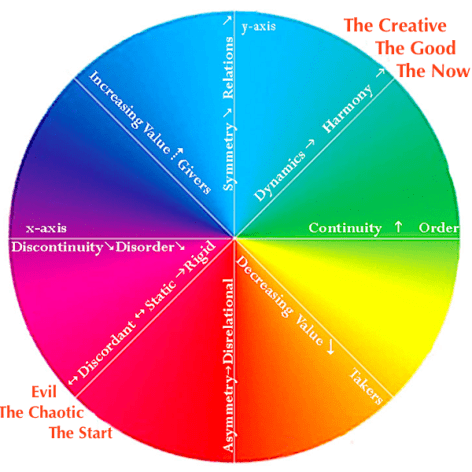
The circular color chart opens the door on the story. This chart seems to represent all the energies,  negative and positive, within our finite universe, including our finite world, and our finite life. Using Cartesian coordinates as the container, here the x-axis (horizontal axis) is the totality of time. The vertical y-axis becomes the totality of space. This work emerged from our earlier discussions about foundations.

These thrusts -the energy and purpose – are the most basic forms/functions of life. Though part of our business formulations for many years, this circular image marks the first time it has been used as a comprehensive valuation structure and the basis for modelling the universe (a very large file, may open slowly).

Above the x-axis are all the constants and universals that define who we are, our life, the arts, sciences, business and religion. Below that x-axis — domains that involve so much of human activity — is the antithesis of Order/Continuity, Relations/Symmetry, and Dynamics/Harmony.

The antithesis of these form/functions create a de facto ethical platform by which we can begin to judge ourselves, our businesses, our religion (including atheism), and our political and social organizations.

Of course, this is a first pass at a complex subject addressed by a relatively simple person trying to make sense of it all. There will be many more updates to come.

An earlier article about the constants and universals anticipates this chart but was prior to the chart’s development. Title: Just what are we to believe about anything?

The first use of the chart in June 2014 was within the article, Is There Order In The Universe?

Tweety
The Big Board-little universe in a horizontally-scroll chart (our current work)

Is There Order In The Universe?

UniverseTable Updated: November 30, 2015
Note: Links open a new tab or window. If any link goes back to Small Business School where it was first posted, use your back button to return here.  All postings are being consolidated within http://bblu.org, the main website for secondary schools, and within http://81018.com, the main site for college, university and research-and-development.

Our high school geometry classes created a simple, mathematically and geometrically-ordered view of the known universe. We also found an inherent geometry for disorder.

Yes, rather unwittingly we backed into developing what we now call our Universe View. We used a very simple logic and math. First, we divided an object by 2 until we were down in the range of the smallest measurement of a length; then we multiplied the object by 2 until we were finally out around the largest-known measurement of a length.

Our work began in December 2011. That simple exercise resulted in measurements which opened paths to challenging facts, rather fun concepts, obviously wild-and-crazy ideas, and truly playful speculations.

Throughout this little article there are many references with links. However, there are just nine primary references to other pages. These links are also at the bottom of the page. Also, please be advised, that this project will always be a work in progress.

1. The Power of 2. There are 201+ base-2 exponential notations (that just means “doublings” or multiplying by 2) starting at the Planck Length, the smallest conceptual measurement of a length in the universe, out to the Observable Universe, the largest possible length. Within a few years we also did the simple multiplication of the Planck Time, side-by-side with the Planck Length, out to the Age of the Universe. Then on February 11, 2015 we posted our very first draft of a table of the basic five Planck Units (with a most-speculative guess regarding temperature).

The number of notations (also known as doublings, domains, clusters, groups, layers, sets or steps) is a fact established by simple mathematicsReference #1 (below) goes to the initial chart of 2011.  Yes, it is just simple mathematics. And, we were quickly informed that there was a precedence for it.

In 1957 a Dutch high school teacher, Kees Boeke, used base-10 (multiplying by 10). He found 40 of the 62 base-10 notations. Yet, we believe Boeke’s work is the very first mathematically-driven Universe View. We were unaware of Kees Boeke at that time our work began. Also, we started with (1) embedded geometries, (2)  the two measurements, Planck Length and Observable Universe, (3) a simple logic based on the concepts of continuity and symmetry, and (4) multiplying by 2 (base-2 exponential notation). It was not just a process of adding and subtracting zeros. Because base-2 is 3.3333+ times more granular than base-10, it is more informative and natural; the geometries create natural symmetries and levels of imperfection for symmetry-making and symmetry-breaking; and, it mirrors the processes in cellular division, the dipole nature of chemical bonding, combinatorics, group theory, and complexification (1 & 2).

2. Inherent Geometries. We were studying tetrahedrons and octahedrons, two of the most simple Platonic solids. We started our project by dividing each edge of a tetrahedron in half. We connected those six new vertices and discovered a half-sized tetrahedron in each of the four corners and an octahedron in the middle.

We did that same process with the octahedron and found six half-sized octahedrons in each of the six corners and a tetrahedron within each of the eight faces (link opens a new window). We did that process of going within about 118 times. On paper, in about 50 steps we were inside the atom; and, rather unexpectedly, within another 68 steps we were in the range of the Planck Length.

We then multiplied our two objects by 2 and within about 91 notations or steps, we were in the range of the Observable Universe. Then, to standardize our emerging model, we began at the Planck Length and multiplied it by 2 until we were at the edges of the known universe. We had some help to calculate the number of notations.  We settled for a range from 201 to 205.1  (Reference 2 – See point #4   within those 15 points).

Because we started with a geometry, we learned ways to tile the universe with that geometry. It is also quite simple. It puts everything within a mathematically-compact relation that over the years has had a wide range of names from the aether (or ether), continuum, firmament, grid, hypostases, matrix, plenum to vinculum. We call it, TOT tilings. The TOT begins with a ratio of two tetrahedrons to one octahedron.  That combination fills three-dimensional space perfectly. Also, there are two-dimensional tilings everywhere within and throughout the TOT tilings! There are many triangular tilings, square tilings, hexagonal tilings and combinations of the three. One of the most simple-yet-fascinating is created by that group of four hexagonal plates within every octahedron. Observing the models, one can readily see how each of those four plates extend as four hexagonal tilings of the universe.  Each is at a 60 degree angle to the other and each group of four shares a common center vertex.

It is all so fascinating, we are now exploring just how useful these models can become.

That tiling is a perfection, however, imperfections were readily discovered. Using just the tetrahedron, we found that not all constructions fit together perfectly. For example, the simple pentastar, a five-tetrahedral cluster, cannot perfectly tile space; it creates gaps.

Those gaps have now been thoroughly documented; yet to the best of our knowledge, Frank & Kaspers were the first to open this discussion in 1958Englishman F.C. Frank was knighted in 1977 for his lifetime of work.

Using simplicity as our guide, we concluded that here is one of the early beginnings of an imperfection.   This shape is created with just five tetrahedrons and seven vertices. We refer to this object as a pentastar.  It has a gap of about 7.36° (7° 21′) or less than 1.5° between each of the ten faces.

There is a quite fascinating warping and weaving between the perfect and imperfect.

By adding just one more tetrahedron to that pentastar cluster, a 2D perfection is created by the hexagonal base of six tetrahedrons.  Then, by adding more tetrahedrons it can become the 20 tetrahedral cluster known as the icosahedron, and then out to the 60 tetrahedral cluster, the Pentakis Dodecahedron.

We dubbed these imperfect figures, squishy geometry; the constructions have considerable play. Yet in more temperate moments, we call this category of figures that do not fit perfectly together, quantum geometry.  At that time, we did not know there is actually a disciple within geometry and theoretical physics defined as such.

3. Numbers and Potential Geometries Gone Wild. By the 10th doubling there are 1024 vertices. Assuming 1 for the Planck Length, there are then 2, 4, 8, 16, 32, 64, 128, 256, 512, and 1024. The simple aggregation of all notations up to 10th would be 2000+ vertices. Within just the 20th doubling (notation) there are over 1-million vertices, within just the 30th notation over 1-billion, the 40th notation over 1-trillion, and the 50th over a quadrillion vertices. By the 60th notation, a quintillion more vertices are created and that measurement is still below the range of our elementary or fundamental particles.

Imagining all the possible hidden complexities has become a major challenge!

Although this rapid expansion of vertices within each doubling is entirely provocative, it became even greater when we finally followed the insights of Freeman Dyson (Reference #3 – point #11). Dyson is Professor Emeritus, Mathematical Physics and Astrophysics at the Institute for Advanced Studies in Princeton, New Jersey. He said, “Since space has three dimensions, the number of points goes up by a factor eight, not two, when you double the scale.”  On the surface, it is straightforward, yet we are now trying to get the deepest understanding of scaling laws and dimensional analysis to most fully work with Dyson’s comment. Also, we believe that scaling symmetries are necessarily involved with the transitions from one doubling (domain, layer, notation or phase) to the next.

4. Driving Concepts. The simple mathematics provides a basic order and continuity that we have imposed on the universe. The simplest geometries provide a robust range of symmetries and relations. Add time and put these objects in motion, folding and enfolding within each other like a symphony, and we can begin to intuit very special dynamics and a range for harmony (Reference #4).  When those concepts were first written up back in the 1970s, it seemed to describe a perfected state within space and time, but it was too vague. It needed a domain or container within which to work and it seems that this just may be it (opens new window/tab).

5.  Initially called, Big Board-little universe and then, The Universe Table (Reference #5). By September 2013, a class of sixth grade students got involved and a core group of about 40 high school students continued to study this formulation. First, it seemed like an excellent way to visualize the entire universe in a systematic way and on a single piece of paper. Second, as a simple ordering tool, it placed most of the academic disciplines in the right sequence. Mathematics, logic, philosophy, theology and ethics seemed to apply to every notation. An interdisciplinary study called STEM for Science-Technology-Engineering-Mathematics seeks a deeper and more vibrant exploration of all four. This chart readily did that and more. Our chart was developing a special traction. It was working for us.

We then began observing some very simple correlations between notations and let our imaginations work a little overtime.

6. Keys to humanity are in the middle of the Known Universe. Within our range from 201+ to 205+ notations, human sperm is within notation 100, human hair within 101, the thickness of paper (upon which we record our history) 102, and the human egg 103 (Reference #6).

That seems like a concrescence of meaning.

We are just starting to parse the 201+ notations in thirds, fourths, fifths… using musical notation as the analogue and metaphor.

7. The first 60+ notations, doublings, or layers are unchartered. We asked, “What could possibly be there?” To get some ideas, we started going back throughout history and philosophy. We placed Plato’s Forms (Eidos) within the first ten notations. Aristotle’s Ousia (Essence or structure) became the next ten from 11 to 20. Substances were 20-30, Qualities from 30-40, Relations 40-50 and then Systems 50-60. Within Systems we projected a place for The Mind (Reference #7), from the most primitive to the most developed.

Within these first sixty notations, it seems we just might be seeing the basis for isotropy and homogeneity within our little universe. As the domains (doublings, layers, notations, steps) approach he Planck Units, the number of vertices become smaller, and the everything in the universe increasingly shares  some aspect of the systems, relations, qualities, substance and structures, and perhaps everything shares all aspects of the forms. Here is the pre-structure of structure.  Of course, we are just being speculative.

It’s great fun to be speculative, yet we will try not to be too reckless!

“It seems that the cellular automata (of the Wolfram code) belong right within the Forms.” Of course, that’s also a simple guess. We continued, “And within Systems, we have all those academic subjects that have never had a place on a scientific grid or scale of the universe.”

We dubbed this domain “the really-real Small-Scale Universe.”

8. Einstein-Rosen Bridges, Wormholes & Intergalactic Travel The imagination can readily get ahead of facts, yet bridges and tunnels appear everywhere in nature. So, when we partitioned our known universe in thirds, we discovered that elementary particles and atoms began to emerge in the transition area from the first-third, our Small-Scale Universe, to the second-third, our Human-Scale. Well then, what happens in the transition to the third-third, from the Human-Scale to the Large-Scale Universe?

We decided to be wildly speculative.

In the grand scheme of things, the transition from the second-third begins with notations 134 to 138. At Notation 134 you could up on the International Space Stations,  just 218 miles above the earth’s surface. At Notation 137, you would be about 1748 miles up and at Notation 138, about 3500 miles up.

What happens? “Einstein-Rosen!” was the charge. “It’s the beginning of wormholes!”

That raised a few eyebrows. After all, we surely need a shortcut to explore the Large-Scale Universe. So, now we are calling on our leading space entrepreneurs (Reference #8), especially Elon Musk of SpaceX, “Go out looking, but don’t go inside any of those wormholes yet. We all need to be thinking a bit more about their structure.” If we take it as a given that space is derivative of geometry (symmetries), and time derivative of number (continuities), we begin to see the universe quite differently.

Of course, we have far more questions than we have insights so we truly welcome yours.

9. A system for value, thinking, logic, reasoning and more. As you can see, our evolving Universe View was quickly becoming a structure for a rather idiosyncratic style of thinking, reasoning and logic (Reference #9).

The concept of a perfected moment in space-and-time was pushing us to think about order, relations and dynamics in new ways. Continuity, symmetry and harmony were becoming richer than space and time. This marks our first attempt to begin writing about this perception of our interior universe where our numerical-geometrical structure of the universe became its own inherent logic. It wasn’t long before we began thinking about how this structure could also be applied to thinking itself, then reasoning, and so much more. A mentor and friend from long ago, John N. Findlay, might call it an architecture for the thrust or zest for life.

This system seems to have within it many possibilities for seeing wholeness where today information and systems do not cohere, so we are glad to share these skeletal models (including the one just to the left) for your inspection. We hope you find it all as challenging as we have, and that you have enjoyed taking this rather quick tour through this work.

We are in the very early stages of this journey and we welcome your insights, your comments, and your questions. Thank you.

Endnotes, footnotes and references:

  1. The URL for the very first chart of our simple math: http://smallbusinessschool.org/page2851.html
    These pages were to support our attempt to publish a Wikipedia article about base-2 exponential notation from the Planck Length. That article was published in April 2012 but their specialists led by an MIT mathematician deemed it “original research” and it was removed early in May 2012. That was our truly first indication that our simple logic-math-and-geometry had been overlooked by the larger academic community.
  2. An analysis of 15 key points: http://smallbusinessschool.org/page3006.html
  3. Prof. Dr. Freeman Dyson, Professor Emeritus, Mathematical Physics and Astrophysics of the. Institute for Advanced Studies (IAS), Princeton, New Jersey since 1953., author (among hundreds of article and dozens of books)  of Interstellar Transport (Physics Today 1968), Disturbing the Universe (Harper & Row, 1979). This link opens within the IAS website.
  4. The first principles based on the concept of perfection: http://smallbusinessschool.org/page869.html
  5. A ten-step tour of the Big Board-little universe and the Universe Table: http://smallbusinessschool.org/page2990.html
  6. Space Entrepreneurs to Star Wars VII: http://smallbusinessschool.org/page3007.html
  7.  An analysis of the work in progress:   http://smallbusinessschool.org/page3000.html
  8. Belief systems: http://smallbusinessschool.org/page1887.html
  9. The circular chart just above.

More analysis: All these writings are in process. Here are our initial drafts:

There will come an invitation to participate, then perhaps a collaborative exploration of these questions:

15 Key Questions About Our Universe And Us

Prepared by Bruce Camber for five classes of high school geometry students and a sixth-grade class of scientific savants. There are no less than 15 concepts reviewed here. All have been explored within a high school yet have been virtually ignored by the larger academic community. It begs the questions, “Are any of these concepts important? Which should we keep studying and which should be deleted?” And, of course, if we delete any, we need to know why.

TetrahedronStudents have been known to ask a rather key question, i.e., “Can’t you make it easier to understand?

So, in light of the universal pursuit for simplicity, beauty and wholeness, our geometry classes just may have stumbled onto a path where we begin to see all the forces of nature come together in a somewhat simple, beautiful, yet entirely idiosyncratic model. It feels a bit like Alice-in-Wonderland — the entire known universe in 201+ notations or doublings — all tied together with an inherent geometry, an ever-so-simple complexity. The students ask, “Can this somehow be embedded within every thing everywhere?”

#1 Key Question: Is there a deep-seated order within the universe?

Geometry 101: From the Planck Length to the Observable Universe
December 19, 2011: Defining our Parameters and Boundaries
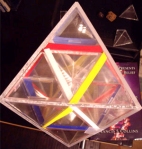
octahedronOver 120 high school students and about twenty 6th graders have divided each of the edges  of a tetrahedron in half.  They connected the new vertices to discover four half-sized tetrahedrons in each of the corners and an octahedron in the middle. They did the same with that octahedron and observed the six half-sized octahedrons in each of the corners and eight tetrahedrons, one in each face. We continued this process mathematically about 116 times until we were in the range of the Planck length. We eventually learned that this process is known as base-2 exponential notation. When we discovered-then-compared our work to that of Kees Boeke (Cosmic View, Holland, 1957), we thought base-2 was much more informative, granular, and natural (as in biological reproduction and chemical bonding) than Boeke’s base-10. Plus, our work began with an inherent geometry, not just a process of adding and subtracting zeros.  More… (opens in new tab/window).


#2 What are the smallest and largest possible measurements of a length?

Doublings and Measurement
December 2011: Getting More Results

We had taken those same tetrahedrons with their embedded octahedrons and multiplied them by 2. Within about 90 steps (doublings), we thought we were in the range of the recently-reported findings from Hubble Space Telescope and the Sloan Digital Sky Survey (SDSS III), Baryon Oscillation Spectroscopic Survey (BOSS) measurements (opens in new tab/window) to bring us out to the edges of the observable or known universe. It appeared to us that this perfect conceptual progression of embedded tetrahedrons and octahedrons could readily go from the smallest possible measurement to the largest in less than 209 notations. We decided at the very least it was an excellent way to organize the data in the entire universe.

More questions:  What are the most-simple parameters with which to engage the universe?  Do the geometries (relation/symmetry), base-2 (operations of multiplication or division), and sequence (order/continuity) provide an operational formula for expansion of the operand?

#3  Do these charts in any way reflect the realities within our universe?

 Big Board – little universe and our first Universe Table
2011 -2012SDSS-III-BOSS

We had also develop a big board (1′ by 5 ‘) upon which to display this progression so we could begin inserting and updating examples from the real world within each notation (domain, doubling, or step). To simplify the look and feel of those listings, we also made a much smaller table (8.5″ x 11″) in September 2012.   The very first, very rough board (December 2011): http://smallbusinessschool.org/page2790.html and within a blog (May 2012): http://doublings.wordpress.com/  Then, we developed the Universe Table based on the board: http://utable.wordpress.com/2013/11/01/1/

Another question: What are the necessary relations between adjacent notations?

#4 How do we prioritize data (calculations), information and insight?  What is wisdom?BigBoard8.5.jpg

202.34 to 205.11: From Joe Kolecki to Jean-Pierre Luminet
May 2012: Getting Some Professional Insight and Confirmation

We consulted with Joe Kolecki, a retired NASA scientist involved with the education of school children. He did a calculation for us and found about 202.34 notations from the smallest to the largest (based on the age of the universe).

We had also consulted with Jean-Pierre Luminet, a French astrophysicist and research director for the CNRS (Centre National de la Recherche Scientifique) of the observatory of Paris-Meudon. He calculated 205.11 notations: http://doublings.wordpress.com/2013/07/09/1/#Footnotes See footnote 5 on this page within doublings.wordpress.com.

The nagging question: What are the necessary relations between adjacent notations (or doublings, layers or steps)?

#5 How does each notation build off the prior notation? Is it geometrical?
An Encounter with Wikipedia
April-May 2012: Grasping the New Realities

We wrote it up for Wikipedia to have a place to collaborate and build out the document with other schools and even universities. But, in May 2012, their review group told us that it was original research. Though there was a clear analogue to base-10 notation from Kees Boeke from 1957, an MIT professor, Steven G. Johnson (he reviews entries for Wikipedia) said that it was “original” research. We begrudgingly accepted his critique:
http://bigboardlittleuniverse.wordpress.com/2013/02/26/1/
The simple math: http://doublings.wordpress.com/2013/04/17/60/

#6 What is perfect and what is imperfect?

Pentastar, Icosahedron, Pentakis Dodecahedron

December 2011 to December 2012: One Year of Insights

We then observed some curious things. First, geometries can get messy very quickly. We were using the five Platonic solids. Starting with the tetrahedron, we quickly discovered that these objects rarely fit perfectly together. The pentastar, five tetrahedrons clustered tightly together, do not perfectly tile space, but leave a gap. This gap has been thoroughly documented yet to the best of our knowledge it was first written up by two mineralogists, Frank & Kaspers, in 1958. In its simplicity, we concluded that this was the beginning of imperfections and it extended out to the 20 tetrahedron cluster also known as the icosahedron, and then out to the 60 tetrahedron cluster (just the outer shell), which is called a Pentakis Dodecahedron. We dubbed these figures, “squishy geometry” because you could actual squish the tetrahedrons together. In a more temperate moment, we dubbed this category of figures a bit more appropriately, “quantum geometry.”

#7   What is the Planck Length? Is it a legitimate concept?

Frank Wilczek, Encouragement from an Authority, December 2012

We consulted Prof. Dr. Frank Wilczek (MIT) regarding his many articles in “Physics Today” about the Planck Length. He assured us that it was a good concept and that the Planck Length could be multiplied by 2. We titled our next entry, “Everything Starts Most Simply. Therefore, Might It Follow That The Planck Length Becomes The Next Big Thing? The current state of affairs in the physics of CERN Labs is anything but simple. We figure if we built things up simply, we might gain a few new insights on the nature of things.

#8  Is life a ratio?  Does it begin with Pi and the circumference of a circle?

Steve Waterman’s polyhedra and mathematics
March 2014: Discovering Others Searching the Boundaries

In December 2013, I sent a note around to an online group of mathematicians, mainly geometers; and of those who responded, Steve Waterman had done some truly original, rather-daunting, work that had certain similarities to Max Planck’s work a century earlier. It was not until a lengthy discussion in April 2014 that I began to understand the simplicity and uniqueness of his extensive work. He had emerged with many, if not most, of the 300+ NIST constants, the gold standard of the sciences. He had used constants in a similar way that Max Planck used the speed of light and the gravitational constant to begin his quest for the Planck Length. Waterman provokes the ratios of known constants to come ever so close to the NIST measurements. His math implies an inherent universal wholeness and he does it with a series of “what if” questions. It took me awhile to grasp his fascinating, far-reaching results:
http://watermanpolyhedron.com/abequalsc2.html
http://www.watermanpolyhedron.com/smallFOUR.html

#9 Is there anybody doing mathematics in any way related to these notations?

 Edward Frenkel and his book, “Love & Math: The Heart of Hidden Reality”

In October 2013, Edward Frenkel’s book, “Love & Math: The Heart of Hidden Reality” became part of our picture. Perhaps this remarkable mathematician can shed light on those areas where we all are weakest. We let him know we had his book and would be reading it to answer simple questions, “Why doesn’t anybody care about this construction? What are we missing? Why are people so sure that the fermion and its extended family represent the smallest-possible measurement of a length, especially in the face of the Planck Length? Why shouldn’t we attempt to think of the Mind and mathematics as representations of those steps between the Planck Length and those within the particle families?”

Through Frenkel’s work we have begun to discover the Langlands Program and its progenitors (i.e. Frobenius) and the current work in areas like sheaves, the categorifications of numbers, and the correlation functions. We have begun to learn about the work of other remarkable mathematicians like Grothendieck, Drinfield, Witten, Kapustin, and so many more.

The most important first-impression was that we could begin to discern the transformations from one notation to the next and possibly even discern the very nature of a vertex.

#10   What is a vertex? Are there primary vertices that establish the Planck Unit measurements and secondary scaling vertices?

Over a Quintillion key vertices within just the 60th notation using base-2 exponentiation

Throughout these past 2+ years, we have discerned other simple-yet-interesting mathematical facts.  First, we decided that we should not refer to the Planck Length as a point because it is a rather exact length, so we are giving each vertex a special status and believe we might learn more by understanding Alfred North Whitehead’s concept of pointfree geometries introduced within his book, “Process and Reality.”

Within just the 10th doubling there are 1024 vertices. The simple aggregation of all notations up to 10 would be 2046 vertices. Within just the 20th doubling (notation) alone there are over 1 million vertices. In just 30th notation alone, another one billion-plus vertices are created. Within the 40th notation another trillion-plus vertices. With just the 50th notation, you’ll find over a quadrillion vertices. By the 60th notation, a quintillion more vertices are created. Imagine all the possible hidden complexity!

The expansion of vertices within each doubling has been a challenge for our imaginations and conceptual limitations. Yet, it could be an even greater challenge and far more complex if we were to follow Freeman Dyson’s suggestion. Using base-4 notation for the expansion of the tetrahedrons and base-6 notation for the expansion of the octahedrons, at the 60th notation, there would be a subtotal of 1.329228×1036 for the tetrahedrons and 4.8873678×1046 vertices from the octahedrons. Using simple addition that would be:

488,736,780,000,000,000,000,000,000,000,000,000,000,000,000,000,000,000

+                    1,329,228,000,000,000,000,000,000,000,000,000,000,000,000

488,736,780,001,329,228,000,000,000,000,000,000,000,000,000,000,000,000

The base-2 exponentiation is the “simple math” starting point. It is a simple focus on the process called doubling and only accounts for number of times the original Planck Length has been doubled for each notation. If the focus is on objects, after the fourth doubling, there are four expansions to track, base-1 for the sole octahedron within the tetrahedron, base-4 for the tetrahedrons within the tetrahedrons, and base-6 for the octahedrons within the octahedron and base-8 for the tetrahedrons within the octahedron.  Addressing that schema and the results are:

Base-8 tetrahedrons:   1.5324955×1054 units

Base-6 octahedrons in the octahedron:  4.8873678×1046

#11 What are scaling laws and dimensional analysis?

Freeman Dyson

Mon, Oct 22, 2012

Freeman Dyson, in an email to me (for which he gave me permission to share), suggested the following: “Since space has three dimensions, the number of points goes up by a factor eight (scaling laws and dimensional analysis), not two, when you double the scale.” Of course, we felt we had more than enough vertices with which to contend, so we just multiplied by 2, using the simple analogue from biology or chemistry. Yet, we readily acknowledge that his advice could readily open even more doors for new explorations, so this question is raised and another dimension of our work has been set out before us by a sage of our time!

#12 Key Question: Is the inherent structure of the first 60 notations shared by everything in the universe?

January 2013 to today

#12a   January 2013:  Speculations about the first 60 notations

With our simple logic, it seems that with the diversity of particles and the uniqueness of identity, that the structure could continue to expand right up to the 201+ notations.

However, below that emergence of measurable particles, and their aggregate structures, a simple logic would tell us that there is a cutoff point as you go toward the Planck Length where a deep-seated Form (perhaps notations 3-to-10) and Structure (perhaps notations 11-20) might somehow be shared by every thing in the known universe. With vertices rapidly increasing with every doubling, options begin to manifest for types of Substances (possibly notations 21-to-30), then types of Qualities (perhaps notations 31-to-40), then types of Relations (possibly 41 to 50), and finally types of Systems (possibly 51-to-60). What does that mean? How are we to interpret it? It is on our list to continue to ponder.

#12b   February 2013   Literature survey

We’ve thought about this very, very small reality from the first notation to the 60th. Perhaps it is what Frank Wilczek (MIT) calls the Grid and Roger Penrose (Oxford) calls Conformal Cyclic Cosmology. We just call it the Small-Scale Universe. Actually, in deference to one of my early mentors, we call it the “really-real” Small-Scale Universe. And, because we started with simple geometries, our imaginative notions of this part of our universe appear to be historically explored yet relatively unexplored as a current scientific framework. First, we turned to our six sections: Forms (Eidos), Structures (Ousia), Substances, Qualities, Relations, and Systems (The Mind).

Also, picking up on a suggestion by Philip Davis (NIST, Brown), that the sphere is more fundamental than the tetrahedron, we start with a one-dimensional length, the Planck Length. When it doubles, it becomes a two-dimensional sphere. When it doubles again (4), it becomes a three-dimensional sphere with a tetrahedron within it. When it doubles again (8), we see the octahedron within the tetrahedron. When it doubles again (16), we begin to see the four hexagonal plates within the octahedron. We are projecting all these forms-structures, substances-qualities, relations-and-systems are complexifications of the first two vertices within the first doubling. We further project that there is a transitional area between each of the three scales, Small-Scale Universe, Human-Scale Universe, and Large-Scale Universe and each would include somewhere between 67-to-69 notations.

#12c.     Discovering Quanta Magazine

       May 2014

Amplituhedrons, Euler, and geometries mixing within necessary relations with geometries

We discovered the writings of Natalie Wolchover within Quanta Magazine, quantum geometries, and on the work of Andrew Hodges (Oxford), Jacob Bourjaily (Harvard) and Jeremy England (MIT). We believe these young academics are opening important doors so our simple work that began in and around December 2011 has a larger, current scientific context, not just simple mathematics. Within the excitement and continuing evolution of the Langlands programs, we perceive it all in light of defining a science of transformations between notations. We are now pursuing all the primary references for people working within quantum geometries.

The simplest, smallest, largest experiment, albeit a  thought experiment based on logic, the simplest mathematics (base-2 notation and platonic geometry), and the base Planck Units, quickly opened doors to look at this data in a radically new way. It will slowly become the basis for many new science fair projects.  The question is asked, “Could This Be The Smallest-Biggest-Simplest Scientific Experiment?” http://walktheplanck.wordpress.com/2014/03/03/domain/

#13a  October 2013 to February 2014: A National Science Fair Project

Some students wanted to take the project further. Here was an initial entry of one of our brighter students:

http://walktheplanck.wordpress.com/2013/12/03/welcome/

#13b January 2012: Is there a concrescence in the middle?

IUniverse Tables the ratio, 1:2, somehow special? Approximately between 101 and 103, clustered in the middle by the width of a hair, are paper upon which we document our history and the human egg. Perfectly human representations in the middle of this scale became a source for some reflections.

http://walktheplanck.wordpress.com/2013/12/03/c/

#13c   October 2013: Considering the Thirds, 1:3

Between Notation 66-to-67 and from 132-to-134:

The significance of the first third, particularly the transformation from the small scale to the human scale, was obvious — particles and atoms. The last third, the human scale to the large scale, we played with ideas, then made an hypothesis. In a most speculative gesture, turning to the Einstein-Rosen bridges and tunnels, we posited that range as a place to begin looking for wormholes.

http://walktheplanck.wordpress.com/2013/12/03/j/

We are now studying the fourths, fifths, sixths and sevenths… wondering in what ways are there parallels to music. How do things combine, mix, and move together to create a specific thing or a new thing? We began studying the notational ranges defined by simple mathematics and music to see what we could see.

Notational range for The Fourths: 50.6 – 51.3, 101.17 – 102.6, and 151.7 – 153.8 and finally 202.34 – 205.11 Notational range for The Fifths: 40.47 – 41.2, 80.94 – 82.4, 121.41-123.6, 161.86 – 164.8… Notational range for The Sixths: 33.72 – 34.35, 67.44 – 68.70, 101.17 -102.6, 134.89 – 136.95, 168.61 – 171.30… Notational range for The Sevenths: 28.62 – 29.30, 57.24 – 58.60, 86.46 – 87.90, 114.48 – 117.20…

To date, our very cursory, initial observations have not opened up more wild-and-crazy speculations! However, the obvious parallel to music has us thinking about the nature of chord, half notes and ratios (July 2014).

#14 Who are we and where did we come from?
1971-1973: Synectics, Polymorphs, Colloquiums, and more
Continuity-Order, Symmetry-Relations, Harmony-Dynamics

We are products of our experience. In 1971, when I (Bruce Camber) was just 24 years old, though active in the radical-liberal political community, my longstanding intellectual curiosity was the nature of creativity, the processes for problem-solving, the nature of a paradigm, and the stuff of scientific revolutions. At a think tank in Cambridge, I focused on interiority, analogies, empathy, and processes to open pathways to a deeper sense of knowing and insight. Within a Harvard study group, the Philomorphs, I studied basic geometric structures with Arthur Loeb. At Boston University, I was deeply involved with the weekly sessions of the Boston Studies in the Philosophy of Science with Robert S. Cohen, chairman of the Physics Department. It was within this mix, that the form-and-function of a momentary perfected state in space and time was engaged (continuity-order, symmetry-relations, harmony-dynamics). For many years, that formulation drove my studies to the point of ignoring all else. Now, years later, that work continues.

#15 Where are we going?  What is the meaning and value of life?

This Day and beyond   The Derivative Nature of Space and Time

Some of us have come to believe that space is derivative of geometry and time derivative of number… and all things as things are unique ratios between the two. Of course, we continue to ask ourselves, “So? What does that mean and what do we do with it?” And, as you might suspect, we have far more questions than we have insights. We are way out on the edges looking for new meaning in this universe. The inquiring minds of our most inquisitive students, want to go further,”Maybe we can find a path to a multiverse! “

_______________________________________________________________________________
Let’s develop a community of people and schools who are working on this simple structure.  Please let us know if you are interested. Please share your helpful comments.

Extremely-Small and Extremely-Large Numbers

Let us start with the two key numbers:
1. The Planck Length: 1.61619926×10⁻³⁵ meters which is 0.0000000000000000000000000000000000161619926 meters

2. The Observable Universe: 8.79829142×1026meters or 879,829,142,000,000,000,000,000,000 meters

There are many numbers in between the two. Each “0” represents a major base-10 transformation; and within each base-10, there are three or four base-2 notations. Though some say that the Planck Length is a special type of singularity, it has a specific length. Yet, that length is so small, for about 100 years, it was virtually ignored by the entire scientific community. Perhaps a better way of looking at the Planck Length is through the lenses of geometry. If we make it one of Alfred North Whitehead’s point-free vertices of a specific length, each time we multiply by two we grow the size as well as the number of vertices.

The Numbers of Vertices at Key Notations Between 1 and 65. When you assume that the Planck Length is a vertex, unusual concepts flow. First, consider the generation of vertices just by multiplying by 2, then each result by two, over and over again. By the tenth doubling there are 1024 vertices. By the 20th doubling, over a million more are added. On the 30th, another billion+ are added. Then, comes another trillion+ at the 40th, a quadrillion+ at the 50th notation and a quintillion+ at the 60th. At the 61st there are another 2+ quintillion vertices added. These vast arrays and systems of vertices cannot be observed.

This is the domain of postulations and hypostatizations. Consider this concept: going within from about the 65th notation, the domains begin to be shared. More and more is shared by everything as the Planck Length approaches. Each notation organizes uniquely, yet within groups. And these natural groupings reflect all the diversity within all the notations 65 and higher. It seems that the mathematics of cellular automaton may figure into the first 20 or 30 notations. We start with the most basic Forms, then Structures, which become the pre-structure for Substances, archetypes for Qualities, then Relations, then the Mind. We turn to systems theory, group theory, and set theory to discern the order of things.

Perhaps there are five hot spots for immediate research:
* Notations 1-20 and the foundations of cellular automaton and fractal geometries by using the functions created by more than one million vertices
* Notations 50-60 and the foundations of the Mind, logic, psychology, memory, thought, epistemology and learning with over 500 trillion vertices at the 59th notation and then another quintillion+ vertices within the 60th notation.
* Notations 60-80, the emergence of the particles and atoms and the most basic structures of all physical matter
* Notations 100-103, the emergence of the human life and most all life as we know it
* Notations 135-138, the transition to the Large-Scale Universe with the possibilities of uncovering pathways to the Einstein-Rosen bridges and tunnels also known as wormholes.
Key references for more: The numbers

Facts & Guesses. The Facts are what is measurable and what fits within each domain. The Guesses are about what goes on with those domains (aka steps, notations, layers or doublings) especially those that remain blank. Is there a pattern, especially a cyclic pattern that manifests in another notation? We followed Max Planck where he took the constants of nature, starting with the speed of light to calculate the smallest number. We took the age of the universe, with some help from scientists, to learn the largest calculation of a length, the Observable Universe. Making sense of these numbers is another story. So, over the forthcoming weeks, months and years, we will be looking even deeper. Would you help us now and take the little survey?

More notes about the how these charts came to be:
1Three downloads authored by Prof. Dr. Frank Wilczek: Scaling Mt. Planck (from Columbia University), C. Alden Mead’s letter and Wilczek’s response in Physics Today, and Wilczek’s August 2013 Lecture notes on units and magnitude (If you like this paper, also read this one).

The simple conceptual starting points
An article (unpublished) to attempt to analyze this simple model. There are pictures of a tetrahedron and octahedron.
A background story: It started in a high school geometry class on December 19, 2011.
The sequel: Almost two years later, a student stimulates the creation of this little tour.

Wikipedia on the Planck length
Wikipedia on the Observable Universe

Take it as a given that it is also a vertex. By the second doubling, there are four vertices, just enough for a tetrahedron. By the tenth doubling there are 1024 vertices. The number doubles each notation. By the 20th doubling, over a million more are added. On the 30th, another billion+ are added. Then, comes a trillion+ at the 40th, a quadrillion+ at the 50th notation and a quintillion+ at the 60th. At the 61st there are another 2+ quintillion vertices. What does it mean?

The simplest geometries yield a deep-seated order and symmetries throughout the universe. Those same simple geometries also appear to provide the basis for asymmetry and the foundations of quantum fluctuations and perhaps even human will.

Science Fiction – Science Fact

If Star Wars VII had communicated a bold new vision
of our scientific potential, the economic, intellectual,
and spiritual revolution have been truly unstoppable.

The film, Gravity, didn’t even attempt to give us a cosmological view.
Interstellar  had good intentions, but got hung up in a blackhole.

BransonMuskAllen Bezos

Our most-visible space entrepreneurs – Richard Branson, Elon Musk, Paul Allen, and Jeff Bezos   (Virgin Galactic, SpaceX , SpaceShipOne of Stratolaunch and Blue Origin respectively) — are each working hard and investing heavily to open new ways to outer space. NASA and a few professors like Carl Sagan once owned the domain. Certainly it has included some of our best science fiction writers. The blockbuster producers of major motion pictures like Star Wars, Star Trek, 2001, A Space Odyssey, Gravity, ET, Contact, and Close Encounters, teased the imaginations of the public, but did very little to teach.

Interstellar was to change the SciFi metaphor.  They surely tried.  They had the best of the best to help shape their narratives, including Cal Tech’s gravitational-black hole expert, Kip Thorne (author, The Science of Interstellar).  But what can we expect when the working concepts of today’s scientific elite still do not include an integrated Universe View? How can we hope for a new model if our old paradigms don’t shift a bit?

New Narratives:   Just think what might have happened if a production like Star WarsVII incorporated iconic storylines where our four space entrepreneurs (pictured above) had a role. Just think what would happen if the best of future science fiction movies built upon each other’s themes and developed a meta-reality which clearly beckoned us all into the future.

New concepts and ideas can be communicated in the drama of a major theatrical production. These four people  could make a huge difference. Educate the public? No, these folks could mesmerize the world.

Let us look at four very simple facts that sound more like science fiction, but these alone truly engender the imagination to see things in new ways:

1. 201+ base-2 exponential notations. That takes us from the smallest possible measurement of a length to the largest; that is from the Planck Length to the Observable Universe. That seems unbelievable, but it is true. Simple math. Add some simple geometries and magic happens. Within our most speculative visions, we ask, “Why not try to apply the work with amplituhedrons (new window) and the Langlands program (new window) as a partial definition for the transformations between notations (layers, domains, doublings, or steps)?”  There is a certain magic that happens when you envision the universe in 205+ steps.  Perhaps it will only be a metaphor or possibly a new intellectual art form. It may be, as the intellectual elites might say, “Not Even Wrong,” but what fun the rest of us can have learning a little about an ordered universe and about the limitations of thought!

2. There is no concurrence about the first 60 notations. These notations are not acknowledged by the general scientific community, so none per se  have been knowingly used experimentally! So, be speculative. Use this domain with its no less than a quintillion vertices to construct primal machines. Be bold. Develop a simple logic to control gravity. Extend it to create enormous reserves of a most basic energy that gives rise to quantum fluctuations. Develop logical-albeit-quite-imaginative constructs that educate and challenge us to understand “Beam me up, Scotty!” Have fun and put down that gun (symbolic or otherwise).

3.    Work the ratios between all 201+ to 202 notations and the natural groupings and sets. That range is naturally divided in half, and then by thirds, fourths, fifths and so on.

Consider the halfway point. Within the 101st notation is the human hair, within the 102nd notation is the width of the piece of paper, within the 103rd notation is the egg (and the sperm is at 100). Yes, there is a concrescence for life in this middle of this definition of the universe.  From here we go on out to discover the remaining 101 to 103+ exponential notations to the Known or Observable Universe.

4.  Consider the potential magic within the thirds. Physical things emerge between notations 67 and 80. That includes all the particles, all the atoms and all the elements of the periodic table. That is the transition from the small scale to the human scale.

Now, consider the transition from the human scale to the large scale. It is highly speculative yet entirely within the scope of a vivid imagination to expect that the Einstein-Rosen tunnels and bridges, commonly known as wormholes (possibly good for inter-galactic travel, just might begin to emerge between notations 136 and 138.  That’s in the range of the two-thirds transition. And, that would put them in the range of 874 to 3500 miles above the earth. The International Space Station is anywhere from 230 to 286 miles above the earth and geosynchronous satellites are around 35,786 kilometers or 22,236 miles above the earth’s equator.

A Dream: Develop a cooperative production studio area that incorporates a space elevator that becomes a major edutainment sector whereby the public can actually begin to participate in the most extraordinary educational scenes of major science fiction productions. Surely, the drama of a meteor shower might be part of it taking scenes directly out of Gravity.

A few scenes from most major films within the science fiction – science fact genre could be readily reused.

Editor’s Notes:  Most of the links stay within the domain of the primary URL displayed above.  Some links go to a Wikipedia reference and open in a new window or tab.  Also, many of these short articles have been duplicated on other sites.  The three primary sites are Small Business School, where the very first reflections about the Big Board-little universe   and its Universe Table were first posted in January 2012.  You will also find these postings in several inter-related WordPress pages and within LinkedIn pages.  The related Facebook and Blogger pages will be included eventually.

Endnotes, footnotes and references: