A natural value in life is freedom, and within freedom comes those unalienable rights, “…of life, liberty, and the pursuit of happiness” (from the Declaration of Independence, July 4, 1776).
Initiated: April 16, 2016 Work-In-Progress: July 2016
Abstract: An alternative to the Big Bang theory originates from the studies of a high school geometry class of combinatorial geometries and base-2 exponential notation from the Planck base units, especially Planck Time, to the current time and Age of the Universe. Preliminary studies of five columns and 200+ notations begin to address key questions raised about the relation between the Standard Model of Particle Physics (SMPP) and the Standard Model of Cosmology (SMC). The simple doubling logic echoes bifurcation theory, imputes homogeneity and isotropy, and provides clues about the deeper workings of renormalization and universality. The first 67 notations, a very different small-scale universe, provides the essential foundations for this model. At the 67th notation the Planck Time doubling is still a very, very short duration: 1.59126 ×10⁻²³ seconds. At the 134th notation it is just two-one thousandths of a second (from the first moment of creation) and the model already provides a deep infrastructure for life. Each of these notations might be considered an archetypal layer, the foundations for our Human Scale universe which must itself also be archetypal. It will take just another 67 more notations to bring us to this day. From notation 134 to 201, traditionally referred to as the Large-Scale Universe, all of human life and our earth and solar systems evolved in that last notation, #201. We hope to explain this model’s voracious appetite for information yet why its simplicity may give rise to the potential veracity as a model.
1. Key Questions
This article is built around five key questions to take us into the rows and columns of numbers within this model.
How can this model explain an integrated universe that includes everything, everywhere, and throughout all time?
Can such a simple model account for the complexity of the Standard Model of Particle Physics (SMPP)?
Could this model build bridges that create continuity from that small-scale universe to the large-scale universe in such a way to account for dark matter, dark energy, and inflation?
In what ways could the model account for quantum mechanics (SMPP) and gravitational forces within Condensed Matter Physics (CMP)?
Does this infrastructure give rise to homogeneity, isotropy, universality, and renormalization?
Let us take each question, one at a time.
2. How can this model possibly explain an integrated universe that includes everything, everywhere, and throughout all time?
There are now two charts that show the progression of tabulations from the Planck base units. Our very first in December 2011 only involved the Planck Length. In February 2015 all five of the Planck base units were tabulated together. We now study up and down each of the five columns as well as across those columns. We are also now studying the number of simple vertices and scaling vertices within the small-scale universe. The simple logic evolves into complexity and a very different view of the universe.
The five Planck base units are time, length (space), mass, charge, and temperature. First, notice that Planck Temperature starts in the current notation and is halved with each successive notation down to the other Planck base units.At the Planck singularity, we assume 0º Kelvin. On the first notation it jumps to 4.4084867×10⁻²⁷ Kelvin.
You may notice that the first doubling of the Planck Length is repeated. There are too few vertices for projective geometry, but there are enough for a pointfree vertex to establish a two-dimensional plane that on the next doubling becomes a three-dimensional sphere.
We impute that infinity is a perfection and the most simple perfections are order which is continuity, and relations which is symmetry. Simple conceptual numbering such that the first sequence is necessarily related to the second and all subsequent sequences is continuity. To build a universe, sequences interact with sequences forming relations that are best described as symmetries.
The computation of Planck Time…
3. Could a more simple model or theory account for the complexity of the SMPP model? Check the number of vertices by the 20th notation. The September 2012 version of that chart begins with the simple doubling of the Planck Length to the Observable Universe. The most instructive tabulations only happened after Freeman Dyson said, “Since space has three dimensions, the number of points goes up by a factor eight,* not two, when you double the scale.” As a result, on the horizontally-scrolled chart, there is a row labelled, the Scaling Vertices (×8). Base-8 is not as fast as base-10, but it certainly is dramatic. By the sixth notation base-2 has reached 16 pointfree vertices while base-8 is up to 32,768.
“In the beginning was the Word, and the Word was with God, and the Word was God. The same was in the beginning with God. All things were made by him; and without him was not anything made that was made. In him was life; and the life was the light of men. And the light shineth in darkness; and the darkness comprehended it not.” John 1:1-5
These words took on new meaning back within the first week of May 2016 — it is a very simple fact that every notation for the entire universe, everything, everywhere, throughout all time, is embedded within light.
The explanation is rather straightforward and, although there may be a few new concepts here, it is actually all very simple.
There are three charts, all based on multiplication by 2, that will help to explain. This first chart (opens in new tab or window), first printed up in December 2011, begins at the Planck Length (the smallest possible length) and goes out to an approximation of the size of the universe which is called, the Observable Universe. The February 2015 chart begins at the Planck Time and it uses 13.8 billion years as the Age of the Universe, the endpoint of this simple mathematical progression. Within this chart all five of the Planck base units are tracked to their current expressions. Again, there are just over 201 base-2 exponential notations from that first moment of creation to this day. These two charts are vertically-scrolled.
The third chart, developed in April 2016, is horizontally-scrolled. It is a very different experience to follow the progressions of the top rows where the Planck Time and Planck Length scale up to the current time (Age of the Universe) and to the Observable Universe. Here is the key:
At any notation along the scale, one can take the number from Planck Length scale and divide it by the corresponding number from the Planck Time scale and result will approximate the speed of light.
Every notation reflects the speed of light. Yes, let there be light. In every notation let the light shine. And, may it shine in all the dark places on this earth and beyond. -Amen
To you who call yourself religious,
you may call yourself by a particular name,
Christian, Jew, or Muslim (Abrahamic faiths), or
Bahá’í, Buddhist, Hindu, Jain, Sikh (Indo-European religions) or
Confucian, Taoist, or one of many different specially-defined, local groups of believers: Though my focus is on the first three groups because the tensions between them are so high and they are influencing the character of our little world, I write to all who have faith in God or many Gods.Here the literal interpretation of your religious texts will be questioned and challenged. Yes, the literal interpretation, whether it is of the Bible, the Qur’an, or the Tanakh or any other Religious Writings (and all the other associated religious documents with each), is limiting our depth of thought.
Fundamentalism and literalism make the same mistake no matter what the belief system. The frameworks for interpretation are limited.
Terrorists and warriors take the historic writings within their holy books and use-and-abuse them to justify the most ungodly behavior. The universal writings of the these books reflect God. The historic writings reflect humanity.
Within the Abrahamic traditions, there is Allah, Jehovah, and Yahweh. For those of us from non-Arab-speaking countries, Allah is the Arabic word for God. To discern which writing is historic (finite) and which is universal (infinite) is the work for scholars. It is hard work, called exegesis, and the discipline is called hermeneutics.
There are many ways to know your God, also known as the Infinite, the Perfect, the One, the Creator, the Sustainer, the Imminent, the Transcendent, the Omnipotent, the Omnipresent, Omnibenevolent…
All of the historic documents, especially all those lines-and-paragraphs within your Religious Writingsthat reflect the tensions of their unique timeswithin which the words were written, need to be set aside as the history of a particular time. The universal writings, all the lines-and-paragraphs within your Religious Writings that are timeless, not in any way time-stamped, must be developed as a basis for a working faith.*
To discern between the historic and the universal is the key to our global future.
There are many groups and movements within Abrahamic faiths that have not done exegetical and hermeneutical work.
Within Christianity there is the KKK, the Christian Identity Movement, the Arayan Nations, and many more. Within Islam that includes movements like Salafism, the Muslim Brotherhood, al-Qaida, Hezbollah, Taliban, ISIL, Boko Haram, Al-Shabaab and any others who believe, “Allah is our objective… death for the sake of Allah is our wish.” Within Judaism there is the Jewish Underground which includes informal groups like Price Tag, and more formal groups like Kach, Kahane Chai, and the Bat Ayin Underground.
To know about your God, one must read sacred texts. To know the face of God, one must study those elements within the sciences and mathematics that are universal and constant. And, those texts with no time stamp within our Religious Writings truly reveal the very nature of the God who creates and sustains. Here is a guide:
• The second form is symmetry and in its perfection functions to create relations. In the Abrahamic tradition the perfection of that symmetry is the love doctrine, i.e., to love God with all one’s heart, soul, mind and strength, and one’s neighbor as oneself. Any symmetry that creates real relations is a metaphor and a direct expression of the presence of the Love of God. Anything that breaks relations is from man.
• The third form is dynamics and its perfection, a complex symmetry extended within time, is harmony. Again, in the Abrahamic tradition, the gift of God’s Spirit transcending a moment in space and time to create a profound joy, deep insight, compelling love… simply a moment of perfection. Any dynamic experienced as a harmony is a metaphor, albeit the real presence, of God’s Spirit within that moment.
Every scientific and religious assertion, both seeking to understand and define the universal, begins with the same first principle and evolves within its own understanding to the second and third. Therefore we have a diversity of faith statements which includes all of the sciences.
This is also the basis of the value chain. The more perfect a moment or an experience is, OR the more perfected a thing or system is, the more valuable it becomes. Thus, we have the beginnings of business. Here is the baseline beginning of value and values.
Any assertion that counters life’s evolving perfections is not religion (at best, it’s a cult*); it is also not business (it’s exploitation or a bad company); certainly it is not good government; and most often, it is not even good science.
My bottom line conclusion is simple, “Let us open another front within this epic battle with any and all people who cause the death of another.”
Editor’s note: An early form of this post was a letter, originally written on the 3rd of March 2015 to Barack Hussein Obama, President, USA, and Benjamin Netanyahu, Prime Minister, Israel. It was then updated on Monday, December 28, 2015 to include Ali Khamanei, Ayatollah Seyyed, Iran. It was sent via those links embedded within their names (on that page) on February 10, 2016.
Could it be that our small scale was not small enough?
Are the Planck base units the right place to begin an analysis of the universe?
In March 2012 I initiated an article for Wikipedia about our work within a local high school. A few months earlier we had started to explore a very simple model where the small scale started with the Planck units, used base-2 exponential notation, and went up to the fermion. It then continued on to the Observable Universe for a total of just over 201 notations. Actually published in Wikipedia early in April, that article was deleted on May 2, 2012. In the course of online discussions with an MIT mathematics professor, a major Wikipedia editor, he said it was “original research.” There was no history within scholarship where the universe was defined by 201+ base-2 exponential notations which used the Planck base units and the simplest Platonic geometries to define an infrastructure for the entire universe.
So, what is wrong with that starting point for a model of the universe?
You are here reading this posting for a purpose. I hope it is to think about its veracity and cogency, or to give it a critical review, or to share it with someone else. A simple “Thumbs Up” to encourage us to go forward would be helpful. An insightful comment would be highly appreciated. Sharing this posting with another is encouraged. Becoming associated with this research effort would be most uplifting. You are always invited and most welcomed.
It was with that 1979 project at MIT that I began to see the universe in terms of the small scale, human scale, and large scale (ontology, epistemology, and cosmology). With the Big Board-little universe project that early work has been re-birthed. On December 20, 2012, in response to an email, Frank Wilczek, MIT physics professor and Nobel laureate, said, “I should emphasize that the Planck length is not a substance or law, just a rough concept. So, for example, twice or half the Planck length would be just as good as the Planck length itself, as a concept — it’s basically a matter of convention which you use.”
Yet, within those charts that slowly emerged from our work, there are many, many numbers that should be analyzed and discussed. That has sparked these three conclusions:
3. Your critical review of any posting in the Index is encouraged. Or, you could help with the current work focused on the best guesses of scholars regarding the expansion of the universe within the first seconds, years, millennium, and then million-year cycles. Please pass along any helpful references you have (such as Wikipedia’s Chronology of the universe and Timeline of the formation of the Universe). Of course, if there is any parity with the notations within the 201+ doublings, a much deeper analysis will commence!
Vladimir Igorevic Arnol’d “Ordinary differential equations“, various editions from MIT Press and from Springer Verlag, chapter 1 “Fundamental concepts“.
I. D. Chueshov “Introduction to the Theory of Infinite-Dimensional Dissipative Systems” online version of first edition on the EMIS site [1].
Roger Temam “Infinite-Dimensional Dynamical Systems in Mechanics and Physics” Springer Verlag 1988, 1997.
Genesis 1:1In the beginning God created the heavens and the earth…
As many of you already know, there are a total of 202 notations using base-2 exponentiation (mathematical continuity) and simple nested geometries to most-simply interconnect the entire universe. It would appear that there is a deep infrastructure that is created and sustained between notations 1 and 144 (1.2023 seconds) That notation defines the first second of creation. Over two-thirds of the chart are the notations that define the first second of creation.
One might conclude that there is something exquisitely important happening within the very small, seemingly instantaneous, 144-steps of creation. It will take another 17 notations before we get through just the first day of creation. In this chart it appears that the first day of creation is for all time. It doesn’t go away. It is part of the infrastructure of the universe that defines the very nature of the first day. It is still doing the work it was created to do.
One day: 86,400 seconds. Out of the 200+ notations, one day is between the 160th and 161st notations. One week: 604,800 seconds. One week is within the 163rd notation. One month: An average of 2,629,746 seconds, it is within the 165th notation. One year: An average of 31,556,952 seconds, it is between the 168th and 169th notations. One millennium: 1000 years, an average of 31,556,952,000 seconds, is between the 178th and 179th notations. One million years: An average of 31,556,952,000,000 seconds, is between the 188th and 189th notations. The first billion years, an eon, is approximately 31,556,952,000,000,000 seconds; it is between the 199th and 200th notations.
The universe today is approximately 435.48 quintillion seconds old. (Calculation: 31.5 quintillion seconds in a billion years, multiplied by 13.8 is 435.48 quintillion seconds.)
Each notation harbors its unique, constant-and-abiding unfolding.
And, yes, this is our little universe.
How this notational time applies to Genesis is anybody’s guess today, so let’s initiate those seven guesses:
1. The first day separates light from darkness. Though in this model, light is an inherent part of the definition of each notation (see line 10), there is what cosmologists propose as a photon epoch from 10 seconds out to about 380,000 years. Just because one solar day falls within that period, I would suggest a biblical day within Genesis 1 could possibly equal a solar day on earth. That would be perfectly symbolic. And, it would bring us up in between Notations 160 to 161.
2. The second day creates the firmament, the heavens, and the division of waters. Let us get the counsel of great biblical scholars, yet it seems, by reading ahead to day 3, that we need to be up to 150 million solar years between Notations 197 and 198.
3. The third day opens galactic formations. The earth is pegged to be around 4.543 billion years old and that brings us into the 198th notation. Though a multi-billion year notation, it is as if a day.
4. The fourth day must therefore be notation 199-to-200. Now the notations are in billions-of-years groups. Though a multi-billion (measured by solar-years) notation, the perception of it is as if just one day.
5. The fifth day defaults to notation 200-to-201. Another billions-of-year group, this notation is also but a day in God’s plan.
6. The sixth day bring us into human history which is within the 202 notation. We are blessed and charged. Though another multi-billion, solar-year notation, this “day” is only part of the 202 notation.
7. The seventh day brings us to the current day all within Notation 202.
First, in 2011 a few high school geometry classes explored a pervasive geometry and mathematics that encloses all things everywhere throughout all time.
I had been actively studying the foundations of science and religion throughout the years going back into the heydays of the ’70s with professors like David Bohm, Olivier Costa de Beauregard, Jean-Pierre Vigier, John Bell, Victor Weisskopf and others. Yet, it was only in 2011, in that high school geometry class that we discovered the universe inside simple geometric objects. The first, called the tetrahedron, can be discovered by dividing the edges by two and connecting the new vertices. We found a tetrahedron in each of the four corners and an octahedron in the middle. Do the same to the octahedron; you’ll find an octahedron in each of six corners and a tetrahedron in each of the eight faces.
Keep going deeper and deeper within each structure.
Strange thing is that in about 44 steps, you’ll run out of space. Everybody always will. You will find yourself at the edge of the smallest particles within an atom and nothing truly goes inside those spaces. But, we knew we had a long way to go to get to the smallest possible space (called the Planck Length), so on paper we continued to go within. In just 67 more theoretical steps, we were at long last down to the smallest possible size, mathematically determined by one of our great scientists, Max Planck, who first started working to develop these base units in 1899 and first published his results in 1906.
There are a total of 111 notations going within. It didn’t take too much imagination to take our original object and multiply it by two, over and over again. The results were even more surprising.
Within just seven steps that little tetrahedron is bigger than the tallest person and it has a multitude of parts. Within 30 more steps we are out well beyond the International Space Station and the complexity is overwhelming. There are no tricks, no special formulas. It is all just simple math. Each time we just double the length. Within 40 more steps we are out on the edges of the Solar System. And, within less than just 24 more steps, we are at the edges of the universe. In 90+ steps, we have mathematically defined the rest of our little universe.
That process is called base-2 exponential notation and we were most surprised that something so simple had never been discussed within our schools. Of course, Kees Boeke’s 1957 work in Holland used base-10 and it became popular. Yet, his model was never used for scientific formulations. So now we are asking our the best living scholars, “What do we do with our simple mathematical model?” It defines our universe with numbers and geometries within a dynamic tension, all in just over 201 steps or notations.
Yes, from the beginning of creation to this day there are just over 201 doublings. It is just too simple.
We began by calling this project, “The Big Board – little universe project.” It was for high school kids and one class of very special 6th graders. Later, as we added more Planck base units to the chart, we began to refer to the model as the “Quiet Expansion.” It seemed that this simple model could become a better model of our universe than the theory given within big bang cosmology. Every step (also called a notation, group, container…) becomes part of the actual definition of a real and never-ending, highly-integrated universe.
It is all based on the Planck base units and at each step, divide the Planck Length multiple by the Planck Time multiple and you’ll approximate the speed of light. Yes, each notation is filled with an essence of light. So, let there be light. Indeed!
Let us all again look at and review each of those seven steps. The first day of creation takes us up to the 160th of those 201+ notations:
One day: At 86,400 seconds, it is between the 160th and 161st notations. One week: At 604,8000 seconds, it is between 162-165, but within the 163rd notation. One month: An average of 2,629,746 seconds, it is within the 165th notation. One year: An average of 31,556,952 seconds, it is between the 168th and 169th notations. One millennium: 1000 years, an average of 31,556,952,000 seconds, is between the 178th and 179th notations. One million years: An average of 31,556,952,000,000 seconds, is between the 188th and 189th notations. The first billion years, an eon is an average of 31,556,952,000,000,000 seconds; it is between the 199th and 200th notations. And, for those of you who use theological language, within this current doubling, the Creator-Sustainer has taken a well-deserved “day of rest.”
This model is vastly different from any model that has ever been proposed and it needs prayers and reflection. The power and presence of your prayers as this work moves forward is requested.
Some may say these are my assumptions, others first principles, and then the judging ones, silly, nonsense and the like. My response is simple: You are all right. It is all of the above.
Everything starts simply. Complexity always emerges from something more simple.
Everything is related to everything throughout the universe and throughout all time. The universe is a highly-integrated system.
Continuity-order, symmetry-relations, and dynamics-harmony are fundamentally within everything, everywhere for all time. It is the basis of all things within space and time and begets space and time.
“I have learned that many of the Greeks believe Pythagoras said all things are generated from number. The very assertion poses a difficulty: How can things which do not exist even be conceived to generate? But he did not say that all things come to be from number; rather, in accordance with number – on the grounds that order in the primary sense is in number and it is by participation in order that a first and a second and the rest sequentially are assigned to things which are counted.”
– Theano, On Piety (as reported by Thesleff, Stobaeus, and Heeren)
Please note: Links inside the body of the article most often open a new tab or window within a Wikipedia page. For those occasional inks that do not open new windows, please use the back-arrow key to return to the referring page. All links within the Endnotes will eventually go to source materials if posted on the web.
Most of us know the universe is infused with numbers. It seems nobody really knows how all these numbers are organized to make things and hold it all together.
That little fact is as unknown as it is incredible (even as of January 2016 when this article was first posted).
In December 2011 we could find no references to the 201+ notations in books or on the web. We did find Kees Boeke’s 1957 work with base-10 notation. It was a step in the right direction, but it had no lower and upper boundary, no Planck numbers, and no geometry. It had just 40 steps amounting to adding zeroes.
We were looking for anything that could justify our “little” continuum. We didn’t know it at the time, and we later learned that we were looking for those deep relations and systems that give us homogeneity and isotropy, a cosmological constant, and an equation of state. Though we already had put everything, everywhere throughout all time in an ordered relation, we had no theoria, just the praxis of numbers. We tried to set a course to go in the direction of a theory that might bind it all together.
The first 60+ doublings constitute a range that scholars have been inclined to dismiss over the years as being too small; some say, “…meaninglessly small.” Yet, being naive, it seemed to us that the very simple and very small should be embraced, so we started thinking about the character of the first ten (10) doublings. Trying to understand how to “Keep It Simply Simple,” we were pleasantly surprised to discover that there was so much work actively being pursued by many, many others throughout academia and within many different disciplines to develop the logic of the most simple and the most small.
It is from within this struggle to understand how all these numbers relate, we began our rank ordering of all possible numbers. This exercise helps to focus our attention.
Planck Length and Planck Time. One might assume that we would put the five Planck base units among the most important numbers to construct the universe. As important as each is, it appears at this time that none of them will be among the Top 5. Although very special, the Planck numbers are determined by even more basic and more important concepts and numbers. At the very least, all those numbers will come first.
“#10” for us it is, “Continuity contains everything, everywhere, for all time, then goes beyond.” One of the key qualities to select our most important numbers is the condition of continuity and discontinuity starting with the simplest logic and simplest parts.
A Quick Review of the Top Ten Numbers in the Universe.
Because many scholars have addressed the question, we did a little survey.
Pi was somewhere on most everybody’s list among our sample.
There is this one equation by Euler — ei*Pi + 1 = 0 — where five key numbers are used in what Richard Feynman considered to be the crown jewel of mathematical equations about identity.
Though infinity is not a number but a concept, it was on many lists.
The numbers for the speed of light, c, and the gravitational constant, G, are also on many lists. These numbers are keys used by Max Planck for his calculations of the Planck base units back in 1899.
We added two numbers not cited at all: mathematician Thomas Hales‘ number from his proof of the Kepler Conjecture and what we call the Pentastar 7.38 degree gap.
Scholars and thought leaders. Our limited survey began with leading thinkers in the academic-scientific community and then thoughtful people from other disciplines:
Base-2 notation. Yes, our work with base-2 notation originated from within a high school. We have no published scholarly articles and there has been no critical review of our emerging model. Nevertheless, we forge ahead with our analysis of numbers and systems.
Discussion. Pi still holds many mysteries waiting to be unlocked. Among all numbers, it is the most used, the most common, and the most simple but complex. We assume, that along with the other mathematical constants, pi (π) is a bridge or gateway to infinity. We assume it is never-repeating and never-ending. It is “diverse continuity.” There are enough scaling vertices within ten doublings to construct virtually anything. So, to analyze a possible logical flow, any and all tools that have something to do with pi (π) will be engaged. Again, among these tools are combinatorics, cellular automaton, cubic close packing, bifurcation theory (with Mitchell Feigenbaum’s constants), the Langlands program, mereotopology and point-free geometry (A.N. Whitehead, Harvard, 1929), the 80-known binary operations, and scalar field theory. Perhaps we may discover additional ways to see how pi gives definition — mathematical and geometric structure — to our first 60-to-67 notations. What are the most-simple initial conditions?
More Questions. What can we learn from a sphere? … by adding one more sphere? When does a tetrahedral-octahedral couplet emerge? When do the tessellations emerge? At the third notation with a potential 512 scaling vertices, surely dodecahedral and icosahedral forms could emerge. Within the first ten notations with over one billion potential vertices, could our focus shift to dynamical systems within the ring of the symmetric functions?
#2 = Kepler’s Conjecture
Not a very popular topic, one might ask, “How could it possibly be your second choice?” Even among the many histories of Kepler’s voluminous work, his conjecture is not prominent. To solve a practical problem — stack the most cannon balls on the deck of a ship — he calculated that the greatest percentage of the packing density to be about 74.04%. In 1998 Professor Thomas Hales (Carnegie Mellon) proved that conjecture to be true. By stacking cannon balls, all the scholarship that surrounds cubic close packing (ccp) enters the equation. The conjecture (and Hales 1998 proof) opens to a huge body of current academic work.5 There we found this animated illustration on the right within Wikipedia that demonstrates how the sphere becomes lines (lattice), triangles, and then a tetrahedron. With that second layer of green spheres emerges the tetrahedral-octahedral couplet.
Attribution: I, Jonathunder
This image file (right) is licensed under the Creative Commons Share-Alike 2.5 Generic license.
Revisions. As we find experts to guide us within those disciplines where pi has a fundamental role, undoubtedly sections of the article will be substantially re-written and expanded. Our goal has been to find the most logical path by which all of space and time becomes tiled and tessellated. Perhaps there is a new science of the extremely small and the interstitial that will begin to emerge. These just might be foundations of foundations, the hypostatic, the exquisitely small, the ideal.6 We plan to use all the research from Kepler to today, particularly the current ccp (hcp and fcp) research from within our universities, in hopes that we truly begin to understand the evolution of the most-simple structures.
The little known 7.356103 degree gap is our fourth most important number, the possible basis for diversity, creativity, openness, indeterminism, uniqueness and chaos.7 That Aristotle had it wrong gives the number some initial notoriety; however, it is easily observed with five regular tetrahedrons which would have eight vertices. It appears to be transcendental, non-repeating, and never ending. Where the tetrahedron with four vertices and the octahedron with six have been been whole, ordered, rational, and perfect, tessellating and tiling the entire universe, the potential for the indeterminate which has the potential to become the chaotic resides somewhere deep within the system. We believe that place just may be right here.
Within this infinitesimal space may well be the potential for creativity, free will, the unpredictable, and the chaotic. Here may well be the basis for broken symmetries. Of course, for many readers, this will be quite a stretch. That’s okay. For more, we’ll study chaotic maps and the classification of discontinuities.
Of all the many articles and websites about the golden ratio and sacred geometry, our focus is on its emergence within pi and within the platonic solids. Phi is a perfection. It is a mathematical constant, a bridge to infinity. We are still looking to see if and how phi could unfold within the tetrahedral-octahedral simplex. Could that answer be within Petrie polygons? The magic of the golden ratio does unfold with the dodecahedron, the icosahedron, and the regular pentagon. Within this listing, phi has bounced back and forth with the Pentastar gap. Which manifests first? Is it manifest if it is inherent?
Starting with this article, we have begun an active study of Phi and its relations to pi and the Platonic solids. Although there are many, many papers about phi, none are from our special perspective of 201+ notations.
We are the first to admit that we are way beyond our comfort zone, yet to analyze and interpret the processes involved within each of the doublings, each an exponential notation, requires tools. This Feigenbaum constant gives us a limiting ratio from each bifurcation interval to the next…. between every period doubling, of a one-parameter map. We are not yet sure how to apply it, but that is part of our challenge.
It gives us a number. It tells us something about how the universe is ordered. And, given its pi connection, we need to grasp its full dimensions as profoundly as we can. We have a long way to go.
We have been working on our little model since December 2011. Over the years we have engaged a few of the world’s finest scientists and mathematicians to help us discern the deeper meaning of the Planck Base Units, including the Planck Constant. We have studied constants from which the Planck numbers were derived, i.e. the gravitational constant (G), thereduced Planck constant (ħ), the speed of light in a vacuum (c), the Coulomb constant, (4πε0)−1 (sometimes ke or k) and the Boltzmann constant (kB sometimes k). This engagement continues. We have made a very special study of the Planck Base Units, particularly how these numbers work using base-2 exponential notation and with the Platonic solids. We had started with the Planck Length, then engaged Planck Time. Finally in February 2015, we did the extension of Planck Mass, Charge, and, with a major adjustment to accommodate simple logic, Temperature. We have a long, long way to go within this exploration. Essentially we have just started.9
Notwithstanding, there is a substantial amount of work that has been done within the academic and scientific communities with all the Planck numbers and those base numbers that were used to create the five Planck base units. Perhaps chemistry professor, C. Alden Mead of the University of Minnesota began the process in 1959 when he first tried publishing a paper using the Planck units with serious scientific intent. Physics professor Frank Wilczek of MIT was the first to write popular articles about the Planck units in 2001 in Physics Today (312, 321, 328). From that year, the number of articles began to increase dramatically and experimental work that make use of these numbers has increased as a result. https://bblu.org/2016/01/08/number/#7
Given we started with pi (π), it should not be surprising that we are naturally attracted to any real data that shows pi at work such as the Buckingham π theorem and the Schwarzschild radius.
In studying the functionality of these many numbers, especially those among the dimensionless constants, we believe this list will evolve and its ordering will change often. In searching the web for more information about about dimensionless constants, we came upon the curious work of Steve Waterman and an emeritus chemistry professor at McGill University in Montreal, Michael Anthony (Tony) Whitehead. I showed their work to a former NIST specialist and now emeritus mathematics professor at Brown University, Philip Davis. He said, “There are always people who wish to sum up or create the world using a few principles. But it turns out that the world is more complicated. At least that’s my opinion. P.J.Davis” Of course, he is right; Einstein did a good job with e=mc2. Because claiming to find all the physical constants derived by using pi, the isoperimetric quotient, close cubic packing and number density is not trivial10, we’ll be taking a second look. Perhaps they are onto something! We have brought their work out in the open to be re-examined and in so doing we will re-examine over 140 physical and mathematical constants. This work is also ongoing.
This number is important because it creates a boundary condition that is generally recognized for its accuracy throughout the scientific and academic communities. Though it may seem like an impossibly large number of years, it becomes quite approachable using base-2 exponential notation. Without it, there is no necessary order of the notations.
Although there are many different measurements of the age of the universe, for our discussions we will use 13.799±0.021 billion years. The highest estimate based on current research is around 13.82±0.021 years. Also, within this study there are some simple logic problems. In 2013, astrophysicists estimated the age of the oldest known star to be 14.46±0.8 billion years.
Notwithstanding, using base-2 exponential notation all these measurements come within the 201st notation. At the 143rd notation, time is just over one second. Within the next 57 doublings, we are out to the Age of the Universe. So, with the Planck Time as a starting point and the Age of the Universe (and our current time) as the upper boundary, we have a container within which to look for every possible kind of doubling, branching and bifurcation. We can study hierarchies of every kind, every set, group or system. Eventually we can engage holomorphic functions within our larger, ordered context, i.e. the seen-and-unseen universe.11https://bblu.org/2016/01/08/number/#8
1 Our Initial exploration of the types of continuity and discontinuity: Continuous-discrete, continuous-quantized, continuous-discontinuous, continuous-derivative… there are many faces of the relations between (1) that which has a simple perfection defined in the most general terms as continuity yet may best understood as the basis of order and (2) that which is discrete, quantized, imperfect, chaotic, disordered or otherwise other than continuous. These are the key relations that open the gateways between the finite and infinite.
2We are simple, often naive, mathematicians. We have backed into a rather unique model of the universe. To proceed further we will need to understand much more deeply a diverse array of relatively new concepts to us; we are up for the challenge. We have introduced just a few of those many concepts that attempts to define the very-very small and/or the transformations between the determinant and the indeterminant. There will be more!
3Of the Top Ten Reasons, the first three given are our first principles. We know it is an unusual view of life and our universe. The sixth reason advocates for a Quiet Expansion of our universe whereby all notations are as active right now as they were in the very earliest moments of the universe. When space and time become derivative, our focus radically changes. It opens a possible place for the Mind down within the small-scale universe. Our current guess is between the 50th and 60th notations. The archetypes of the constituents of our beingness are between notations 67 (fermions) to notation 101 (hair) to notation 116 (the size of a normal adult). Then, we live and have our sensibility within notation 201, the current time, today, the Now. So, this unusual view of the universe has each of us actively involved within all three sections of the universe: small scale, human scale, and large scale. To say that it challenges the imagination is a bit of understatement.
4Open Questions. There are many open questions throughout this document. It is in process and will surely be for the remainder of my life. All documents associated with this project may be updated at anytime. There should always be the initial date the document was made public and the most recent date it was significantly updated. Although the Feigenbaum constants are our seventh number selected (and there are more links and a little analysis there), we will attempt to find experts who can guide us in the best possible use of these two constants within our studies. Bifurcation, it seems, has an analogous construct to cellular division, to chemical-and-particle bonding, to cellular automaton (especially Rule 110,) and to the 80 categories of binary operations.
6 A hypostatic science. Our small-scale universe, defined as the first 1/3 of the total notations, ranges from notation 1 to just over 67. It is established only through simple logic and simple mathematics. Because it cannot be measured with standard measuring tools or processes, validating its reality requires a different approach. Because it cannot be measured with standard measuring tools or processes, validating its reality requires a different approach. Our first indication that it may be a reality is found between notations 143 and 144 at exactly one second where the speed of light “can be made” to correspond with the experimental measurement of the distance light travels in a second. Currently it appears to be one notation off which could be as brief as just one Planck Time unit.
One of our next tasks is to carry that out to a maximum number of decimal places for Planck Time and Planck Length, and then to study the correspondence to a Planck second, a Planck hour, a Planck Day-Week-Month, a Planck Light Year, and finally to the Age of the Universe and the Observable Universe.
Our goal is to determine if this is the foundational domain for the human scale and large-scale universe. We are calling this study a hypostatic science because it is a study of the foundations of foundations.
7From SUSY to Symmetry Breaking and Everything In Between. One of the great hopes of the Standard Model and many of the CERN physicists is that supersymmetries will be affirmed and multiverses will wait. Within the Big Board-little universe model, their wish comes true. Plus, they gain a reason for quantum indeterminacy and embark on a challenge to apply all their hard-earned data acquired to embrace the Standard Model to the most-simple, base-2 model.
8Cellular Automaton. Although the discipline is intimately part of computer science, its logic and functions are entirely analogous to mathematical logic, functions, and binary operations. We have just started our studies here with great expectations that some of this work uniquely applies to the first ten notations.
9The Planck Platform. All the numbers associated with the generation of the Planck Constant and the five Planck base units, plus the Planck units unto themselves are grouped together until we can begin to discern reasons to separate any one number to a notation other than notation 1.
11The first 67 notations. Given the work of CERN and our orbiting telescopes, we can see and define most everything within notations 67 to just over 201. The truly unseen-unseen universe, defined only by mathematics and simple logic, are: (1) the dimensionless constants, (2) that which we define as infinite, and (3) the first 60-to-67 notations. It is here we believe isotropy and homogeneity are defined and have their being. It is here we find the explanation for the most basic cosmological constant. It is here the Human Mind takes its place on this grid which claims to include “everything-everywhere-for-all-time.”
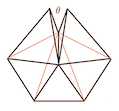
Eight vertices can be ordered to make five regular tetrahedrons.
These five regular tetrahedrons using a common center edge will create one 7.38º (degree) gap which is, to date, unnamed.
Five irregular tetrahedrons were used to make the Chrysler logo; introduced in 1962, it was named the Pentastar.
For the purposes of this article our object is called a Pentastar and the focus is on the 7.38º gap.
There is a dynamic between the Pentastar and pi. There is also a dynamic with cubic close packing, bifurcation theory and cellular automaton.
The purpose of this short article is to introduce the Pentastar 7.38º gap, to invite initial comments, and to invite experts to study those relations and dynamics with pi. Is it here that we find the foundations for quantum theory, identity, chaos, indeterminacy, and the self?
It is one of the most simple constructions in the universe, and it must in very special ways interact with the non-repeating, never-ending numbers of pi and the other nine fundamental numbers and number groups that are discussed in the article about the importance of numbers, On Constructing The Universe From Scratch.
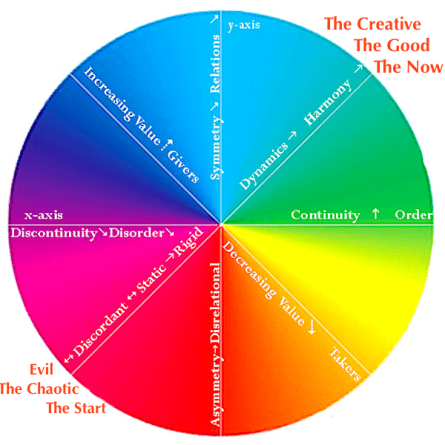 A Focus on Human Will: This chart has been used in several blogs. The first time was in June 2014 when the question was asked, Is there order in the universe? Click on the chart itself (or here) to go to a related blog, Where is the Good in Science, Business, and Religion?
 The roots of this project go back to 1979 in the main entrance of MIT, Lobby 7, where the works of 77 key, living scholars were placed within either the small-scale, human-scale, or large-scale universe
 (
(



 = φ = 1:1.618033988749894848204586


 Big Board-little universe