Frank Wilczek

First email to 2004 Nobel laureate, MIT physics professor, Frank Wilczek

On Fri, Dec 14, 2012 at 5:40 PM
Bruce Camber wrote:

Dear Prof. Dr. Frank Wilczek:

Back ten days ago, we sent this note through your resources page
within your your website — http://frankwilczek.com/resources.html
It is from five high school geometry classes.

We have a model of the universe and we are not sure what to do with it.

We started with one meter and divided it in half as if it
were an edge of a tetrahedron, and then we continued dividing
in half until we got down in the area of the Planck Length. Later,
we started at the Planck Length and used base-2 exponential notation
to go out the 202+ steps to the edges of the observable universe.
We used Plato’s five basics as an inherent continuity equation and
symmetry function.

It seems too easy, perhaps a bit of poppycock, but we don’t know
why. The question now is how to continue to develop it. Is it a useful
ordering system (STEM project)? Or, could it possibly be more?
We don’t know. After all we are just five high school geometry classes.

Is it just a bit of silliness? Or, might it be useful? We, the kids and
teachers, are anxious to know. We will be having a major discussion about it
next week with all five classes. Thanks. -Bruce

Bruce Camber

Note: We first found you here:
Physics Today, Alden Response PDF
http://frankwilczek.com/resources.html

Could The Planck Base Units Open A Secret Door To A New Universe Of Knowledge?

Five Planck Base Units Science is filled with mysterious numbers that defy logic and explanation. Among them are extremely small numbers that were introduced in 1899. Largely ignored for over 100 years, today these Planck Units have opened a rather magical pathway that has a little potential to become a new study within the sciences. Some might think it is a science of the mind. Though possibly true, it could be much more. (new window).

CurtisHere the old-fashioned thought experiment could become a new art form. A little high school, not far from the levee along the Mississippi River, a little up river from the French Quarter but downriver from the New Orleans airport, has big dreams and plenty of brains-and-brawn. Yet, never did they expect to be the place where base-2 exponential notation from the Planck Length to the Observable Universe and from the Planck Time to the Age of the Universe would be birthed. The fateful day was December 19, 2011, the last day of classes before their Christmas holiday recess and it begged the question, “Could this possibly be the beginnings of a very simple model for everything, everywhere, for all times?” More

For five groups of students who were studying the basic tenets of geometry, a strange thing happened. They saw the entire universe and parts of the unknown universe all at one time, all interrelated on one board, and organized by (1) a simple logic, (2) the Planck Length, (3) simple geometries and (4) simple mathematics (multiplying and dividing by 2). Just over 201 doublings captured our entire known universe. More

Just over 201 notations. What does it mean? What difference does it make? The first insight was that there is a deep-seated order in the universe. The order is imputed. It comes from logic and mathematics not from experimentation and measurement. Although it creates a special continuity from the smallest to the largest measurements of space and time, they can only say for sure, “Here it is,” then ask questions such as “What is wrong with this picture?” Very quickly, fifteen more key questions were raised. Third, also imputed are structural relations that create a diversity of symmetries that literally bind everything in the known universe. That’s quite an achievement unto itself, but it must be defended with facts that have some basis in reality.  More

Hardly intimidated, this group believes that the facts are, by and large, self evident and that there is so much more to discover and learn. More

NewOrleans

Located in River Ridge (a hamlet just downriver from the airport), the Curtis School is well-known among the football quarters, not within  the studies of cosmology and astrophysics. Though there are rumblings and a very small scientific group moving away from the Big Bang Theory, this little  group within the school could land a tackle that suddenly causes this leading intellectual theory to stop in its tracks. If their map of the universe is truly a new domain of science, the human mind may end up taking its rightful place of importance within their grid that begins to redefine who we are and why. More…

That is enough, but there is more.To date, science has had very little to say about values and ethics, You can hear the pragmatists say, “Those are not measurable qualities.” And they would be right, yet here, if the inherent structure of science is order-continuity and relations-symmetry, extended logically, it could become a structure for value and even for a moment of perfection within what appears to be a finite universe. Two symmetries interacting over time, give us the first dynamical moments that have a harmony which unto itself is a compelling infrastructure for valuation and ethics. More…

Also, deep in the heart of this discussion is the place of the finite-and-infinite, and geometry-and-calculus. The old world of geometry gave us a special grounding. Structure was everything. Then, the newer world of calculus came in and slowly began to give us a new sense of change, openness, and a very long vision. People thought they could see forever. Professor Max Planck was 41 years old when he did those special calculations back in 1899. He was 60 years old when in 1918 he received his Nobel Prize for his work to define a quanta of energy. By 1944, now 87 years old, he penned these few special words that could set the stage for a science of the Mind. More

Throughout it all, his precious Planck Units had been virtually ignored. It wasn’t until 2001 before his earlier calculations, now over 100 years old, began to see the light of day. In a series of three articles in Physics Today. Prof. Dr. Frank Wilczek of MIT (Nobel laureate, 2004) acknowledged their presence and potential importance. Finally, the Planck numbers gained a little respect as the conceptual limits on the smallest side of every equation. It seemed to suggest a way to begin to see the universe as a finite place. Rather suddenly Planck’s work gained a solid foothold. Also, science had advanced far enough to begin to suggest that there are upper boundaries as well. For the first time in centuries, the finite was gaining ground; the infinite seemed more ephemeral. The kids had plenty of ideas and comments. “This is a great STEM tool. Science-Technology-Engineering-Mathematics all makes sense here.” Another said, “Let’s keep the small “I” of the infinite so all our atheist friends have something in which to believe so they don’t have to believe.” More

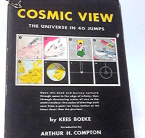
Our “Planck students” soon discovered that they were not alone in their sense that the universe could be reduced to simple, logical working principles. In 1957 in Holland a little-known high school teacher, Kees Boeke, wrote a very short book, Cosmic Vision, The Universe in 40 Jumps. In 1962 a film was made about it and then in 1965 a coffee table book was published. By 2001, the scholarly community had become Boeke.png
familiar with base-10 notation. The River Ridge group was just getting to know him. They quickly acknowledged that Boeke’s book was the very first universe view. But because he only found 40 of 62 base-10 notations, it was dubbed “universe-view light.”Yet, base-10 has an important place in this discovery process and work with it is still being done. In July 2014, Gerard ‘t Hooft and Stephan Vandoren published a book, Time in the Powers of TenOf course, base-2 is much more granular (3.3333 times) and mimics cellular reproduction on one hand and chemical bonding on the other. More importantly, this base-2 work is rooted within the Planck base units and basic geometries where space and time are seen working together throughout the 201+ notations that define our universe. More.

There are several next steps. A few students (and their teacher) speculate:
Let’s make a movie about it that focuses on our most speculative guesses.”
Let’s focus on that small-scale universe and try to figure it out. There are doctoral dissertations in there.
“Let’s get other schools involved and promote this simple model as a powerful STeEM (Science-Technology-[Education]-Engineering-Technology) tool. (A link will be forthcoming)*

Endnote: The following Max Planck quote is currently linked to the place where the source pages are housed in Berlin at a place called the Archiv zur Geschichte der Max-Planck-Gesellschaft: “All matter originates and exists only by virtue of a force which brings the particle of an atom to vibration and holds this most minute solar system of the atom together. We must assume behind this force the existence of a conscious and intelligent mind. This mind is the matrix of all matter.”  From “The Nature of Matter” within the Archiv zur Geschichte der Max-Planck-Gesellschaft, Abt. Va, Rep. 11 Planck, Nr. 1797, 1944

Jo Edkins Geometries

Tilings and Tessellations from Cambridge, England

A tessellation is the tiling of a plane using geometric shapes called tiles and it has no gaps or overlaps.

In our search of the web for images of tetrahedrons and tessellations or tilings of triangles, squares and hexagons, there were thousands of possibilities. Among the best were these very clean images from Jo Edkins, especially made for teachers.

Jo is from the original Cambridge in England and loves geometry. She has encouraged us in our work and, of course, we thank her and her family’s wonderful creativity and generosity of spirit.

The Edkins triangular tessellations

Jo’s square tessellations

Hexagonal tessellations

For more variations, go to Jo’s website:  http://gwydir.demon.co.uk/jo/tess/grids.htm

Just what’s happening here?

For over 100 years, the Planck Length was virtually ignored.  That length was so small, it seemed meaningless.¹  Nothing and nobody could measure it.  It was just a ratio of known constants.  Yet, it created a conceptual limit of a length which gave a New Orleans high school geometry class a goal or a boundary beyond which they did not have to go Recent measurements from the Hubble telescope provided the upper limit so this class could define the number of base-2 exponential notations from the smallest measurement of a length to the Observable Universe, the largest.

Within that continuum everything can be placed in a mathematical and geometric order.  Everything.  That is, everything in the known universe. The most remarkable discovery was that it took no more than 205.1 base-2 exponential notations.  It would be our very first view of an ordered universe. And, it readily absorbed all of our worldviews.

That was December 19, 2011.  Formally dubbed, “The Big Board – little universe,” we then asked, “What does it mean?  How do we use it?”  When we engaged the experts, they appeared a bit puzzled and seemed to be asking, “Why haven’t we seen this chart before?” Those who knew Kees Boeke’s 1957 book, Cosmic Vision,  asked, “How is it different from Boeke’s work using base-10 exponential notation?”   That was a challenge. Our best answers to date – it’s more granular, it mimics chemical bonding and cellular reproduction; it’s based on cascading, embedded, and combinatorial geometries – were not good enough.  In April 2012 even the Wikipedia  experts  (Steven Johnson,  MIT) protested.  He classified our analysis as  “original research” and within a very short time our Wikipedia article was taken down.  Others called it idiosyncratic (John Baez, UC-Riverside), but they did not tell us what was wrong with our analysis.

“Let’s just make as many observations as we can to see what can we learn?”  A NASA senior scientist and a French astrophysicist helped us with our calculations.  Their results gave us a range; the low was 202.34 notations and the high, 205.11.  We could identify many things between the 66th notation and the 199th notation.  But, there were blanks everywhere so we got busy speculating about them. The biggest group of empty notations was from 2 to about 65. We asked, “Conceptually, what could be there?”  Max Planck may have given us a clue when in 1944, in a speech in Florence, Italy; he said, “All matter originates and exists only by virtue of a force which brings the particle of an atom to vibration and holds this most minute solar system of the atom together. We must assume behind this force the existence of a conscious and intelligent mind. This mind is the matrix of all matter.” (The Nature of Matter, Archiv zur Geschichte der Max-Planck-Gesellschaft, Abt. Va, Rep. 11 Planck, Nr. 1797, 1944)  Matrix is a good word. Throughout history others have described it as the aether, continuum, firmament, grid, hypostases, plenum and vinculum.

We made two columns and within the top notations, 100-to-103, we found humanity.  That seemed politically incorrect until we discovered the cosmological principle that the universe is isotropic and homogeneous.  So, if it is true for us, it would also have to be true for “everybody” anywhere in the universe.

This is high school.  We had been following embedded geometries, particularly the tetrahedron and octahedron.  We observed a tetrahedral-octahedral-tetrahedral chain.  In no more than 206 layers everything in the universe is bound together.  We learned about tilings and could see that the four hexagonal plates we discovered within the octahedron also created tiles in every possible direction.

“What is this all about?  Just what’s happening here?”

We knew we were imposing a certain continuity and order with our mathematics (base-2 exponential notation), and we were also conveying certain simple symmetries and relations with our geometries.  That wrapped our work within a conceptual framework that was quite the opposite of the chaotic world of quantum mechanics.  Our picture of the known universe was increasingly intimate and warm; it was highly-ordered and had immediate value. And the more we looked at it, the more it seemed that all of science and life had an inherent valuation structure.   Here numbers became the container for time, and geometries the container for space.  How each was derived became our penultimate challenge. Ostensibly we had backed into a model of the universe and somehow we began to believe that if we could stick with it long enough, it just might ultimately give us some answers to the age-old question, “What is life?”

We had strayed quite far from those tedious chapters in our high school geometry textbook.  Yet, we also quickly discovered how little we knew about basic structure when we attempted to guess about the transitions from one notation to the next.  We asked, “How can we get from the most-simply defined structure, a sphere, to a sphere with a tetrahedron within it?”  We needed more perspective.

Who is doing this kind of work?”  We began our very initial study of the Langlands Program and amplituhedrons. Then, we walked back through history, all the way to the ancient Greeks and we found strange and curious things all along the way. There were the circles of Metatron that seemed to generate the five platonic solids. “How does that work? Are there experts who use it?  How?”  We still do not have a clue.  All the discussions about infinitesimals seemed to come to a crescendo with the twenty-year, rancorous debate between Thomas Hobbes and John Wallis.  It was here that we  began to understand how geometry lost ground to calculus and algorithms.

The Big Board-little universe was awkward to use.  It was five feet tall and a foot wide.  Using the Periodic Table as a model, an 8½-by-11 chart was created and quickly dubbed, The Universe Table.  It would be our Universe View into which we could hopefully incorporate any worldview.  It was an excellent ordering and valuation system.

Frank_WilczekThough the Planck Length became a natural unit of measurement, a limit based on known universal constants, it wasn’t until Frank Wilczek of MIT opened the discussion did things really begin to change. In an obscure 1965 paper by C. Aldon Mead, his use of the Planck Length was pivotal. In 2001 Wilczek’s analysis of Mead’s work and their ensuing dialogue was published in Physics Today. Wilczek, well on his way to obtaining a Nobel Prize, then began writing several provocative articles, Scaling Mt. Planck.  Even his books were helpful. In January 2013 he personally encouraged us on our journey.

In 1899 Max Planck began his quest to define natural units.  At that time he took some of the constants of science and he started figuring out natural limits based on them. There are now hundreds that have been defined. Each is a ratio and each can be related to our little chart and big board.  The very nature of a ratio seems to be a special clue. It holds a dynamic tension and suggests that the relation is primary and all else is derivative.

We have a lot of work in front of us!  And, we are up for the challenge.

Who would disagree with the observation that our world has deep and seemingly unsolvable problems?  The human future has become so problematical and complex, proposals for redirecting human energies toward basic, realizable, and global values appear simplistic.  Nevertheless, the need for such a vision is obvious. Rational people know that there is something profoundly missing. So, what is it? Is it ethics, morality, common sense, patience, virtues like charity, hope and love?  We have hundreds of thousands of books, organizations and thoughtful people who extol all of these and more.  The lists are robust.  The work is compelling, but obviously none of it is quite compelling enough.

First, it has to be simple.  Our chart is simple.

Second, it has to open up to enormous complexities. Using simple math, by the tenth notation there are 1024 vertices. We dubbed it the Forms or Eidos after Plato. The 20th notation would add a million vertices; we called it Structure. The 30th adds a billion new vertices. We ask, “Why not Substances?” The 40th adds a trillion so we think Qualities. The 50th adds a quadrillion vertices. We speculate Relations. By the 60th notation there are no less than a total of 2 quintillion vertices with which to create complexity. We speculate Systems and within Systems there could be The Mind. As if a quintillion vertices is not enough, the great physicist,  Freeman Dyson, advises us that really we should be multiplying by 8, not by 2, so potential complexity could be exponentially greater.

Three, it should be elegant.  There is nothing more elegant than complex symmetries interacting dynamically that create special harmonies.  We can feel it. And, we believe the Langlands program and amplituhedrons will help us to further open that discussion.

What is life?  Let us see if we can answer very basic questions about the essence of life for a sixth grade advanced-placement science class and for very-average, high-school students.  These are our students.  The dialogue is real.  The container for these questions and answers is base-2 exponential notation from the Planck Length to the Observable Universe.  To the best of our knowledge, December 19, 2011 was the first time base 2 exponential notation was used in a classroom as the parameter set to define the universe.  Though our study at that time was geometry, this work was then generalized to all the scientific disciplines, and more recently it was generalized to business and religion.  So, as of today, readers will see, and possibly learn, the following:

1.  See the totality of the finite, highly-ordered, profoundly inter-related, very-small universe where humanity is quite literally back in the middle of it all.

2.   Engage in speculations about the Infinite and infinity whereby the Creative and the Good take a prominent place within the universal constructs of Science.

3.   Extend the scale of the universe by redefining the Small Scale and engaging in speculations about the deep symmetries of nature, giving the Mind its key role within Systems, and demonstrating the very nature of homogeneity and isotropy.

4.   Adopt an integrated universe view based on Planck Length and Planck Time such that Science, Technology, Engineering and Mathematics are demythologized,  new domains for research are opened, and philosophies and religions are empowered to be remythologized within the constraints of universals and constants.

People ask, “Aren’t you getting ahead of yourself?  Isn’t this a bit ambitious?”  The concepts of space and time raise age-old questions about who we are, where we have come from, and where we are going.  With our little formulation, still in its infancy, we are being challenged to see life more fully and more deeply.  And so we reply, “What’s wrong with that?”

###

1  http://www.phys.unsw.edu.au/einsteinlight/jw/module6_Planck.htm   Physics professor, Joe Wolfe (Australia), says, “Nothing fundamentally changes at the Planck scale, and there’s nothing special about the physics there, it’s just that there’s no point trying to deal with things that small.  Part of why nobody bothers is that the smallest particle, the electron, is about 1020 times larger (that’s the difference between a single hair and a large galaxy).


Extremely-Small and Extremely-Large Numbers

Let us start with the two key numbers:
1. The Planck Length: 1.61619926×10⁻³⁵ meters which is 0.0000000000000000000000000000000000161619926 meters

2. The Observable Universe: 8.79829142×1026meters or 879,829,142,000,000,000,000,000,000 meters

There are many numbers in between the two. Each “0” represents a major base-10 transformation; and within each base-10, there are three or four base-2 notations. Though some say that the Planck Length is a special type of singularity, it has a specific length. Yet, that length is so small, for about 100 years, it was virtually ignored by the entire scientific community. Perhaps a better way of looking at the Planck Length is through the lenses of geometry. If we make it one of Alfred North Whitehead’s point-free vertices of a specific length, each time we multiply by two we grow the size as well as the number of vertices.

The Numbers of Vertices at Key Notations Between 1 and 65. When you assume that the Planck Length is a vertex, unusual concepts flow. First, consider the generation of vertices just by multiplying by 2, then each result by two, over and over again. By the tenth doubling there are 1024 vertices. By the 20th doubling, over a million more are added. On the 30th, another billion+ are added. Then, comes another trillion+ at the 40th, a quadrillion+ at the 50th notation and a quintillion+ at the 60th. At the 61st there are another 2+ quintillion vertices added. These vast arrays and systems of vertices cannot be observed.

This is the domain of postulations and hypostatizations. Consider this concept: going within from about the 65th notation, the domains begin to be shared. More and more is shared by everything as the Planck Length approaches. Each notation organizes uniquely, yet within groups. And these natural groupings reflect all the diversity within all the notations 65 and higher. It seems that the mathematics of cellular automaton may figure into the first 20 or 30 notations. We start with the most basic Forms, then Structures, which become the pre-structure for Substances, archetypes for Qualities, then Relations, then the Mind. We turn to systems theory, group theory, and set theory to discern the order of things.

Perhaps there are five hot spots for immediate research:
* Notations 1-20 and the foundations of cellular automaton and fractal geometries by using the functions created by more than one million vertices
* Notations 50-60 and the foundations of the Mind, logic, psychology, memory, thought, epistemology and learning with over 500 trillion vertices at the 59th notation and then another quintillion+ vertices within the 60th notation.
* Notations 60-80, the emergence of the particles and atoms and the most basic structures of all physical matter
* Notations 100-103, the emergence of the human life and most all life as we know it
* Notations 135-138, the transition to the Large-Scale Universe with the possibilities of uncovering pathways to the Einstein-Rosen bridges and tunnels also known as wormholes.
Key references for more: The numbers

Facts & Guesses. The Facts are what is measurable and what fits within each domain. The Guesses are about what goes on with those domains (aka steps, notations, layers or doublings) especially those that remain blank. Is there a pattern, especially a cyclic pattern that manifests in another notation? We followed Max Planck where he took the constants of nature, starting with the speed of light to calculate the smallest number. We took the age of the universe, with some help from scientists, to learn the largest calculation of a length, the Observable Universe. Making sense of these numbers is another story. So, over the forthcoming weeks, months and years, we will be looking even deeper. Would you help us now and take the little survey?

More notes about the how these charts came to be:
1Three downloads authored by Prof. Dr. Frank Wilczek: Scaling Mt. Planck (from Columbia University), C. Alden Mead’s letter and Wilczek’s response in Physics Today, and Wilczek’s August 2013 Lecture notes on units and magnitude (If you like this paper, also read this one).

The simple conceptual starting points
An article (unpublished) to attempt to analyze this simple model. There are pictures of a tetrahedron and octahedron.
A background story: It started in a high school geometry class on December 19, 2011.
The sequel: Almost two years later, a student stimulates the creation of this little tour.

Wikipedia on the Planck length
Wikipedia on the Observable Universe

Take it as a given that it is also a vertex. By the second doubling, there are four vertices, just enough for a tetrahedron. By the tenth doubling there are 1024 vertices. The number doubles each notation. By the 20th doubling, over a million more are added. On the 30th, another billion+ are added. Then, comes a trillion+ at the 40th, a quadrillion+ at the 50th notation and a quintillion+ at the 60th. At the 61st there are another 2+ quintillion vertices. What does it mean?

The simplest geometries yield a deep-seated order and symmetries throughout the universe. Those same simple geometries also appear to provide the basis for asymmetry and the foundations of quantum fluctuations and perhaps even human will.

Universe Table: The Human Scale

Small Scale
Speculations
Ideas
Concepts
and
Parameters

Boundaries
and
boundary
conditions

Trans-
forma-
tions

Human Scale

Numbers
and
Number
Theory
Forms, Order, Relation and Dynamics Functions Continuity, Symmetry, Harmony

Large Scale

1
Planck Length
( ℓP )
Transition:
Small-to-Human Scale

1. Display area: Every number/word hyperlinked – quick results display here

2. Options: Open full screen, new tab or window to the research of the experts

3. Also: Related videos-images and online collaborations with up to nine visitors

4. Key Links: http://bblu.org    Universe-View.org   BigBoardLittleUniverse.org

Transition:
Human-to-Large Scale
205+
Observable Universe
2- 10
Forms1
Vertices:1024
77
Research
ℓP:2.44×10⁻¹²m
78
X-ray
Wavelength
95
Range:
Visible Light
96
Bacteria
Red Light
113
Hand-sizeH
16.78+cm
114
TextbookT
12.8+inches
131
Marathon
27+miles
132
54+ miles
87.99+km
204+
Observable
Universe
11-20
Structure-Ousia
V: 1+million
76
Gamma
Wavelength
79
Huang
Scale
94
Nanoparticles
100-10000+nm
97
Blood cellR
2.4+microns(µm)
112
Finger-size
3.3″(inches)
115
Things
67.134±cm
130
Race
21.998+km
133
Drive
108+miles
202-203+
Observable
Universe
21-30
Substances
V:1+ billion
75
Falstad
Scale
80
Periodic
Table
93
Gold LeafG
160.06±nm
98
Capillary
5.12+microns
111
Spoonful
4.19+cm
116
A child
52.86±in
129
Distances:
6.834+miles
134
Gravity-free
351.97+km
198-201
Superclusters

6.1-54+yottometers
31-40
Qualities
V:1+ trillion
74
Research
1.52+x10-13m
81
HydrogenH
31±pm
92
Nanowires
80.03±nm
99
Cells
10.24±microns
110
MakeupM
.82±inches
117
A bed
105.72±inches
128
Village
3.41±miles
135
Distance
437.41±miles
191-197
Virgo
Supercluster3
41-50
Relations
V:1+ quadrillion
73
Research:
Tunneling4
82
HydrogenH
78+ pm
91
Little chipslc
40.01+nm
100
Sperm
20.48+microns
109
LipstickL
1.04+centimeters
118
Bedroom
5.37+meters
127
Walk
1.7+miles
136
Fly
874+miles
181-190
Galactic
Group6
51-60
Systems
The MindM
72
NucleusN
7.63+x10-14m
83
CarbonC
70±pm2
90
Viruses
20.007+nm
101
HAIR
40+microns
108
DiamondD
5.2+mmM
119
Home
35.24+feet
126
Downtown
1.37+km
137
Rivers
2815.81+km
171-180
Milky
Way
61-65
Elementary
Particles
71
GoldAU
Nucleus

84
WATERW
3.12+x10-10m
89
Cell Wall
10+nm
102
Paper
81.95+microns
107
Ants
2.62+mm
120
Property
21.48+m
125
Superdome
687.45+m
138
USA-to-UK
3500+miles
161-170
SolarS
Interstellar
65-67
Neutron
Proton-Fermion
70
AluminumAl
1.90+x10-14m
85
DNAD
6.25+x10-10m
88
Insulin
5.00+x10-9m
103
EggE
.16+millimeters
106
Sand
1.31+mm
121
Yacht
142+feet
124
Skyscraper
343.7+meter+
139
EarthE
11,263+km
151-160
Solar
SystemS
68
HeliumHe
4.77+x10-15 m
69
Electron
9.54+x10-15m
86
Buckyballs
1.25+nm
87
Ribosomes
2.50+nm
104
>.< Period
.32+mm
105
Bacterium
.65+mm
122
Sequoia
85+meters
123
Tall Building
171.86+m
140
GPS Satellite
22526+km
141-150
Earth
Systems

Tetrahedrons & Octahedrons

Tetrahedron

The text within the picture reads as follows:

Three levels of simple complexity:

1. Observe the tetrahedron in the bottom left corner.

2. Notice that it is enclosed in a larger tetrahedron. Right beside is
an octahedron, plus there is a tetrahedron in each of the other three corners. Every tetrahedron encloses four half-sized tetrahedrons and an octahedron.

3. Notice that our larger tetrahedron is enclosed by an even larger tetrahedron. This pattern repeats itself getting smaller and getting larger. Part of the complexity can be seen by observing the center octahedron. Notice the red, black and blue hexagonal plates. A white plate has been obscured.

For more, please follow this page on the website:
https://bblu.org/2014/12/01/tiling
“Tiling the Universe in 201+ Exponential Notations:
The Great Chain of Being”

Freeman Dyson: A Guiding Light

BigBoard8From: Freeman Dyson
Date: Mon, Oct 22, 2012 at 11:12 AM
Subject: Re: 34 years later… Might it be useful to see the universe as 202.34 notations that are necessarily related through simple geometries all nested within each other?
To: Bruce Camber

Dear Bruce Camber,

Thank you for the invitation to comment. Without seeing your  scheme, it is hard to judge whether it would make sense. If I take your three questions literally, the answer is No to all three.

1.  Since space has three dimensions, the number of points goes up by a factor eight,* not two, when you double the scale.

2.  The universe we live in is not nested at all.   On the contrary, larger levels of structure are quite different from smaller levels. Larger levels bring qualitatively new structures. For example, a galaxy does not look like a big star, and a star does not look like a big planet, and a planet does not look like a big elephant, and an elephant does not look like a big bacterium, and a bacterium does not look like a big atom.

3.  I don’t know any recent work that would be important for your project. There are plenty of new pictures for you to choose from, both in the large and in the small, from galaxies to viruses.

Sorry I do not have any more useful ideas. I will be interested to see what comes out of your project.

Yours sincerely,

Freeman Dyson

* Editor’s note and reference:  http://www.av8n.com/physics/scaling.htm  We can extend this idea into three dimensions. The volume goes up by a factor of eight because the cube is twice as wide…

Here is the letter to which Prof. Dr. Freeman Dyson was responding:

On Fri, 19 Oct 2012, Bruce Camber wrote:

> Dear Prof. Dr. Dyson:
> Just over 34 years ago I contacted you regarding a special project at MIT called,
> “An architecture for integrative systems.” It was a display project in the main rotunda
>  just off Massachusetts Avenue. It borrowed Erwin Schrodinger’s title from his much
>  earlier work, a book entitled, “What is life?” Seventy-seven leading, living scholars
> participated and you were one of them. We are taking that old product and re-purposing
> it online within a very similar framework — Small Scale, Human Scale, Large Scale —
> however, we are using base-2 exponential notation from the Planck Length to the
> edges of the observable universe which gives us 202.34 ordered steps in which to context
> information.  By assuming nested geometries at each doubling, it seems that we
> will have an inherent structure for analogous or metaphorical connection-making.
>
> But before we go too far, I would like to re-engage you and ask for your advice:
> 1.  If the Planck Length is a dimensionful number representing a singularity
> or a point, can we multiply it by 2 and assume two points? …multiply it again
> and assume 4, then 8, 16, 32 and on up to 1024 by the 10th doubling?
> 2.  Can we assume nested geometries throughout?
> 3.  We will use the same infrastructure as used by Wikipedia to build it out, so
> owner’s of information can readily edit and update content. Is there any particular
> recent work to which you would want us to take note?
>
> Thank you.
>
> Warmly,
>
> Bruce

NASA scientist’s report regarding his calculations

Some Thoughts about Measurement

Back in December 2011, Bruce Camber and five high-school geometry classes in New Orleans involved themselves in an interesting little thought journey. When I was contacted by them, they were deeply into the process to discover that the number 2202.34 represents the ratio between the Hubble radius of the observable universe (according to the results in March 2012) and the Planck length (a number from modern quantum physics).

Here is how they did it:

1. The Hubble radius [astronomical measurement] is taken to be 1.31 x 1026 m and the Planck length [calculated] is 1.62 x 10⁻³⁵ m. The Hubble radius comes from a recent estimate of the age of the universe published in Discover Magazine. The Planck length L may be calculated from: L = (hG/(2πc3))1/2 where h is Planck’s constant, G is Newton’s gravitational constant, and c is the speed of light, all in appropriate units of measure.

2. The ratio between the two distances is then found to be: 1.31 x 1026 m / 1.62 x 10⁻³⁵ m = 202.34

This calculation arises from a related classroom activity, begun by Mr. Camber with those five geometry classes. The ratio is shown as a power of 2 (it could as well have been shown as a power of 10, or of any other number) in answer to the original class question, “How many times does one have to double the smallest known distance (the Planck length) to acquire the largest known distance (the present-day Hubble radius of the universe). I was consulted by Mr. Camber and assisted and advised him and his classes to produce the result shown above.

The significance of this result is that it displays the most extreme distance ratio imaginable in terms of a surprisingly finite number (202.34) of doublings. In a sense, it takes two quantities, neither of which can be adequately pictured in the mind, and shows them in ratio as a number that can be more easily pictured. I thought the exercise interesting and worth the effort and was happy to be called upon to contribute.

3. One additional note, the standard meter (1m) when compared to the Planck length corresponds to a ratio of 2115.57. We note that 2115 corresponds to 0.67m, and 2116 corresponds to 1.35m. In other words, the standard meter is not an even power-of-2 multiple of the Planck length. Mr. Camber and his classes have therefore suggested that a possible redefinition of the standard meter might be made by choosing one of these possibilities (i.e., 2115 or 2116 times the Planck length) and used to replace the present-day standard. The present day standard is based on the wavelength of a particular atomic emission line. This new standard would be based on a purely theoretical concept.

Bravo to Mr. Camber and his classes for some very nice (and out-of-the-box) original thinking!!!

– Joe Kolecki, NASA scientist, retired

202 base-2 notations from the Planck scale render a highly-integrated model of the universe

The Big Board–Little Universe Project, part of Center for Perfection StudiesUSA

Last update: 8 August 2017

IntroductionBig Board-little universe
In December 2011 two teachers and about 80 high school students rather naïvely began to explore a geometric progression that first went down in size to the Planck Length then reversed to go back up all the way to the Observable Universe (most links open a tab or window and go to an in-depth Wikipedia page).

The first chart to be developed, pictured on the left, measures 60×11 inches. It is a view of the entire universe and has just over 200 base-2 exponential notations (dividing or multiplying by 2, over and over again). Thinking that this simple math was already part of academic work, they began asking friends and family, “What is right or wrong within our logic for this model?” A two-year search did not uncover any references to base-2 and the Planck Length.* In that time, asking around locally and then globally, many people were puzzled and asked, “Why haven’t we seen a base-2 scale of the universe before now?”

An Integrated Universe View
Dubbed Big Board – little universe, this project started as a curiosity; today, it is an on-going study to analyze and develop the logic and potential links from their simple mathematics to all the current mathematics that define the universe, all its parts, everything from everywhere, and from the beginning of time to this very moment in time. Their hope is that this simple logic has simple links to real realities. Their standing invitation is, Open To Everyone, to help. This chart follows the progressions from the smallest to the largest possible measurement of a length. Subsequent charts engage the other Planck base units. With more questions than answers, this group is trying to grasp the logic flows in light of current academic-scientific research. Progress is slow.

____________

Yes, on December 19, 2011 the geometry classes in a New Orleans high school were introduced to the chart on the left (Planck Length to the Observable Universe). In December 2014 they began to track Planck Time to the Age of the Universe. When they added the other the Planck base units to each maximum value, it seemed to call out for a horizontally-scrolled chart to follow each line of data more easily. Natural inflation becomes self-evident. And, that opened the way to question the big bang theory, especially the first four epochs — the Planck Epoch, the Grand Unification Epoch, the Inflationary Epoch, and Electroweak Epoch. In their search for answers about this model, questions abound.

This first chart is very early work.
Click on it, then click on it again to enlarge it
.

What’s next?
They ask, “Where are the informed critics to tell us where we are going wrong?” One rather brilliant, young physicist told them that the concept for this project is idiosyncratic. They quickly learned how right he was. Nobel laureates and scholars of the highest caliber were asked, “What is wrong with our picture? Where is our fallacy of misplaced concreteness?” The group is slowly analyzing the logic and developing their thoughts as web postings with the hope that somebody will say, “That’s wrong” and be able to tell them in what ways they have failed logically and mathematically.

The first 36 of 200+ notations of the horizontally-scrolled chartIf not wrong, the extension of their basic logic could begin to yield rather far-reaching results. For example, the Big Bang theory could get a special addendum, the first 67 notations. That would make it simple, symmetric (entirely relational), predictive, and totally other. The entire universe could get an infrastructure of geometries whereby many issues in physics, chemistry and biology could be redressed. The finite-infinite relation is opened for new inquiries. In this model of the universe, time-and-space are derivative of two quantitative qualities of infinity: continuity-and-symmetry. As a result, these derivative relations begin to have an inherent qualitative or value structure. If so, ethics and the studies of the Mind (the discernment of qualities) just might, for the first time in history, become part of a scientific-mathematical continuum. A trifurcated definition of the individual may emerge whereby people are simultaneously within the small scale, human scale, and large scale universe. Embracing a different sense of the nature of space and time by which both are localized by notation is surely enough; yet there will always be more. There are many working postings that have been written since their first chart; all of it needs constant updating. Many can be found through the top navigation bar option, INDEX.

Notes, lesson plans and posts (and all new posts) are being consolidated and linked from this homepage. Now called, The Big Board – little universe Project, it is a Science-Technology-Engineering-Mathematics (STEM) application. Secondary schools from around the world are being invited to join the exploration. Daily work on the topic is being researched, developed, and communicated through a sister website, http://81018.com.

The earliest postings and blogs were done by Bruce Camber within a section of his website — SmallBusinessSchool.org. That site supports a television series, Small Business School, that he and his wife, Hattie Bryant, started. It aired for 50 seasons on most PBS-TV stations throughout the USA and on thousands around the world via the Voice of America-TV affiliates.

Articles and blogs have been posted on WordPress, LinkedIn, Blogger, and Facebook (often those links open in new windows). An April 2012 article, formatted for and displayed within Wikipedia for a few weeks, was deleted on May 2, 2012 as “original research” by highly-specialized Wikipedia editors. Only then did this little group of teachers and students finally begin to believe that base-2 notation had not already been applied to the Planck base units. And, as they have grown in their analyses, it has become increasingly clear that this area of simple math and simple logic is a relatively new exploration and that notations 1-to-67 may be a key to unlock a new understanding of the nature of physical reality.

The challenge is to study the logic flow within their many charts, all based on the Planck base units, both up and down and across, to build on the question, “Is this logic simple and consistent? What does it imply about the nature of the universe?”

So, even now, there is much more to come. At the end of the year, 2015, a Lettermanesque Top Ten was added. In January 2016 an article, Constructing the Universe from Scratch, emerged. In April 2016 the horizontally-scrolled chart provided a better sense of the flow and of phase transitions. Still a “rough draft” this project has a long way to go! Bruce Camber says, “You are most welcome to add your comments, questions, ideas and insights!

*****

* Footnote: In 1957 Kees Boeke did a very limited base-10 progression of just 40 steps. It became quite popular. In July 2014, physicists, Gerard ‘t Hooft and Stefan Vandoren wrote a scholarly update using base-10. Notwithstanding, base-2 is 3.3333+ times more granular than base-10 plus it mimics cellular reproduction and other naturally bifurcating processes in mathematics, physics, chemistry, biology, topology, botany, architecture, cellular automaton and information theory; it has a geometry; it has the Planck base units, and, it has a simple logic and so much more.

Twitter

If you would like to contribute content to this site, please contact Bruce Camber
at camber – (at) – bblu.org or click here for more contact information. Thank you.