Finite-Infinite

Center for Perfection StudiesThe Big Board–Little Universe Project 

What is finite? And, what is truly infinite?

“Finite or Infinite? Is That The Question?”    (link goes to Part II)

Some of our high school students think our scientific community makes the study of Science, Technology, Engineering and Mathematics (STEM) all too difficult to understand and overly complex by defying a certain commonsense logic. (Reference #1)

We have been studying simple math and simple geometries from the smallest possible measurement of a length to the largest (Reference #2). It appeared to some of the students, based on this work, that the universe is obviously finite. They have been told that intellectually and historically, it is an open question. For them, “Make a choice and see where it takes you.”

The students with strong faith statements said, “Only God is Infinite. All things within space and time are finite.” (Reference #3) When asked about all the universals-and-constants and space-and-time, the concurrence is that these are the access paths, interconnections and transformations between the Finite and the Infinite.

For the best of these students, asking the question, “What is the Infinite?” is like asking the question, “Who is God?” And, they have answers.

Of course, as a result of a little coaching, they say, “First, God is Perfect.” When asked, “What is perfection?” they echo their coach: “Perfection is order-continuity, relations-symmetry and dynamics-harmony, all rolled into one.” (Reference #4) That amounts to an understanding of the Infinite without importing all the related history and revelation from the various faith statements within our very short history throughout our little world. The Finite is another story. We turn to many people from Euclid to Einstein for inspiration to provide the academic and religious communities with our simple observations and assumptions.

Hardly postulates and axioms, our statements are a praxis in-search-of theoria:

If these statements are taken as a given, then what kind of universe and what kind of science do we have? Should we re-examine the use of infinity throughout the ages going back to the ancient Greeks? Should we reconsider the theory of indivisibles? And, perhaps we should even reconsider the very nature of the Big Bang and its theory.

Of course, that is our agenda (Reference #8),   our current focus for the immediate future.

References:

1. One of two key general overview and working article,  Order in the Universe

2. One of the earliest reflections on all our efforts and work: Is it true that everything starts most simply?

3. Initially written in November 2012, just what is the nature of belief?

4. In light of those constants, universals and the finite-infinite relation, the nature of perfection seems to follow: http://smallbusinessschool.org/page1695.html

5. Examining basic structure in basic ways: Simple View of the Universe http://smallbusinessschool.org/page2546.html#TetraInside

6. Our first look at the progression of doublings.  This listing was written to accompany an article for Wikipedia: Written in March 2012 to support an article for Wikipedia

7. There are somewhere over 201 base-2 exponential notations (doublings, domains, layers or steps) within the Known Universe.

8. Another analysis of key points: There are 15 in this article.

Even between atheists and believers

Perhaps all it comes down to is an answer to the question, “Whose metaphor is more meaningful?” You will not find many atheists who deny science. They do not deny the constants and universals that are always in the back of the science textbooks.

There are three constants within the sciences that remain clear, in spite of quantum mechanics. The first is that there is order and continuity in the world. It is the basis of knowing. In every discipline there are multiple parameter sets where this is true. Beginning in mathematics, a rather pure form of thought, abstraction and representation, we then move into physics. It has multiple parameter sets as well. There is one for Newtonian mechanics, another for General Relativity and Special Relativity and yet another for quantum mechanics. Then chemistry and biology have their own parameter sets. All these parameters simply establish the boundary conditions of what is being measured within them.

Each has a formalized language. And, each has a metaphorical language that pushes into the edges of the unknown.

The sciences all embrace varying definitions of relations yet all of these definitions are understood by a symmetry function.

Specialized disciplines with each of the sciences hypothesize about the nature of the unknown, just beyond their limits of knowledge, and all these hypotheses are a study of the deepest dynamics of their discipline. The experience of insight, the “ah-ha” of the creative surge, is experienced as a concrescence of symmetries or harmony.

The atheists mostly object to the use of specialized language. They understand rules, mores, and societal law and order even though many are nihilistic, others narcissistic, and many both.

Yet, change will come. Some of these folks will begin to realize that time is not a fundamental frame of reference and that there are qualities of life that permeate everything in every way, and that these qualities empower order, relations, and dynamics, and that these three scientific functions with the faces of continuity, symmetry and harmony just might also be understood with very personal language. When and if they do, they are on their way to create a personal bridge to religion and some of the brave among them just may cross it.
Is There Order In The Universe?

UniverseTable Updated: November 30, 2015
Note: Links open a new tab or window. If any link goes back to Small Business School where it was first posted, use your back button to return here.  All postings are being consolidated within http://bblu.org, the main website for secondary schools, and within http://81018.com, the main site for college, university and research-and-development.

Our high school geometry classes created a simple, mathematically and geometrically-ordered view of the known universe. We also found an inherent geometry for disorder.

Yes, rather unwittingly we backed into developing what we now call our Universe View. We used a very simple logic and math. First, we divided an object by 2 until we were down in the range of the smallest measurement of a length; then we multiplied the object by 2 until we were finally out around the largest-known measurement of a length.

Our work began in December 2011. That simple exercise resulted in measurements which opened paths to challenging facts, rather fun concepts, obviously wild-and-crazy ideas, and truly playful speculations.

Throughout this little article there are many references with links. However, there are just nine primary references to other pages. These links are also at the bottom of the page. Also, please be advised, that this project will always be a work in progress.

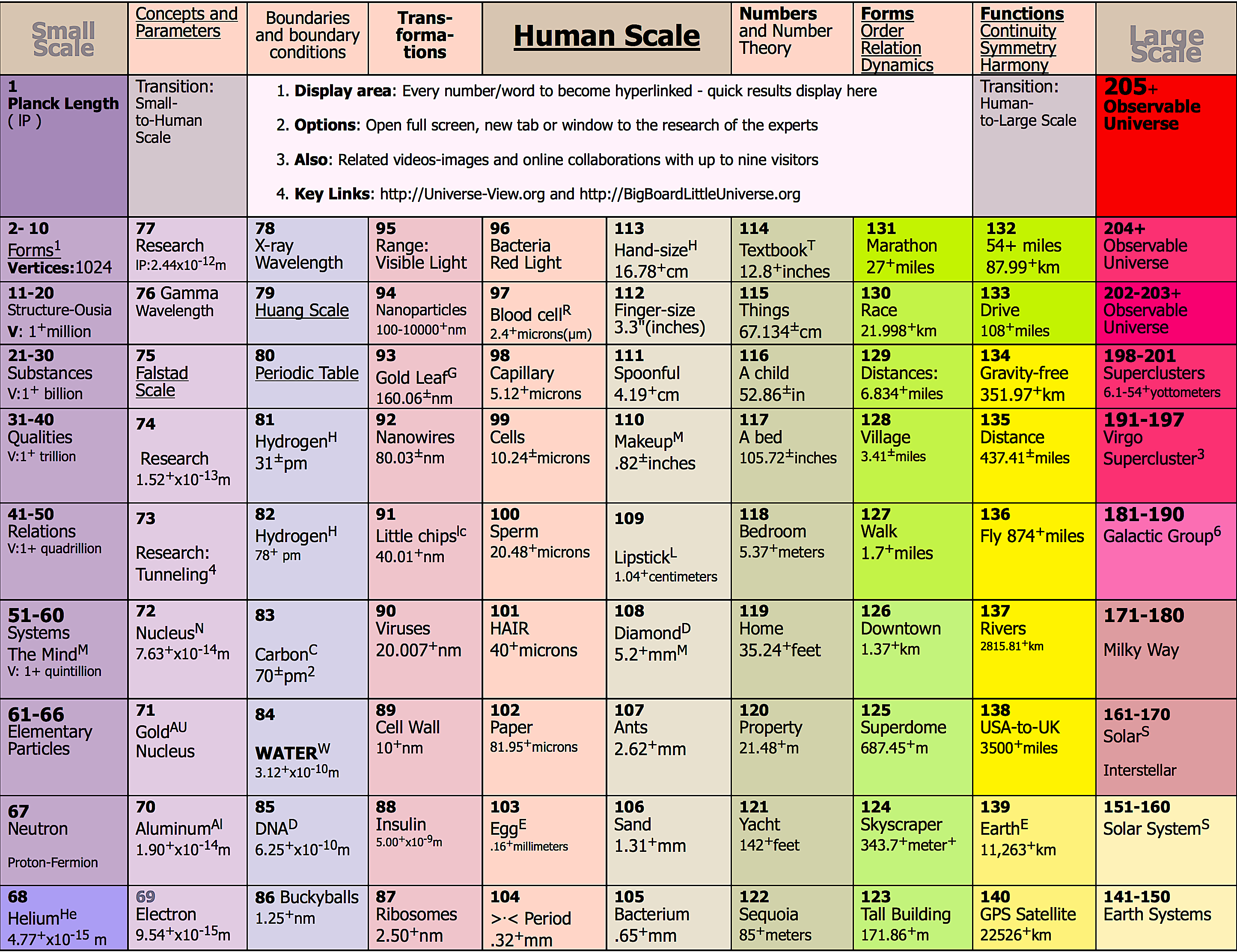
1. The Power of 2. There are 201+ base-2 exponential notations (that just means “doublings” or multiplying by 2) starting at the Planck Length, the smallest conceptual measurement of a length in the universe, out to the Observable Universe, the largest possible length. Within a few years we also did the simple multiplication of the Planck Time, side-by-side with the Planck Length, out to the Age of the Universe. Then on February 11, 2015 we posted our very first draft of a table of the basic five Planck Units (with a most-speculative guess regarding temperature).

The number of notations (also known as doublings, domains, clusters, groups, layers, sets or steps) is a fact established by simple mathematicsReference #1 (below) goes to the initial chart of 2011.  Yes, it is just simple mathematics. And, we were quickly informed that there was a precedence for it.

In 1957 a Dutch high school teacher, Kees Boeke, used base-10 (multiplying by 10). He found 40 of the 62 base-10 notations. Yet, we believe Boeke’s work is the very first mathematically-driven Universe View. We were unaware of Kees Boeke at that time our work began. Also, we started with (1) embedded geometries, (2)  the two measurements, Planck Length and Observable Universe, (3) a simple logic based on the concepts of continuity and symmetry, and (4) multiplying by 2 (base-2 exponential notation). It was not just a process of adding and subtracting zeros. Because base-2 is 3.3333+ times more granular than base-10, it is more informative and natural; the geometries create natural symmetries and levels of imperfection for symmetry-making and symmetry-breaking; and, it mirrors the processes in cellular division, the dipole nature of chemical bonding, combinatorics, group theory, and complexification (1 & 2).

2. Inherent Geometries. We were studying tetrahedrons and octahedrons, two of the most simple Platonic solids. We started our project by dividing each edge of a tetrahedron in half. We connected those six new vertices and discovered a half-sized tetrahedron in each of the four corners and an octahedron in the middle.

We did that same process with the octahedron and found six half-sized octahedrons in each of the six corners and a tetrahedron within each of the eight faces (link opens a new window). We did that process of going within about 118 times. On paper, in about 50 steps we were inside the atom; and, rather unexpectedly, within another 68 steps we were in the range of the Planck Length.

We then multiplied our two objects by 2 and within about 91 notations or steps, we were in the range of the Observable Universe. Then, to standardize our emerging model, we began at the Planck Length and multiplied it by 2 until we were at the edges of the known universe. We had some help to calculate the number of notations.  We settled for a range from 201 to 205.1  (Reference 2 – See point #4   within those 15 points).

Because we started with a geometry, we learned ways to tile the universe with that geometry. It is also quite simple. It puts everything within a mathematically-compact relation that over the years has had a wide range of names from the aether (or ether), continuum, firmament, grid, hypostases, matrix, plenum to vinculum. We call it, TOT tilings. The TOT begins with a ratio of two tetrahedrons to one octahedron.  That combination fills three-dimensional space perfectly. Also, there are two-dimensional tilings everywhere within and throughout the TOT tilings! There are many triangular tilings, square tilings, hexagonal tilings and combinations of the three. One of the most simple-yet-fascinating is created by that group of four hexagonal plates within every octahedron. Observing the models, one can readily see how each of those four plates extend as four hexagonal tilings of the universe.  Each is at a 60 degree angle to the other and each group of four shares a common center vertex.

It is all so fascinating, we are now exploring just how useful these models can become.

That tiling is a perfection, however, imperfections were readily discovered. Using just the tetrahedron, we found that not all constructions fit together perfectly. For example, the simple pentastar, a five-tetrahedral cluster, cannot perfectly tile space; it creates gaps.

Those gaps have now been thoroughly documented; yet to the best of our knowledge, Frank & Kaspers were the first to open this discussion in 1958Englishman F.C. Frank was knighted in 1977 for his lifetime of work.

Using simplicity as our guide, we concluded that here is one of the early beginnings of an imperfection.   This shape is created with just five tetrahedrons and seven vertices. We refer to this object as a pentastar.  It has a gap of about 7.36° (7° 21′) or less than 1.5° between each of the ten faces.

There is a quite fascinating warping and weaving between the perfect and imperfect.

By adding just one more tetrahedron to that pentastar cluster, a 2D perfection is created by the hexagonal base of six tetrahedrons.  Then, by adding more tetrahedrons it can become the 20 tetrahedral cluster known as the icosahedron, and then out to the 60 tetrahedral cluster, the Pentakis Dodecahedron.

We dubbed these imperfect figures, squishy geometry; the constructions have considerable play. Yet in more temperate moments, we call this category of figures that do not fit perfectly together, quantum geometry.  At that time, we did not know there is actually a disciple within geometry and theoretical physics defined as such.

3. Numbers and Potential Geometries Gone Wild. By the 10th doubling there are 1024 vertices. Assuming 1 for the Planck Length, there are then 2, 4, 8, 16, 32, 64, 128, 256, 512, and 1024. The simple aggregation of all notations up to 10th would be 2000+ vertices. Within just the 20th doubling (notation) there are over 1-million vertices, within just the 30th notation over 1-billion, the 40th notation over 1-trillion, and the 50th over a quadrillion vertices. By the 60th notation, a quintillion more vertices are created and that measurement is still below the range of our elementary or fundamental particles.

Imagining all the possible hidden complexities has become a major challenge!

Although this rapid expansion of vertices within each doubling is entirely provocative, it became even greater when we finally followed the insights of Freeman Dyson (Reference #3 – point #11). Dyson is Professor Emeritus, Mathematical Physics and Astrophysics at the Institute for Advanced Studies in Princeton, New Jersey. He said, “Since space has three dimensions, the number of points goes up by a factor eight, not two, when you double the scale.”  On the surface, it is straightforward, yet we are now trying to get the deepest understanding of scaling laws and dimensional analysis to most fully work with Dyson’s comment. Also, we believe that scaling symmetries are necessarily involved with the transitions from one doubling (domain, layer, notation or phase) to the next.

4. Driving Concepts. The simple mathematics provides a basic order and continuity that we have imposed on the universe. The simplest geometries provide a robust range of symmetries and relations. Add time and put these objects in motion, folding and enfolding within each other like a symphony, and we can begin to intuit very special dynamics and a range for harmony (Reference #4).  When those concepts were first written up back in the 1970s, it seemed to describe a perfected state within space and time, but it was too vague. It needed a domain or container within which to work and it seems that this just may be it (opens new window/tab).

5.  Initially called, Big Board-little universe and then, The Universe Table (Reference #5). By September 2013, a class of sixth grade students got involved and a core group of about 40 high school students continued to study this formulation. First, it seemed like an excellent way to visualize the entire universe in a systematic way and on a single piece of paper. Second, as a simple ordering tool, it placed most of the academic disciplines in the right sequence. Mathematics, logic, philosophy, theology and ethics seemed to apply to every notation. An interdisciplinary study called STEM for Science-Technology-Engineering-Mathematics seeks a deeper and more vibrant exploration of all four. This chart readily did that and more. Our chart was developing a special traction. It was working for us.

We then began observing some very simple correlations between notations and let our imaginations work a little overtime.

6. Keys to humanity are in the middle of the Known Universe. Within our range from 201+ to 205+ notations, human sperm is within notation 100, human hair within 101, the thickness of paper (upon which we record our history) 102, and the human egg 103 (Reference #6).

That seems like a concrescence of meaning.

We are just starting to parse the 201+ notations in thirds, fourths, fifths… using musical notation as the analogue and metaphor.

7. The first 60+ notations, doublings, or layers are unchartered. We asked, “What could possibly be there?” To get some ideas, we started going back throughout history and philosophy. We placed Plato’s Forms (Eidos) within the first ten notations. Aristotle’s Ousia (Essence or structure) became the next ten from 11 to 20. Substances were 20-30, Qualities from 30-40, Relations 40-50 and then Systems 50-60. Within Systems we projected a place for The Mind (Reference #7), from the most primitive to the most developed.

Within these first sixty notations, it seems we just might be seeing the basis for isotropy and homogeneity within our little universe. As the domains (doublings, layers, notations, steps) approach he Planck Units, the number of vertices become smaller, and the everything in the universe increasingly shares  some aspect of the systems, relations, qualities, substance and structures, and perhaps everything shares all aspects of the forms. Here is the pre-structure of structure.  Of course, we are just being speculative.

It’s great fun to be speculative, yet we will try not to be too reckless!

“It seems that the cellular automata (of the Wolfram code) belong right within the Forms.” Of course, that’s also a simple guess. We continued, “And within Systems, we have all those academic subjects that have never had a place on a scientific grid or scale of the universe.”

We dubbed this domain “the really-real Small-Scale Universe.”

8. Einstein-Rosen Bridges, Wormholes & Intergalactic Travel The imagination can readily get ahead of facts, yet bridges and tunnels appear everywhere in nature. So, when we partitioned our known universe in thirds, we discovered that elementary particles and atoms began to emerge in the transition area from the first-third, our Small-Scale Universe, to the second-third, our Human-Scale. Well then, what happens in the transition to the third-third, from the Human-Scale to the Large-Scale Universe?

We decided to be wildly speculative.

In the grand scheme of things, the transition from the second-third begins with notations 134 to 138. At Notation 134 you could up on the International Space Stations,  just 218 miles above the earth’s surface. At Notation 137, you would be about 1748 miles up and at Notation 138, about 3500 miles up.

What happens? “Einstein-Rosen!” was the charge. “It’s the beginning of wormholes!”

That raised a few eyebrows. After all, we surely need a shortcut to explore the Large-Scale Universe. So, now we are calling on our leading space entrepreneurs (Reference #8), especially Elon Musk of SpaceX, “Go out looking, but don’t go inside any of those wormholes yet. We all need to be thinking a bit more about their structure.” If we take it as a given that space is derivative of geometry (symmetries), and time derivative of number (continuities), we begin to see the universe quite differently.

Of course, we have far more questions than we have insights so we truly welcome yours.

9. A system for value, thinking, logic, reasoning and more. As you can see, our evolving Universe View was quickly becoming a structure for a rather idiosyncratic style of thinking, reasoning and logic (Reference #9).

The concept of a perfected moment in space-and-time was pushing us to think about order, relations and dynamics in new ways. Continuity, symmetry and harmony were becoming richer than space and time. This marks our first attempt to begin writing about this perception of our interior universe where our numerical-geometrical structure of the universe became its own inherent logic. It wasn’t long before we began thinking about how this structure could also be applied to thinking itself, then reasoning, and so much more. A mentor and friend from long ago, John N. Findlay, might call it an architecture for the thrust or zest for life.

This system seems to have within it many possibilities for seeing wholeness where today information and systems do not cohere, so we are glad to share these skeletal models (including the one just to the left) for your inspection. We hope you find it all as challenging as we have, and that you have enjoyed taking this rather quick tour through this work.

We are in the very early stages of this journey and we welcome your insights, your comments, and your questions. Thank you.

Endnotes, footnotes and references:

  1. The URL for the very first chart of our simple math: http://smallbusinessschool.org/page2851.html
    These pages were to support our attempt to publish a Wikipedia article about base-2 exponential notation from the Planck Length. That article was published in April 2012 but their specialists led by an MIT mathematician deemed it “original research” and it was removed early in May 2012. That was our truly first indication that our simple logic-math-and-geometry had been overlooked by the larger academic community.
  2. An analysis of 15 key points: http://smallbusinessschool.org/page3006.html
  3. Prof. Dr. Freeman Dyson, Professor Emeritus, Mathematical Physics and Astrophysics of the. Institute for Advanced Studies (IAS), Princeton, New Jersey since 1953., author (among hundreds of article and dozens of books)  of Interstellar Transport (Physics Today 1968), Disturbing the Universe (Harper & Row, 1979). This link opens within the IAS website.
  4. The first principles based on the concept of perfection: http://smallbusinessschool.org/page869.html
  5. A ten-step tour of the Big Board-little universe and the Universe Table: http://smallbusinessschool.org/page2990.html
  6. Space Entrepreneurs to Star Wars VII: http://smallbusinessschool.org/page3007.html
  7.  An analysis of the work in progress:   http://smallbusinessschool.org/page3000.html
  8. Belief systems: http://smallbusinessschool.org/page1887.html
  9. The circular chart just above.

More analysis: All these writings are in process. Here are our initial drafts:

There will come an invitation to participate, then perhaps a collaborative exploration of these questions:

202 base-2 notations from the Planck scale render a highly-integrated model of the universe

The Big Board–Little Universe Project, part of Center for Perfection StudiesUSA

Last update: 8 August 2017

IntroductionBig Board-little universe
In December 2011 two teachers and about 80 high school students rather naïvely began to explore a geometric progression that first went down in size to the Planck Length then reversed to go back up all the way to the Observable Universe (most links open a tab or window and go to an in-depth Wikipedia page).

The first chart to be developed, pictured on the left, measures 60×11 inches. It is a view of the entire universe and has just over 200 base-2 exponential notations (dividing or multiplying by 2, over and over again). Thinking that this simple math was already part of academic work, they began asking friends and family, “What is right or wrong within our logic for this model?” A two-year search did not uncover any references to base-2 and the Planck Length.* In that time, asking around locally and then globally, many people were puzzled and asked, “Why haven’t we seen a base-2 scale of the universe before now?”

An Integrated Universe View
Dubbed Big Board – little universe, this project started as a curiosity; today, it is an on-going study to analyze and develop the logic and potential links from their simple mathematics to all the current mathematics that define the universe, all its parts, everything from everywhere, and from the beginning of time to this very moment in time. Their hope is that this simple logic has simple links to real realities. Their standing invitation is, Open To Everyone, to help. This chart follows the progressions from the smallest to the largest possible measurement of a length. Subsequent charts engage the other Planck base units. With more questions than answers, this group is trying to grasp the logic flows in light of current academic-scientific research. Progress is slow.

____________

Yes, on December 19, 2011 the geometry classes in a New Orleans high school were introduced to the chart on the left (Planck Length to the Observable Universe). In December 2014 they began to track Planck Time to the Age of the Universe. When they added the other the Planck base units to each maximum value, it seemed to call out for a horizontally-scrolled chart to follow each line of data more easily. Natural inflation becomes self-evident. And, that opened the way to question the big bang theory, especially the first four epochs — the Planck Epoch, the Grand Unification Epoch, the Inflationary Epoch, and Electroweak Epoch. In their search for answers about this model, questions abound.

This first chart is very early work.
Click on it, then click on it again to enlarge it
.

What’s next?
They ask, “Where are the informed critics to tell us where we are going wrong?” One rather brilliant, young physicist told them that the concept for this project is idiosyncratic. They quickly learned how right he was. Nobel laureates and scholars of the highest caliber were asked, “What is wrong with our picture? Where is our fallacy of misplaced concreteness?” The group is slowly analyzing the logic and developing their thoughts as web postings with the hope that somebody will say, “That’s wrong” and be able to tell them in what ways they have failed logically and mathematically.

The first 36 of 200+ notations of the horizontally-scrolled chartIf not wrong, the extension of their basic logic could begin to yield rather far-reaching results. For example, the Big Bang theory could get a special addendum, the first 67 notations. That would make it simple, symmetric (entirely relational), predictive, and totally other. The entire universe could get an infrastructure of geometries whereby many issues in physics, chemistry and biology could be redressed. The finite-infinite relation is opened for new inquiries. In this model of the universe, time-and-space are derivative of two quantitative qualities of infinity: continuity-and-symmetry. As a result, these derivative relations begin to have an inherent qualitative or value structure. If so, ethics and the studies of the Mind (the discernment of qualities) just might, for the first time in history, become part of a scientific-mathematical continuum. A trifurcated definition of the individual may emerge whereby people are simultaneously within the small scale, human scale, and large scale universe. Embracing a different sense of the nature of space and time by which both are localized by notation is surely enough; yet there will always be more. There are many working postings that have been written since their first chart; all of it needs constant updating. Many can be found through the top navigation bar option, INDEX.

Notes, lesson plans and posts (and all new posts) are being consolidated and linked from this homepage. Now called, The Big Board – little universe Project, it is a Science-Technology-Engineering-Mathematics (STEM) application. Secondary schools from around the world are being invited to join the exploration. Daily work on the topic is being researched, developed, and communicated through a sister website, http://81018.com.

The earliest postings and blogs were done by Bruce Camber within a section of his website — SmallBusinessSchool.org. That site supports a television series, Small Business School, that he and his wife, Hattie Bryant, started. It aired for 50 seasons on most PBS-TV stations throughout the USA and on thousands around the world via the Voice of America-TV affiliates.

Articles and blogs have been posted on WordPress, LinkedIn, Blogger, and Facebook (often those links open in new windows). An April 2012 article, formatted for and displayed within Wikipedia for a few weeks, was deleted on May 2, 2012 as “original research” by highly-specialized Wikipedia editors. Only then did this little group of teachers and students finally begin to believe that base-2 notation had not already been applied to the Planck base units. And, as they have grown in their analyses, it has become increasingly clear that this area of simple math and simple logic is a relatively new exploration and that notations 1-to-67 may be a key to unlock a new understanding of the nature of physical reality.

The challenge is to study the logic flow within their many charts, all based on the Planck base units, both up and down and across, to build on the question, “Is this logic simple and consistent? What does it imply about the nature of the universe?”

So, even now, there is much more to come. At the end of the year, 2015, a Lettermanesque Top Ten was added. In January 2016 an article, Constructing the Universe from Scratch, emerged. In April 2016 the horizontally-scrolled chart provided a better sense of the flow and of phase transitions. Still a “rough draft” this project has a long way to go! Bruce Camber says, “You are most welcome to add your comments, questions, ideas and insights!

*****

* Footnote: In 1957 Kees Boeke did a very limited base-10 progression of just 40 steps. It became quite popular. In July 2014, physicists, Gerard ‘t Hooft and Stefan Vandoren wrote a scholarly update using base-10. Notwithstanding, base-2 is 3.3333+ times more granular than base-10 plus it mimics cellular reproduction and other naturally bifurcating processes in mathematics, physics, chemistry, biology, topology, botany, architecture, cellular automaton and information theory; it has a geometry; it has the Planck base units, and, it has a simple logic and so much more.

Twitter

If you would like to contribute content to this site, please contact Bruce Camber
at camber – (at) – bblu.org or click here for more contact information. Thank you.
