Close

1947 – 2016

Please note: This timeline was first posted within the website for the television series on PBS-TV, Small Business School. Many links still go to those original postings. Often new tabs or windows will open. If not, use your back button to return to this page. Thank you.

A rough timeline for Bruce Camber

July 2016: A Quiet Expansion (versus a big bang)

May 2016Notations 1-200: A simple, integrated model of the universe

January 2016:  On Constructing the Universe From Scratch

December 2015:  Top Ten Reasons to Engage the Big Board-little universe

October 2015: Working articles, A Simple View Of The Universe (also on LinkedIn), On Developing A Rationale For A Working Model Of The Universe Based On A Quiet Expansion

March 2015: Introduced three additional Planck Units —  mass, charge and temperature — to the 201+ doublings (groups, layers, steps)  of Planck Time and Planck Length using base-2 exponential notationThe speed of light is mathematically confirmed between notations or doublings 142 and 143. Also, a summary overview highlights twelve key ideas.

December 2014:  Tracked Planck Time using base-2 exponential notation alongside the Planck Length.

July 2014Timeline.  Asked the question, Finite or Infinite: Is that the question? in pursuit of the Theory of Indivisibles. Also, wrote the two summary articles: Order in the Universe and 15 Key PointsAwarded a USPTO patent: TOT lines for construction – initial projects in NOLA.

December 2013Updating a working article about the evolution of the Big Board – little universe project.   We developed a little tour through it. Students began using the board to explore the very nature of science and knowledge.

March 2012:  Wrote an overview of the Big Board attempting to use the format and style of Wikipedia.  It was conditionally accepted by some Wikipedia editors in mid-April. It was indexed on the web for the last two weeks of April before being deleted on May 2, 2012 as original research. The intention was to have that work force us to find the primary reference articles that could justify using these concepts in the way we were using them.

December 19, 2011:  Substituted again.  Initiated the Big Board of our little universe.

March 2011: Asked to substitute for high school geometry classes to focus on the platonic solids. Engaged the icosahedron and dodecahedron.  Developed models of a cumulative or Pentakis dodecahedron.

2009:  Move to New Orleans from California to re-open a small production studio, to have a place for an Institute for Perfection Studies, and to launch the local productions in each DMA in the USA and each country around the world.

2008Stopped productions to initiate local productions by each station in the USA and country-by-country around the world.

2001:  Re-branded the show for the third time.  Small Business School clears on 200+ stations in the USA (PBS-TV) and thousands worldwide through the Voice of America-TV

1999Began streaming our first television shows on the web.

1997Modeling project with tetrahedron and octahedrons begins.

1994 – 2008Television producer, Small Business (1) Today,   (2) 2000, and (3) School

Learned about the death of a friend, David Bohm (1992). Thought about a visit with him in 1977 and his little book,  “Fragmentation and Wholeness”  and now I asked the question, “What is inside the tetrahedron?”

Opened our first web site in December 1994. Broadcast a weekly half-hour about best business practices for over 50 seasons (14+ years) via PBS-TV stations throughout the USA and  via the Voice of America-TV (weekdays on nine global satellites) around the world. Re-broadcast by Dubai Business Channel and CCTV-9 in China.

1990-1993:  Consultant for IBM

1986-1992:  Software developer focused on PARC, object-oriented programming.

1983-1992:  Business Consultant

1982: One of IBM’s first small business partners, outperformed the nation,  won a corvette.

January 1981:  Re-engaged with a company that I had started in 1971.  Within two years we had over 100 employees.

January 1980:  Resident Theologian, The American Church in Paris, studying with Olivia Costa de Beauregard and JP Vigier of the Institut Henri Poincaré.  By the end of that year, got a job.

August 1979:  Coordinated a display project at MIT for the World Council of Churches with 77 of the world’s leading, living scholars at that time (that list is linked from here).

October 1977.  Visited with David Bohm in London focused on points, lines, triangles and the tetrahedron.  Discussed it all in a meeting with Carl Friedrich von Weisäcker.

September 1975.  Began doctoral program on perfected-states in space-time and the Hypostatic Union. Primary focus was on the EPR Paradox and the work of John Bell at CERN.  Visited Bell at CERN as a guest of a former director-general, Victor Weisskopf (chairman, MIT Physics) and Lew Kowarski.  Studied extensively with John Findlay and briefly with Hans Gadamer.

January 1973.  Matriculated at BU STH studying the foundations of physics as related to the foundations of theology.  Engaged the aRb, the subject-object discussions using the expression, “The Relation is the Primary Real and space and time, subject and object, are derivative.” Through the Boston Theological Institute, studied with Arthur McGill, Harvard, focused on hypostatic constructs within Austin Farrer’s 1943 book, Finite and Infinite.

December 1972.  Bob Cohen, chairman of BU’s Physics Department and the Center for Philosophy and History of Science, asks me to discuss perfection concepts with Harry Oliver at the BU School of Theology. Oliver and Dean J. Robert Nelson extend an invitation to study with them. Awarded two fellowships to pay for it all.

January 1971. Started a business, became associated with a think tank in Cambridge (Synectics), and began focusing on perfected moments in space-time. Began studying the physics, philosophy and psychology of perfected states. Re-engaged John Wesley. Became affiliated with a mid-week evening lecture-debate group regarding first-principles in physics. It involved some of the finest within academia in the Boston area and from around the world. Became affiliated with the Philomorphs with Arthur Loeb (Carpenter Arts Center) at Harvard’s Sever Hall. Bucky Fuller was an associate.

January 1970. Became the first full-time employee (without title) functioning as an Executive Director to organize congressional conferences in DC, fund-raising events throughout NYC, full-page ads in the NY Times and WSJ, a Madison Square Garden Rally, and meetings about global priorities, i.e., Cambodia’s Prince Norodom Sihanouk (in Toronto).

October 1969.  Engaged the Fund for New Priorities in America while attending  the Graduate School of New School for Social Research. Working on a masters degree on the foundations of creativity focusing on Carl Jung’s philosophy of archetypes and the Platonic Eidos. Taught 2nd grade special studies in PS 48x, Hunts Point, Bronx.

January 1967. Work with E. Paul Torrance of the Univ. Georgia using his Creativity Testing with pre-schoolers.

September 1965  Matriculate at Wofford College in Spartanburg, SC  June 1965: Graduate from Wilmington HS in Massachusetts.

November 1963  Joined the Students for a Democratic Society at Harvard University, the Student Nonviolent Coordinating Committee (SNCC) and the Southern Christian Leadership Conference and actively studied the formation of national and global political priorities.

October 1962  Studied interior geometrical structure and possibly came up with a new corollary

July 20, 1959  Eye accident, traumatic impact, dislocation (dramatic dreams)

July 20, 1952  Fascinated with a Brownie Camera, inverted images, and the nature of light

July 20, 1947  Born in Jamaica Plain, Boston, Massachusetts
A More Simple View Of The Universe

Waterman“Behind it all is surely an idea so simple, so beautiful, that when we grasp it — in a decade, a century, or a millennium – we will all say to each other, how could it have been otherwise?” by John Archibald Wheeler, 1911-2008, physicist, How Come the Quantum? from New Techniques and Ideas in Quantum Measurement Theory, Annals of the New York Academy of Sciences, Vol. 480, Dec. 1986 (p. 304, 304–316), DOI: 10.1111/j.1749-6632.1986.tb12434.x

Is a simple mathematical and geometrical view of the Universe meaningful or useful?

Can we open a dialogue about the question?

___________________

Note: This article was initiated in July 2015 and it is now a Working Document. I fully acknowledge that the basic concept is idiosyncratic. There are profound challenges in many places, i.e. Planck Temperature and the order of dimensionless constants; and there are more questions than answers. Although I do not want to waste your time, the reason for working in public is to get your insights, suggestions and comments. Links, footnotes, and endnotes are rough. This article builds upon other work; two earlier articles and two sequels:

Thank you. – BEC

________________

In December 2011 we began our work on a very simple mathematical and geometric model of the universe; it was playfully dubbed, Big Board-little universe.

We had started using the following parameters — base-2 exponential notation, the Planck base units, and the Platonic solids — in ways that created heretofore unobserved boundary conditions.

Our Three Initial Conditions

1. A basic chart. There are just 201+ base-2 exponential notations from the base Planck units of Length and Time to the Observable Universe and Age of the Universe respectively. In our chart these two base Planck units tracked together in informative ways and raised many questions. Here the operative function was multiplication by 2 while the two base Planck units were the known properties being multiplied. Notations took on a diversity of names depending on the functional qualities we were observing. A notation could be a cluster, domain, doubling, group, layer, set and/or step. The known universe was defined from about the 65th notation to the 201st-to-202nd doublings. A largely-undefined, very small-scale part of the universe was given a simple geometric and mathematical structure from the 1st to 65th doubling.

Is it significant? The mathematical progressions within the charts are simple, but raise questions. One key question is addressed within the Endnotes (below).

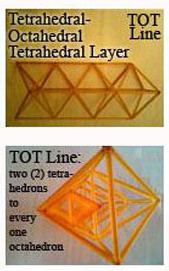
2. Geometries. We imputed a pervasive, simple geometry throughout the universe. This project started within our high school geometry classes by going inside the simple tetrahedron by dividing the edges by 2 and by connecting those six new vertices. We could see four half-sized tetrahedrons in each corner and an octahedron perfectly in the middle. We then went inside the octahedron; there we found six half-sized octahedrons in each corner and a tetrahedron within each face. Our geometry classes were exploring the question, “How far within could we go by continuously dividing by 2 each tetrahedral-octahedral layer?” Then we asked, “How far out can we go by continuously doubling what we had?” With just these two Platonic solids, we could tile and tessellate each layer and between layers or doublings throughout the entire model. We learned about the limits in both directions and we have begun learning about this progression called base-2 exponential notation.

Our initial structures were all three-dimensional. When we found many two-dimensional plates across all the notations, coherence throughout the universe seemed possible.

The cross-notational plates were quickly recognized within nature. The one with just hexagons was an easy analogue of graphene. Within manifold geometries, the analogue would be to fullerenes.

Although there is no evidence that these analogical constructions exist within every layer, we imputed, hypostatized, or hypothesized that in some manner of speaking, such analogues do exist, especially within the first 60 doublings. We could then ask the question, “Given this ubiquitous, four-dimensional web (continuum, matrix, grid), why does the universe work in the manner that it does?” In looking for answers, we have begun to see a means to attract, relate, bind, break or repel constructions within each, and between each, of the 201+ layers.

3. Logic. Our current chart redefines the continuity function to start with the infinitesimally small measurements, the base Planck units, and go out to their largest possible measurements using the Observable Universe and the Age of the Universe as the primary outer limits. Though imputed, this continuity function became our first principle for order in the universe yet it took a period of contemplation of the Big Board-little universe charts and images to begin to see the universe as a natural container for space and time.

As a container with a definitive beginning and current limits, the weight of logic seems to favor the conclusion that the universe is finite. That quickly raises questions about the infinite, such as, “If it is not defined by space and time, how is it defined?”

Within the tilings and tessellations of our pervasive-but-simple geometries and with our base-2 expansion from the base Planck units, we began finding an extraordinary diversity of possible symmetries and potential relations. We asked, “Could symmetry-making and symmetry-breaking through time be the basis for all dynamics? Could the illusive harmony be a perfection of those symmetries within a moment in time?” Unto itself, this logic seemed to become its own system of value and for valuations.” Perhaps the very nature of space and time is derivative; and order, relations, and dynamics and their three functional qualities — continuity, symmetry and harmony — somehow constitute the infinite and are infinite.”

This simple logic became an important building block to postulate our first principles. Our charts had become a model of the known and a largely-unknown, infinitesimally-small universe.

Who? What? Why? When? Where? How?

4. History. This highly-integrated view of the universe must now be tested within the history of logic, mathematics, philosophy and physics. If this embryonic model is to have a place within the work of scholars, it must be critically analyzed. And, we know it has a long way to go before it earns such a place within scholarship. It must address very basic related questions about duality, finite and infinite sets, group theory, set theory, then advanced mathematical concepts that seem to be necessarily related like advanced combinatorics, matroids, amplituhedrons, and the Buckingham pi theorem. Like breadcrumbs, these topics will be followed up in the near future.

We are still within a very young and naive stage in our development and there are many very-very basic questions to explore:

  • Who are the players — the scientists and mathematicians — who are experts within this small-scale domain?
  • What are the “somethings” that are doubling within each notation?
  • Why have these first 65-or-so notations been declared irrelevant by academics? Why haven’t the philosophers and brain-mind scholars explored the possibility that this continuum is the domain of the mind and values?
  • When does simple logic and simplicity itself override experimental data?
  • Where are the indicators that there is a domain that gives rise to gluons, hadrons, and the rest of the particle zoo?
  • How do the doublings of space and time work to become the container within which those “somethings” begin to expand? Could those somethings best be defined by causal set theory, pi, the dimensionless constants, symmetry making, and perfected states?
  • Does the Michaelson-Morley experiment provide insights from their historic quest to define the aether?
  • Does this small-scale domain have anything to do with the continuum (Cyclic Conformal Cosmology) that was proposed by Roger Penrose of Oxford?
  • Is it the matrix or grid that Frank Wilczek (MIT) delineates? Why? How?
  • Could this small-scale universe be all of the above?
  • Thinking about CERN and their current research from quarks to gluons, how does this small-scale universe work in such a manner to give rise to the impeccable successes of the Standard Model (including confirmation of tetraquarks and pentaquarks) as well as the standard model in cosmology (Lamda CDM)?
  • Might this small-scale domain be the basis for homogeneity and isotropy in the universe? How do dimensional analysis and dimensional homogeneity apply?
  • Might this domain be the basis of fundamental interactions giving rise to dark matter and dark energy?

These are some of the subjects (or objects) that occupy our attention and focus our time. “Let’s go over the details just one more time to attempt to learn how this model provides new footings and foundations that could give rise to some of our current perceptions and accepted models and theories.”

Calculations-Measurements-Observations

5. Starting point or domain or … The key question is, “What is being measured by the doubling of each Planck base unit?” Something is being doubled within each notation of those five columns and 201+ notations. First, we assume that Planck’s base units are the singularity (the Void), yet, we now ask, “What happens when each is doubled? What is manifest that doubles?” …only natural units? These are always based solely on universal dimensionless physical constants. But, all of them? Some of them? If so, which come into play and when do they come into play and why do they come into play? There are many books and articles about these constants, however, our primary reference is the 2006 article by Tegmark, Aquirre, Rees, Wilczek (TARW), “Dimensionless constants, cosmology and other dark matters” where they identify 31 dimensionless physical constants (PDF). The Planck Length (space) and Planck Time are two of their 31.

Once we have begun to understand the TARW conceptual frame of reference, we will attempt to take on the other 104 dimensionless constants defined within Wikipedia.

Our short-term work is to begin to understand the published works of an expert with each of these constants. Perhaps we will begin to see how our two base units create a nondimensionalized plenum and vinculum so an “archetype” of mass(kg) and electric charge (q) begin to manifest and we begin to discern how the parameterizing functions of the Planck constant (h) including the speed of light in vacuum (c), the gravitational constant (G), the electric constant (ε0) and the elementary charge (e) as each comes into play. We assume somewhere along our progression of doublings, the fine-structure constant (α) will present itself as will all the other dimensionless constants.

“What is manifest?” First, we have the actual calculations by Max Planck for length, time, mass and electric charge. Questions abound. “How do these manifest? Though infinitesimal, is there a manifestation of something?”

Our first assumption is that the “somethings” could be either simple vertices or what are known as point-free vertices. Part of our on-going study, we are told by Freeman Dyson that we should be using dimensional analysis and scaling laws to count the vertices within base-2 exponential notation; thus, we should be multiplying the number of vertices by 8 with each doubling. If so, there could be eight vertices within the first or second doubling.

With the second doubling we have the simple calculations — multiplying by 2 — of base Planck units of length, time, mass and electric charge. Then we have the scaling number or 64 vertices. To observe this progression, we will eventually make a chart for our base units to the 65th notation.

The first twenty doublings open our analysis. The first eight vertices constitute the first chapter of the story. Theoretically or conceptually, here is the first abiding step to construct and sustain our little universe. Here we will start our analysis with the tools of causal set theory, cubic close packing, Pi, the dimensionless constants, and a perfected state with continuity, symmetry, and an infinitesimally short moment of harmony.

Then the story becomes increasingly complex with each doubling.

Notations: Doubling: Scaling Vertices* (units)(zeroes):
0 0 0
1 2 8
2 4 64
3 8 512
4 16 4096 (thousand) (3)
5 32 32,768
6 64 262,144
7 138 2,097,152 (million) (6)
8 256 16,777,216
9 512 134,217,728
10 1024 1,073,741,824 (billion) (9)
11 2048 8,589,934,592
12 4096 68,719,476,736
13 8192 549,755,813,888
14 16,384 4,398,046,511,104 (trillion) (12)
15 32,768 35,184,372,088,832
16 65,536 281,474,976,710,656
17 131,072 2,251,799,813,685,248 (quadrillion) (15)
18 262,144 18,014,398,509,481,984
19 524,288 144,115,188,075,855,872
20 1,048,576 1,152,921,504,606,846,976 (quintillion) (18)
*Vertices or point-free vertices

With every one of the TARW 31 dimensionless constants, a guess will be made to see what happens to the number within each doubling. We will watch the simple logic of each doubling, especially between the 65th and the 70th doublings. When does that number punch out and become something that is reduced to practice? Or, in what notation does a dimensionless constant combine with anything that is manifest? When is there an apparent effect?

By the 20th notation, our vertex figure using dimensional analysis is up to an exabyte, the same number as 2-to-the-65th or 1.1529 quintillion vertices. We can see therefore that count continues out to 54 places (18 x 3) by the 60th notation. These numbers are so far beyond “large numbers” that it may seem meaningless. Certainly we all need to begin getting accustomed to very large and very small numbers! It seems that we could conclude that with so many vertices there is enough potential structure to contain every part of the Standard Model known to date.

Anything and everything seems possible.

6. Identity: Humanity at the center of this model of the universe. In December 2014, when we tracked the Planck Time next to the Planck Length, we found 201.264+ notations. Our very first chart in December of 2011 had 209 notations. We did not know where to stop. A NASA scientist helped us; he calculated 202.34 notations. Then a prominent French astrophysicist who did a calculation of 205 notations (See footnote 5).

From the 100th to 103rd notations we find sperm, hair, the thickness of today’s paper from a book or magazine, and the human egg, clearly a few of the basics that evolve to become humanity. And, of course, we recognize that there are many other objects within these four notations. Yet, within its simplicity, there was a quiet affirmation, “Perhaps we, the swarming sea of humanity, are not irrelevant. This model places us squarely in the middle of it all.”

7. The small-scale, human-scale, and large-scale Universe. In our chart of the Big Board – little universe there are 201.264+ notations. When divided by three, each scale would ideally have just over 67 notations. Following a longstanding convention within scholarship, we call these groups, the small-scale universe, the human-scale universe and the large-scale universe.

The small-scale universe ranges from the singularity of the Planck base units to notations 67 and 68. Within the 66th and 67th notations, protons, fermions and neutrons are indexed. Leptons, quarks may well be within the 64th and 65th domain. Some posit them at much smaller sizes. But, the measuring tape is mathematics and it is oblique mathematics to be sure. Common elements of the aluminum and helium atoms show up in the 68th notation.

This human-scale universe ranges from the 68th notation to the 135th notation. There have been times when we have been boldly speculative, perhaps just imaginative, thinking about the transition from the human scale to the large scale.

The large-scale universe ranges from the 135th notation to just over the 201st notation. Not just the domain for governments anymore, here the truly imaginative, speculative, and bold have gone where others would fear and tremble.

These three scales provide the second most-simple division of the universe and by studying the transitions between each, we will engage combinatorial mathematics, group theory and set theory in fundamentally new ways. The continuity conditions are redefined. Symmetry functions are expanded. And, there is a possibility of understanding something new about the harmony of the universe (see history of the Greats who used such terms, i.e. Pythagoras, Plato, Aristotle, Kepler, Newton and Leibniz).

We have begun to analyze other progressions or scales based on fourths, fifths sixths, and so on. In time, we may find something of interest.

8. Numbers and Operands (from Sequential Real Numbers, to Base-2 to Dimensional Analysis). We have observed how the simple mathematics of both base-2 exponential notation and dimensional analysis become unwieldy rather quickly by the 60th and 21st notations respectively. Virtually every day we say, “We need to go over this one more time. It seems that we are missing something.”

First, the notations (doublings or steps) are sequentially ordered, 1 to just over 201. What is that sequence? Is there any possibility that it could be related to the Fibonacci sequence? What is the very nature of addition?

Next, there is multiplication, division, and ratios. A former NIST scientist and mathematics professor at Brown, Philip Davis, cautioned that the circle and sphere are more simple than the tetrahedron. Of course, he is right. We are now learning more about cubic-close packing (ccp) and the world of pi. Within the first notation with its eight vertices, we now know that we have to understand ccp and anticipate that the entire small-scale universe is driven by ccp.

That will be an article in the near future.

At the top of this article is a quote from John Archibald Wheeler who was thinking about the standards for measurement within quantum mechanics. If Pi drives this small scale universe, we know Pi is an irrational number and transcendental number that never ends and never repeats. It gives each construction those qualities and those qualities reflect an essence of quantum mechanics; we know there is a lot to chase down here.

Also, one of the most simple ccp configurations will be the pentastar with seven vertices in the form of five tetrahedrons. There is a 7.38° (7° 21′) gap that we have called squishy geometry as well as quantum geometry; here are degrees of freedom that continue within the icosahedron (20 tetrahedral structure) and the pentagonal dodecahedron (60 tetrahedral structure). What is it all about? We are not sure, but we do know it is worth more study.

There are many notations as those Planck base units are being multiplied by 2, that raise questions. We say, “There are doctoral dissertations in there!” It is within our scope of work. Then it came time to ask, “What has over a quintillion units of something?” Today, we have answered, “Vertices or point-free vertices.” Are there any other possibilities?

What are the key operands? It seems that a vertex is a reasonable answer. It is a special kind of point defined by axioms, and these have no “…length, area, volume, or any other dimensional attributes.” Yet, within our logic these points give functional capabilities to continuity, symmetry and harmony. And, these points have within them the conditions for order, relations and dynamics.

We take the universe as a whole, just as it is given; however, we assume that it is all complete, integrated, where the historic is the current, the here and now.

Thank you.

BEC

Afterthoughts:

  • At some notation, the geometries, logic, and all the somethings of the universe, must begin sharing a common space and time and as we approach the first doubling, everything shares it. We assume this shared space begins somewhere between the 60th and 67th notation. We call this domain, hypostatic, because it provides a working foundation for everything everywhere for all time. We have also referred to it as a substrate.
  • Of course, these observations, guesses, and working conclusions will be revisited often.
  • The model also works as a simple Science, Technology, Engineering, Mathematics (STEM) tool; it organizes data in a robust way and it opens many new doors for exploration. That seems to be a worthwhile use of our time.
  • Part of this project began in 1979 at MIT.

Endnotes

1. Four key charts and key question:

2. The Platonic Solids: The simple geometries still hold new insights

3. A Simple Logic: Continuity, symmetry and harmony

4. History within Logic, Mathematics, Philosophy, and Physics:

5. Starting Points:

6. Identity: Humanity at the center of this model of the universe.

7. Three Scales of the Universe: Small Medium and Large (more to come)

8. Numbers and Operands (more to come)

_____________

UPDATE: Speed of Light, Planck Units, and Base-2 Exponential Notation

Note:  This article was first published in March 2015.  This version has been updated (2016).

Précis. By using Planck Length-and-Time and the simplest mathematics (multiplication by 2), a speed of light can be determined within all 202 base-2 notations from Planck Time to the Age of the Universe. At one light second, it is off by 1% from the experimental data.

Planck Numbers. These most-fascinating, magical numbers have been questioned since their introduction in 1899 by Max Planck. The place of the Planck Base Units did not become a focus of the scientific community until Frank Wilczek (MIT, Nobel laureate, 2004) wrote a series of articles, Scaling Mt. Planck (Physics Today) back in 2001 and 2002 [1].

Yet, even today, these numbers are still questioned by many.

Looking for some boundary conditions within which to work, a New Orleans high school geometry class used the Planck Base Units as a starting point to construct their model of the universe. Their primary operating assumption was that continuity and symmetry are the foundational concepts for universal constructions. As a geometry class they were looking to see how they could tile-and-tessellate the universe. This group found a bit of a correspondence between data derived from experimentation and data derived purely by mathematical theory using Planck Length and Planck Time.

Their first chart with Planck Time. This chart carried over an error (a notation was skipped between Notations 39 and 40) within the listing of the Planck Length.  That error did not exist in the December 2012 chart of just the Planck Length.  As of February 3, 2016, documents from March 2015 forward are being updated.

By the 142nd doubling the Planck Time is correctly posted as .6011 seconds. At the 143rd doubling, it is 1.2023 seconds. In between the two is a single second. In the corresponding column, the Planck length incorrectly reported within the 142nd doubling to be 180,212.316 kilometers and by the 143rd  to be 360,414.632 km. Using the wrong length figure to do the calculation resulted in a number very close to the distance light travels in a second. In actuality, instead of 299,773.654587, that figure without any adjustments would be…

Back to the drawing boards.

There are three facts of mathematics that were particularly noted in the process of developing this base-2 chart of the basic Planck Units to their largest known values, particularly the Age of the Universe and the Observable Universe.

Fact 1: The universe can be contained within 201 to 202 doublings of the Planck Length and the Planck Time [4].  An initial fact of applied Planck mathematics is that the entire known universe can be ordered in 201 to 202 necessarily-related groups by using base-2 exponential notation. The chart is simple to calculate; it was a project that started in a high school geometry class. Unlike Kees Boeke’s base-10 work in 1957 (also in a high school), this chart begins with the Planck Units and gets its order through the Planck Units and the base-2 progression as well as the observed-and-imputed, simple, embedded geometries [5] which adds another dimension of order, i.e. symmetry.

Fact 2: Between notations notation 142 and 143 is a light second.

Experimentally defined over the years [6], here if we were to use the Planck Length as the determinant, light would be quite slow between the 142 and 143 notation. There will be three charts studied.  As noted above, the original with the mistake will be preserved within the Small Business School website.  The page with the correction from February 3, 2016 will be preserved as the “initial correction.”  Additional charts will be constructed whereby a simple logic is imputed whereby adjustments are made to the model so experimentally-defined data is introduced. The small-scale and human-scale notations are in some manner of speaking archetypal.  At one second we are looking at the raw universe just one second old. If the entire universe is dynamically adjusting itself, nothing is static, all notations are dynamic and active, we can begin to hypothesize at which notation the light makes its appearance and at which notations light begins to speed up.

Fact 3:  Either the Known Universe may not be as old as it has been calculated to be and it is not as large as it is thought to be, or it is much older than it is calculated to be, and/or one (or more) of the initial Planck calculations is off,  and/or there is more to learn about the nature of light. There are many more “and/or” scenarios that we can intuit.

Around notation 202 is the estimated Age of the Universe [8].

Though as noted earlier, the Planck Base Units were virtually ignored until MIT professor Frank Wilczek began his earnest study of them in Physics Today (June 2001) [9].  C. Alden Mead, who upon reading the Wilczek article commented in the “Letters” section about his work back in 1959 that argued for the use of the Planck Length. Wilczek acknowledged that Mead had been the first pioneer to advocate for the use of the Planck Length [10] as part of experimental data.

It also seems that this approach of the New Orleans high school geometry class is a first.   Senior editors of Wikipedia told them that they could not publish an article on their site because it was “original research.” Though they readily admit that this work is rather idiosyncratic, they have persevered since December 2011. Using base-2 exponential notation first they found no less than 201 doublings or groups. By dividing the entire scale in half, they found themselves in the middle of the Human Scale universe. By dividing in thirds, there was a natural division between the small-scale, human-scale, and large-scale universe. Within each scale and within each group, they know that there is much more to be uncovered. They have just started to open this door and are working to discover more.[11]

In 2002, Wilczek reflects, “It therefore comes to seem that Planck’s magic mountain, born in fantasy and numerology, may well correspond to physical reality.” [12]   Here the students and their teacher conclude, “The space-time continuum is really real even when using discrete steps.”

References:

[10] http://ctpweb.lns.mit.edu/…/Alden-Repsonse323.pdf From American Institute of Physics, New York, NY, PHYSICS TODAY, S-0031-9228-0111-220-2, 2001 p15

Pi equals 3.1415926535897932384626433832795028…

Pi-unrolled-720.gif

An arc of a circle with the same length as the radius of that circle corresponds to an angle of 1 radian.

A full circle corresponds to an angle of 2π radians.

3.14159265358979323846264338327950288419716939937510

  1. Pi is a constant.
  2. Pi is an irrational number.
  3. Pi is a transcendental number.
  4. Pi is a non-repeating number – no pattern has been identified using computer analysis within over twelve trillion places.
  5. Pi ( π ) is the exact ratio of the circumference of a circle to its diameter.   It is that simple.

Thank you, Wikipedia, for the graphics (above) that demonstrate this simple definition.  There are over 45 Wikipedia articles about pi.

So, what do you make of it?  What is going on?

Perhaps a few more questions and comments would help.

  1. What is it about a circle and sphere that pi is always-always- always true?
  2. How does a number become a constant, irrational and transcendental all at the same time?
  3. Let us compare pi to other unique numbers that have a special role among all numbers.  These are e, 0, 1, and I. They are all magical, but π stands out. So, let’s ask, “What are the shared qualities of these numbers?” Let’s study them to see if we can find any necessary relations.
  4. We have the ratio between a circle and a line. Perhaps this is the fundamental transformation between the finite and infinite? Are circles and spheres always implicating or imputing the infinite?

That is a big question and enough to ponder for awhile.

Notwithstanding, there are many more questions to ask.

Some speculations: Pi may be the key to unlock the small-scale universe within the big Board-little universe
1.   To get to the application of pi  within the Planck Units, we’ll need to emerge from the singularity of the Planck Units.  Is the radian a key to understanding this process?  First, a radius is extended from the singularity.  A radius extends into the preconditions for space and time, a now emergent small-scale universe. It makes that first arc equal to its own length.  It does it again and again and again and again and again (six radians) and then makes that last leap, 2 pi, to complete the circle. Is this a reasonable scenario? Why? Why not?

2. We need to run through dozens of scenarios, often, and slowly and carefully.  What scenarios are perfect and obvious?

3. We are at the singularity of the Planck Units.  We are establishing the foundations for the physical world.  If all things start simply, this must be the place to start.  It doesn’t get more simple and more mysterious. Nothing is a mistake, everything comes from a perfection to a space-time moment, so what could possibly happen?

What happens within the first six doublings?    (to be continued)

For further discussion:
1.  Is the Small-scale Universe the basis for the homogeneity and isotropy of space and time?
2.  Does everything in the universe share some part of the Small-Scale universe?
3.  How is Planck Temperature calculated?  Does it begin with the other Planck Units and expand from that figure at the first notation?

Note:  All of human history has occurred in the last doubling.  Yet, all doublings remain active and current and dynamic.  Continuity trumps time. Symmetries trump space.

What does sleep have to do with anything?  If all time is current, within the moment, we particularize by the day and uniquely within a given waking day.  Sleep seems to bring us into the infinite.  Dreams seem to be the helter-skelter bridge between the finite and infinite.  It seems that these naïve thoughts are worth exploring further.

This Shifting Paradigm Changes Our Perception Of Everything

Editor’s note:  This page was first posted within Small Business School, a television series that aired for over 50 seasons on PBS-TV stations (1994-2012).  It is the author’s business website, so many of the links go to that Small Business School website.    Eventually all links will be redirected to pages within The Big Board – little universe Project.

***

Background: Our study of the Planck Length to the Observable Universe began formally on December 19, 2011. Though we thought about the matrix from the Planck Time to the Age of the Universe, it took until December 8, 2014 to add it the Planck Length chart. Logically, but non-intuitively, the two tracked well together. Based on that work, we started looking at our own foundations for understanding first principles, universals and constants.

First, our television series began in 1994 based on first principles (linked from here). These were a direct reflection of our faith and our belief that faith and science must cohere or one of them is wrong.

Second, we used those first principles in all that we have done. That’s how one knows the first principles work. Yet, eventually, those first principles inform in new ways. It is not automatic. It takes time. But, there is always a next step. We can always improve on the initial conditions.

Third, we all need to extend our principles globally, then extend them throughout the universe. That drove our work on the Big Board-little universe back which started in December 2011.And oddly enough, we can now see how such principles just might become the core of a new small business revolution.

Here is a paradigm shift that just might change our perceptions of everything.

1. The Universe appears to be finite. That’s huge. It has measurable smallest units for space and time. It has measurable units for the largest dimensions of space and time, the Observable Universe and the Age of the Universe, respectively.More

2. The Universe has an ethical bias. Yes, hard to believe, but it seems to be true. If so, the theological among us have some very real work to do because theology will be informed by science and science will actually be informed by theology. And, those within radical Islam will learn that they still have much to learn from their Allah and our science!

3. The Universe is smaller and more ordered than we think.In 202+ steps, you go from the smallest measurement to the very largest.Initially it sounded ridiculous and it seemed inconceivable, yet over time, it sinks in.

4. The Universe is more connected than we think. In fact, everything is related to everything, all within 202+ steps! Seems impossible; it’s not.

5. The Universe gets structure from space-and-time, but not its essence. The structures go back to basic geometries that have become exquisitely complex (Also, see reference #4). One might conclude that the essence of that structure comes from the Infinite through our constants and universals which appear to be best engaged through the Planck Units.

Now, with all these references, we now say, “Let’s get focused; there are great things to do to get us all on track for a brilliant future.”

Part II: The Finite and the Infinite

There is “The Observable Universe” (and everything within it) and then there is Beyond All Space and Time  (link goes to Part I: First Principles)   Author: Bruce Camber.

1.  Introduction

After three years of reflection on our Universe View,  I wrote up yet another summary listing of some of the steps we had taken since December 19, 2011. On that December day, as those five classes were happening, it seemed like we had gone through a door that had not been opened. I wondered, “Why can’t we find any discussions about this simple structure of our universe?”  Beyond a simple ordering system based on the nested geometries of octahedrons and tetrahedrons, it seemed like it could have other useful applications. Nevertheless, my precautionary instincts kicked in. We would go slowly. Our work would be incrementalism at best. Plus, it has been difficult to get solid feedback.  In these days there seems to be a bit of fear of being wrong.

We asked, “How can it be wrong especially if it’s based on such simple logic, simple math, and simple geometries?” Of course, our model became a teaching tool.  It involved science, technology, engineering and mathematics, four of the cornerstones of invention and innovation. We imagined that the worst thing that could happen is being faulted for being overly simplistic.

So what?

The stakes are obviously very high. Our world is coming apart at its seams simply because there is no compelling integrative system of understanding of the sciences, the world’s theologies, and the diversities within the human family and her cultures.

Yet, we all share great commonalities that start from conception and birth.

What happens to us?

As a very little baby, each of us quickly learns there is a “You” and a “Me.”  There is an object out there and there is a subject in here. The emphasis is usually all about the “Me” so much so it has become a common expression in the culture, “It’s all about me.”  Narcissism is all about Me. Barack Obama is all about Me. Vladimir Putin is all about Me. Throughout history leaders are often clearly narcissistic and it is usually quite obvious these models ultimately do not work very well.

2. History Lessons: The Subject-Object problem is as old as history.

Which is more fundamental, the Subject or the Object?  The question has been debated in some form for millennium. It is only in this century and in this time that we can finally break through this historic problem.  We have to.  It seems that human survival is dependent on it.

From 1973 through 1980 I worked with a professor who uniquely focused on the Subject-Object problem.   His focus was on the hyphen between the Subject-and-Object.  He would say things like, “The relation is the primary real and space and time are derivative.”

But again, how so? So what?

If we add the words, “The relation is the primary real between the Finite and the Infinite and space and time are derivative,” we begin getting closer to being able to explore the question, “How does all that work?”

First, we could observe that our relatively new Universe View with its 205+ notations, now called our Universe Table, has taken all of space and time and put the two into a finite container. It necessarily brings the Infinite into the equation yet also appears to puts the Infinite out of reach. That could be controversial, however, it is not out of reach.

3. Constants, Universals, and Reality

The universals and constants seem to provide a bridge between the two.  The universals and constants seem to exist independent  of all space and any time yet also seem to be necessarily dependent  on all space and all time.

Also, along our path we discerned that the 205+ exponential notations imposed a simple ordering scheme.  The notations impose a certain continuity within the universe. The simple geometries within this scale impose an inherent structure that has both symmetries and asymmetries. As the two create relations, the ;door opens to an actual   time or applied time (historic time) and there are dynamics that have a certain harmony and an abundance of dynamics that are clearly dissonant.

Using just this schema alone, we then discerned that these categories imposed an inherent value chain within the very being of science, theology, business and culture.  If order / continuity, relations / symmetry and dynamics / harmony were taken as our first-phase definition of Infinity, it seemed as though we were able to duck under the most specialized language of science – theology – business – culture yet use language that is applicable to all four.

We believe that these three groups are the most simple perfections of form / function.

So what do we do with it?

4.  Perhaps the beginning of a breakthrough:  Could all of life be a ratio?

In December 2013 I sent a note out to an online group called the Polyhedrons.  Mostly mathematicians, and most geometers within that group, they are quite sophisticated and often I barely understand what they are discussing.  Yet, I wanted some feedback on our little project and now we had a student who had entered his work on the Universe Table into the National Science Fair.

Of the few responses, one came from Steve Waterman, a geometer-mathematician who in the 1990s defined an entirely new class of Polyhedron.   Yet, within his voluminous website, he especially wanted us to focus on his work with the constants.  One of the leading global arbiters of scientific constants is the US National Institute for Science & Technology (NIST).  In March 2014, after a few lengthy conversations about how NIST defined these constants (over 300) and how the same constants could be generated through ratios of any number of combinations of constants, I finally began to grasp the extraordinary thing that Steve Waterman has done.

His work is so profound it took awhile to sink into my thick skulls.  I had to have some confirmation that I wasn’t racing ahead to erroneous conclusions.  I contacted a Brown University professor of mathematics, a former NIST scientist, and the author of several basic books about the foundations of mathematics.  He brushed it aside, ” There are always people who wish to sum up or create the world using a few principles. But it turns out that the world is more complicated. At least that’s my opinion”

Of course, he is right.  And de facto, we fall into the group that he has criticized.  Yet, with our simple starting points, we have discovered an exceeding complex universe within relatively simple domains.

There is something more going on here.

If we add the three ratios together, 1/3 + 1/3 + 1/3 we get 1.  If we calculate the ratio and add them together we get .999999+.  Something is lost.  In a dynamic tension, we get wholeness.  When we look at the parts as an object, .33333+ we lose something and the result is slightly off.

NIST lists 335 constants ; all have been defined as a ratio in much the same way Planck calculated his constants.  Reducing them to a number, an actual size that corresponds with the NIST measurements, gives us a few clues as to how things are ordered, key components of the relations, and a door to explore the functionalities in the transformations from one notation to the next.

There is a lot of work to do here and as of this writing, all 300+ NIST constants are now in the pipeline for scrutiny and analysis.

What do you think?

Planck Time to the Age of The Universe alongside Planck Length to The Observable Universe

Early in December 2014 we started this page to follow-up that earlier work on just the Planck Length. We began that effort three years earlier (December 2011) in our local high school’s geometry classes. Because we will continue to find obvious errors (from simple mathematics to our interpretation) of the chart below, this page will be subject to frequent updates.

Background: We had been asking around the scholarly community, “Has anyone done a progression of the Planck Time to the Age of the Universe using base-2 exponential notation (a fancy way of saying, multiplying by 2)?” We did it from the Planck Length to the Observable Universe and had wanted to compare that progression to Planck Time.

Going from the smallest to the largest is a simple ordering logic. Using Max Planck’s smallest possible measurements to go to the known limits seems like an exercise high school students should do.

Here we introduce the simple math from the Planck Time to the Age of the Universe.

In July 2014, Prof. Dr. Gerard ‘t Hooft and Stefan Vandoren published a very helpful book, Time in Powers of Ten, a base-10 chart. We were looking for a base-2 chart which would be 3.333+ times more granular. We could not find it anywhere so this page is our working draft, our starting point.

Perhaps it goes without saying… as you read this note, I appeal to you to ask questions and make comments and suggestions. Thank you. –Bruce Camber

Planck Time is the smallest possible unit of measurement of time. The ratios of all 201+ multiples of the Planck Time to its respective multiple of Planck Length is consistent across the chart.  The original calculations were done by Max Planck in and around 1899. This chart of 201+ notations was done in December 2014. Any numbers smaller than the Planck Time are just numbers that cannot be meaningfully applied to anything.

Planck got his Nobel Prize in 1918 for his discovery of energy quanta. He was also a mentor and friend of Einstein (who received his Nobel Prize in 1921).

The Planck Length and Planck Time are actual values that can be multiplied by 2.
Of course, if one were to multiply each by 2 over and over again, you can assume that you would reach their outer limits. That process looks a bit tedious. After all, the Age of the Universe is somewhere over 13.8+ billion years and the Observable Universe is millions of light years from common sense. Yet, rather surprisingly, to complete that effort doesn’t require thousands of doublings. It is done in somewhere just over 201+ doublings.

That is so surprising, the doublings for both are charted below.

These doublings do kind-of, sort-of end up in sync. Where there is a problem, we assume it is within our simple math. Considering the duration and the length, and the nature of very large measurements, for all intents and purposes, they are synced mathematically. We’ve got a bit of work to do to sync them up intellectually!

Though these charts will be tweaked substantially, the best place to start is at the notations (or doublings) that define a day, a week and a year (in Planck Time units) to see how each corresponds with the distance light travels in Planck Length units, i.e. a light year, “light week,” and “light day.” These are our first baby steps of analysis. How many hundreds of steps are there to go to discern all the faces of its meaning? Who knows? From here, we will continue to look to see what meaning and relation evolves at a particular notation where one column appears to impart value to the other. Just on the surface, this chart seems to suggest that there are other possible views of the nature of space and time where order (sequence), continuity, symmetries, and relations seem to play a more fundamental role.

Science and our common sense worldview assume the primordial nature of space and time. As a result of our work with the Planck Units, we hold that conclusion up for further inspection. How do things appear as one begins to approach a synchronized Planck Length and Planck Time?

Planck Units: As we add more Planck Units to this chart, what else might we see? What might we learn? So, we will add mass, electric charge, and temperature to these listings. And then, we’ll add the derived Planck Units (12) and then ask, “Is there anything more we can do to establish a range from the smallest to the largest? What might a comparative analysis at each doubling reveal to us?” We don’t know, however, we are on a path to explore! We’ll report in right here.

At this point, we are attempting to learn enough to make a few somewhat educated guesses about the nature of things within these scales of the universe.

So, as a result of where we are today, I think it is okay to ask the question, “What would the universe look like if space and time were derivative of order-continuity and relation-symmetry, and of ratios where the subject-object are constantly in tension?”

This stream of consciousness continues at the very bottom of this chart.

Planck Time Doublings:
Primarily in Seconds
Planck Length Doublings:
Primarily in Meters
204

The Age of the Universe:
13.78 to 13.8 billion years

It appears that we currently live in the earliest part of 201 doubling.

Observable Universe: 8.8×10(26) m Planck Multiple: 8.31×1026 m

4.155×1026 m Future Universe

203 6.9309178×10¹⁷ seconds (21.9777+ billion years) 2.077×1026 m Future Universe
202 346,545,888,147,200,000 seconds (10.9888+ billion years) 1.03885326×1026 m Observable Universe
201 173,272,944,073,600,000 seconds (5.49444+ billion years) (1017) 5.19426632×1025 m
In this model: Time is discrete so to know how many years are to be aggregated (to see how close we are to the Age of the Universe), each notation must be added together. By the 200th notation, we would be one Planck Time unit shy of 10.9888 billion years. A possible conclusion could therefore be that we are within the 201st notations.
200 86,636,472,036,800,000 seconds (2.747+ billion years) 2.59713316×1025 m
199 43,318,236,018,400,000 seconds (1.3736+ billion years) 1.29856658×1025 m
198 21,659,118,009,200,000 seconds (686.806+ million years) 6.49283305×1024 m
197 10,829,559,004,600,000 seconds (342.4+ million years) (1016) 3.24641644×1024 m
196 5,414,779,502,320,000 seconds (171.2+ million years) 1.62320822×1024 m
195 2,707,389,751,160,000 seconds (85.6+ million years) 8.11604112×10²³ m
194 1,353,694,875,580,000 seconds (42.8+ million years) (1015) 4.05802056×10²³ m
193 676,847,437,792,000 seconds (21.4+ million years) 2.02901033×10²³ m
192 338,423,718,896,000 seconds (10.724+ million years) 1.01450514×10²³ m
191 169,211,859,448,000 seconds (5.3+ million years) (1014) 5.07252568×10²² m
190 84,605,929,724,000 seconds (2.6+ million years) 2.5362629×10²² m
189 42,302,964,862,000 seconds (1.3+ million years) 1.26813145×10²² m
188 21,151,482,431,000 seconds (640+ thousand years) 6.34065727×10²¹ m
187 10,575,741,215,500 seconds (320+ thousand years) (1013) 3.17032864×10²¹ m or 3 Zettameters or 310,000 ly
186 5,287,870,607,760 seconds (160+ thousand years) 1.58516432×10²¹ m or about 150,000 ly (1.5z)
185 2,643,935,303,880 seconds (83.7+ thousand years) 7.92582136×10²⁰ m
184 1,321,967,651,940 seconds (41.8+ thousand years) (1012) 3.96291068×10²⁰ m
183 660,983,825,972 seconds (20.9+ thousand years) 1.981455338×10²⁰ m
182 330,491,912,986 seconds (or about 10,472.9 years) 9.90727664×10¹⁹ meters
181 165,245,956,493 seconds (1011) 4.95363832×10¹⁹ m
180 82,622,978,246.4 seconds 2.47681916×10¹⁹ m
179 41,311,489,123.2 seconds 1.23840958×10¹⁹ m
178 20,655,744,561.6 seconds 6.19204792×10¹⁸ m
177 10,327,872,280.8 seconds (1010) 3.09602396×10¹⁸ m
176 5,163,936,140.4 seconds 1.54801198×10¹⁸ m
175 2,581,968,070.2 seconds 7.74005992×10¹⁷ m
174 1,290,984,035.1 seconds (109) 3.87002996×10¹⁷ m
173 645,492,017.552 seconds 1.93501504×10¹⁷ m
172 322,746,008.776 seconds 9.67507488×10¹⁶ m
171 161,373,004.388 seconds (108) 4.83753744×10¹⁶ m
170 80,686,502.194 seconds 2.41876872×10¹⁶ m
169 40,343,251.097 sec (466 days)(Note: 31,536,000 s/year) 1.20938436×10¹⁶ m
Comments: A light year is about 9.4605284×10¹⁵ meters (Google) or 9,460,730,472,580,800 metres “exactly” (Wikipedia). Use the Gregorian calendar (circa 1582) where a year is 365.2425 and the speed of light is given as 299,792,458 metres/second, the calculation is 365.2425 times 86400 seconds/day (or 31556952 seconds/year) times 299,792,458 meters/second or 9.4605362+×1015 meters. Discrepancies would become quite large at the size of the Observable Universe and the Age of the Known Universe.Using Planck Units:
One Light Year 9.45994265715×10¹⁵m
168 20,171,625.5485 seconds (233.468 days) 6.0469218×10¹⁵ m [one light year (ly) is 9.4×10¹⁵ m]
167 10,085,812.7742 seconds (116.73 days) (107) 3.0234609×10¹⁵ m
166
166 5,042,906.38712 seconds (58.36+) 1.5117305×10¹⁵ m
165 2,521,453.19356 s (29.1835 days) 7.55865224×10¹⁴ m
164 1,260,726.59678 s (14.59+ days) (106) 3.77932612×10¹⁴ m
163 630,363.29839 s (7.29+ days) 1.88966306×10¹⁴ m (about 7-day light travel)
162 315,181.649195 seconds (3.64794 days) 9.44831528×10¹³ m
161 157,590.824 s (1.82 days) (105) 4.72415764×10¹³ m
160 78,795.4122988 s (.911984 days) 2.36207882×10¹³ m (or close to 24-hour light travel)
159 39,397.7061494 seconds 1.18103945×10¹³ m
158 19,698.8530747 seconds (104) 5.90519726×10¹² m
157 9849.42653735 seconds 2.95259863×10¹² m ()
156 4924.71326867 seconds(3600 s in hour) 1.47629931×10¹² m
155 2462.35663434 seconds 738,149,657 kilometers 1011
154 1231.17831717 seconds (103) 369,074,829 kilometers 1011
153 615.589158584 seconds (10.259+ minutes) 184,537,414 kilometers 1011
152 307.794579292 seconds 92,268,707.1 kilometers (range of earth-to-sun)1010m
151 153.897289646 seconds (102) 46,134,353.6 kilometers 1010
150 76.948644823 s (16+ sec over 1 min) 23,067,176.8 kilometers 1010
Comments: A light minute is, of course, sixty times 299,792.458 km/second. Again, using simple mathematics, the distance light travels in one minute is 17,987,547.48 which is about 1000 kilometers off of 17,986,420.0329 km/second using the simple mathematics of this chart. This difference will be further analyzed.
149 38.4743224115 s (21.53 sec to 1 min) 11,533,588.4 kilometers 1010
148 19.2371612058 seconds 101 5,766,794.2 kilometers 109
147 9.61858060288 seconds 2,883,397.1 kilometers 109
146 4.80929030144 seconds 1,441,698.55 kilometers 109 m
145 2.40464515072 seconds 720,849.264 kilometers 108
144 1.20232257536 s (1s ≠ perfect tp multiple)
One Second:
360,424.632 kilometers 108 meters
Speed of light equals 299,792,458 m/s
Comments: Science knows experimentally that light travels 299,792.458 km/second (a light second). A Planck Time multiple, either 1.202 seconds or .6011 seconds, could be used as a standard unit of time that is based on a theoretical constant. We will explore further the calculations for a day, week, month and year based on such a system. We’ll also explore it in light of recent work to define the theoretical chronon.
A Light Second 299,792.458 km
143 6.0116128768×10⁻¹ seconds 180,212.316 kilometers (111,979+ miles) 108 m
142 3.0058064384×10⁻¹ seconds 90,106.158 kilometers 107 m
141 1.5029032192×10⁻¹ seconds 45,053.079 kilometers 107
140 7.514516096×10⁻² seconds 22,526.5398 kilometers 107
139 3.757258048 × 10⁻² seconds 11,263.2699 kilometers or about 7000 miles
138 1.878629024 × 10⁻² seconds 5631.63496 kilometers 106
137 9.39314512 × 10⁻³ seconds 2815.81748 kilometers 106

The transition from the Human-Scale to the Large-Scale Universe

136 4.69657256 × 10⁻³ seconds 1407.90874 kilometers (about 874 miles) 106 m
135 2.34828628 × 10⁻³ seconds 703.954368 kilometers 105
134 1.174143145978 × 10⁻³ seconds 351.977184 kilometers (218.7 miles) 105
133 5.8707157335 × 10⁻⁴ seconds 175.988592 kilometers (109.35 miles) 105
132 2.93535786675 × 10⁻⁴ seconds 87.994296 kilometers 104
131 1.46767893338 × 10⁻⁴ seconds 43.997148 kilometers 104
130 7.33839466688 × 10⁻⁵ seconds 21.998574 kilometers104
129 3.66919733344 × 10⁻⁵ seconds 10.999287 kilometers or within 6.83464 miles 104
128 1.83459866672× 10⁻⁵ seconds 5.49964348 kilometers 103
127 9.1729933336 × 10⁻⁶ seconds 2.74982174 kilometers 103
126 4.5864966668 × 10⁻⁶ seconds 1.37491087 kilometers 103
125 2.2932483334 × 10⁻⁶ seconds 687.455439 meters 102
124 1.1466241667 × 10⁻⁶ seconds 343.72772 meters or about 1128 feet 102
123 5.73312083348 × 10⁻⁷ seconds 171.86386 meters or about 563 feet 102
122 2.86656041674 × 10⁻⁷ seconds 85.9319296 meters 101
121 1.43328020837 × 10⁻⁷ s 42.9659648 meters 101
120 7.16640104186 × 10⁻⁸ sec 21.4829824 meters 101
119 3.58320052093 × 10⁻⁸ sec 10.7414912 meters or 35.24 feet or 1.074×101 m 101
118 1.79160026046 × 10⁻⁸ seconds 5.3707456 meters 100
117 8.95800130232 × 10⁻⁹ seconds 2.6853728 meters or 105.723 inches 100
116 4.47900065116 × 10⁻⁹ seconds 1.3426864 meters or 52.86 inches 100
115 2.23950032558 × 10⁻⁹ seconds 67.1343176 cm (19.68+ inches or 6.71×10⁻¹
114 1.11975016279 × 10⁻⁹ seconds 33.5671588 centimeters or 3.356×10⁻¹ m)
113 5.59875081396 × 10⁻¹⁰ seconds 16.7835794 centimeters or 1.6783×10⁻¹
112 2.79937540698 × 10⁻¹⁰ seconds 8.39178968 cm (3.3+ inches or 8.39×10⁻² m)
111 1.39968770349 × 10⁻¹⁰ seconds 4.19589484 centimeters 4.19589484×10⁻² m
1109 .99843851744 × 10−11 seconds 2.09794742 centimeters or 2.0979×10⁻² m
1098 3.49921925872 × 10⁻¹¹ seconds 1.04897 centimeters or 1.04897375×10⁻² m
108 1.74960962936 × 10⁻¹¹ seconds 5.24486856 mm (about 1/4 inch) or 5.24×10⁻³ m
107 8.7480481468 × 10⁻¹² seconds 2.62243428 millimeters or 2.62243428×10⁻³ m
106 4.3740240734 × 10⁻¹² seconds 1.31121714 millimeters 1.31121714×10⁻³ m
105 2.1870120367 ×10⁻¹² seconds .655608568 millimeters or 6.55608568×10⁻⁴ m
104 1.09350601835 ×10⁻¹² seconds .327804284 millimeter or 3.27804284 x10⁻⁴ m
103 5.46753009176 ×10⁻¹³ seconds .163902142 millimeters or 1.63902142×10⁻⁴ m
102 2.73376504588 × 10⁻¹³ seconds 81.9510712 microns or 81.9510712 x10⁻⁵ m
101 1.36688252294 × 10⁻¹³ seconds 40.9755356 microns or 4.09755356 x10⁻⁵ m
100 6.83441261472 × 10⁻¹⁴ seconds 20.4877678 microns or 2.04877678×10⁻⁵ m
99 3.41720630736 × 10⁻¹⁴ seconds 10.2438839 microns or 1.02438839×10⁻⁵ m
98 1.70860315368 × 10⁻¹⁴ seconds 5.12194196 microns (.0002+ inches or 5.12×10⁻⁶ m)
97 8.5430157684 × 10⁻¹⁵ seconds 2.56097098 microns or 2.56097098×10⁻⁶ m
96 4.2715078842 × 10⁻¹⁵ seconds 1.28048549 microns or 1.2804854×10⁻⁶ m
95 2.1357539421 × 10⁻¹⁵ seconds 640.242744 nanometers 6.40242744×10⁻⁷m
94 1.06787697105 × 10⁻¹⁵ seconds 320.121372 nanometers 3.20121372×10⁻⁷ m
93 5.33938485524 × 10⁻¹⁶ seconds 160.060686 nanometers or 1.6×10⁻⁷ m
92 2.66969242762 × 10⁻¹⁶ seconds 80.0303432 nanometers or 8.0×10⁻⁸ m
91 1.33484621381 × 10⁻¹⁶ seconds 40.0151716 nanometers or 4.0×10⁻⁸ m
90 6.67423106904 × 10⁻¹⁷ seconds 20.0075858 nanometers or 2.0×10⁻⁸ m
89 3.33711553452 × 10⁻¹⁷ seconds 1.00037929×10⁻⁸ meters or 10 nanometers
88 1.66855776 × 10⁻¹⁷ seconds (smallest measurement – 2010) 5.00189644×10⁻⁹ meters
87 8.34278883632 × 10⁻¹⁸ seconds 2.50094822 nanometers or 2.50094822×10⁻⁹ m
86 4.17139441816 × 10⁻¹⁸ seconds 1.25474112 nanometers or 1.25×10⁻⁹ m
85 2.08569720908 × 10⁻¹⁸ seconds .625237056 nanometers or 6.25237056×10⁻¹⁰ m
84 1.04284860454 × 10⁻¹⁸ seconds .312618528 nanometers or 3.12×10⁻¹⁰ m
83 5.21424302272 × 10⁻¹⁹ seconds .156309264 nanometers or 1.563×10⁻¹⁰ m
82 2.60712151136 × 10⁻¹⁹ seconds 7.81546348×10⁻¹¹ m
81 1.30356075568 × 10⁻¹⁹ seconds 3.90773174×10⁻¹¹ m
80 6.5178037784 × 10⁻²⁰ seconds 1.95386587×10⁻¹¹ m
79 3.2589018892 × 10⁻²⁰ seconds 9.76932936×10⁻¹² m
78 1.6294509446 × 10⁻²⁰ seconds 4.88466468×10⁻¹² m
77 8.147254723 × 10⁻²¹ seconds 2.44233234×10⁻¹² m
76 4.0736273615 × 10⁻²¹ seconds 1.22116617×10⁻¹² m
75 2.03681368075 × 10⁻²¹ seconds 6.10583084×10⁻¹³ m
74 1.01840684038 × 10⁻²¹ seconds 3.05291542×10⁻¹³ m
73 5.09203420188 × 10⁻²² seconds 1.52645771×10⁻¹³ m
72 2.54601710094 × 10⁻²² seconds 7.63228856×10⁻¹⁴ m
71 1.27300855047 × 10⁻²² seconds 3.81614428×10⁻¹⁴ m
70 6.36504275236 × 10⁻²³ seconds 1.90807214×10⁻¹⁴ m
69 3.18252137618 × 10⁻²³ seconds 9.54036072×10⁻¹⁵ m
68 1.59126068809 × 10⁻²³ seconds 4.77018036×10⁻¹⁵ m

Transition from the Small-Scale Universe to the Human-Scale Universe

67 7.95630344044 × 10⁻²⁴ seconds 2.38509018×10⁻¹⁵ m
66 3.97815172022 × 10⁻²⁴ seconds 1.19254509×10⁻¹⁵ m
65 1.98907586011 × 10⁻²⁴ seconds 5.96272544×10⁻¹⁶ m
64 9.94537930056 × 10⁻²⁵ seconds 2.98136272×10⁻¹⁶ m
63 4.97268965028 × 10⁻²⁵ seconds 1.49068136×10⁻¹⁶ m
62 2.48634482514 × 10⁻²⁵ seconds 7.45340678×10⁻¹⁷ m
61 1.24317241257 × 10⁻²⁵ seconds 3.72670339×10⁻¹⁷ m
60 6.21586206284 × 10⁻²⁶ seconds 1.86335169×10⁻¹⁷ m
59 3.10793103142 × 10⁻²⁶ seconds 9.31675848×10⁻¹⁸ m
58 1.55396551571 × 10⁻²⁶ seconds 4.65837924×10⁻¹⁸ m
57 7.76982757856 × 10⁻²⁷ seconds 2.32918962×10⁻¹⁸ m
56 3.88491378928 × 10⁻²⁷ seconds 1.16459481×10⁻¹⁸ m
55 1.94245689464 × 10⁻²⁷ seconds 5.82297404×10⁻¹⁹ m
54 9.7122844732 × 10⁻²⁸ seconds 2.91148702×10⁻¹⁹ m
53 4.8561422366 × 10⁻²⁸ seconds 1.45574351×10⁻¹⁹ m
52 2.4280711183 × 10⁻²⁸ seconds 7.27871756×10⁻²⁰ m
51 1.21403555915 × 10⁻²⁸ seconds 3.63935878×10⁻²⁰ m
50 6.07017779576 × 10⁻²⁹ seconds 1.81967939×10⁻²⁰ m
49 3.03508889788 × 10⁻²⁹ seconds 9.09839696×10⁻²¹ m
48 1.51754444894 × 10⁻²⁹ seconds 4.54919848×10⁻²¹ m
47 7.58772224468 × 10⁻³⁰ seconds 2.27459924×10⁻²¹ m
46 3.79386112234 × 10⁻³⁰ seconds 1.13729962×10⁻²¹ m
45 1.89693056117 × 10⁻³⁰ seconds 5.68649812×10⁻²² m
44 9.48465280584 × 10⁻³¹ seconds 2.84324906×10⁻²² m
43 4.74232640292 × 10⁻³¹ seconds 1.42162453×10⁻²² m
42 2.37116320146 × 10⁻³¹ seconds 7.10812264×10⁻²³ m
41 1.18558160073 × 10⁻³¹ seconds 3.55406132×10⁻²³ m
40 5.92790800364 × 10⁻³² seconds 1.7770306×10⁻²³m
39 2.96395400182 × 10⁻³² seconds 8.88515328×10⁻²⁴m
38 1.48197700091 × 10⁻³² seconds 4.44257664×10⁻²⁴ m
37 7.40988500456 × 10⁻³³ seconds 2.22128832×10⁻²⁴m
36 3.70494250228 × 10⁻³³ seconds 1.11064416×10⁻²⁴m
35 1.85247125114 × 10⁻³³ seconds 5.5532208×10⁻²⁵m
34 9.26235625568 × 10⁻³⁴ seconds 2.7766104×10⁻²⁵m
33 4.63117812784× 10⁻³⁴ seconds 1.3883052×10⁻²⁵m
32 2.315589×10⁻³⁴ seconds 6.94152599×10⁻²⁶ meters
31 1.15779453196× 10⁻³⁴ seconds 3.47076299×10⁻²⁶m
30 5.78897265978 × 10⁻³⁵ seconds 1.735381494×10⁻²⁶ m
29 2.89448632989 × 10⁻³⁵ seconds 8.67690749×10⁻²⁷ m
28 1.44724316494 × 10⁻³⁵ seconds 4.3384537×10⁻²⁷ m
27 7.23621582472 × 10-36 seconds 2.16922687×10⁻²⁷ m
26 3.61810791236 × 10−36 seconds 1.0846134×10⁻²⁷ m
25 1.80905395618 × 10−36 seconds 5.42306718×10⁻²⁸ m
24 9.045269781089 × 10−37 seconds 2.711533591×10⁻²⁸ m
23 4.522263489044 × 10−37 seconds 1.35576679×10⁻²⁸ m
22 2.26131744522 × 10−37 seconds 6.77883397×10⁻²⁹ m
21 1.13065872261 × 10−37 seconds 3.38941698×10⁻²⁹ meters
20 5.65329361306 × 10−38 seconds 1.69470849×10⁻²⁹ meters
19 2.82646806528 ×10−38 seconds 8.47354247×10⁻³⁰ meters
18 1.41323403264 ×10−38 seconds 4.2367712×10⁻³⁰ m
17 7.0661701632 × 10−39 seconds 2.11838561×10⁻³⁰ m
16 3.530850816 × 10−39 seconds 1.0591928×10⁻³⁰ m
15 1.7665425408 × 10−39 seconds 5.29596404×10⁻³¹ m
14 8.832712704 × 10−40seconds 2.64798202×10⁻³¹ m
13 4.416356352 × 10−40 seconds 1.32399101×10⁻³¹ m
12 2.208178176 × 10−40 seconds 6.619955ƒx10-32 m
11 1.104089088 × 10−40 seconds 3.30997752×10⁻³² m
10 5.52044544 × 10−41 seconds 1.65498876×10⁻³² m
9 2.76022272 × 10−41 seconds 8.27494384×10⁻³³ m
8 1.38011136 × 10−41 seconds 4.1374719232×10⁻³³ m
7 6.9005568 × 10−42 seconds 2.0687359616×10⁻³³ m
6 3.4502784 × 10−42 seconds 1.03436798×10⁻³³ m
5 1.7251392 × 10−42 seconds 5.1718399×10⁻³⁴ m
4 8.625696 × 10−43 seconds 2.58591995×10⁻³⁴ m
3 4.312848 × 10−43 seconds 1.29295997×10⁻³⁴ m
2 2.156424 × 10−43 s The second doubling 6.46479988×10⁻³⁵ meters
1 1.078212 × 10−43 s The first doubling 3.23239994×10⁻³⁵ m The first doubling, step, or layer.
5.39106(32)×10−44 seconds 1.616199(97)x10-35 meters

The Planck Time

The Planck Length

Endnotes:1. We are in the process of refining this chart and will be throughout 2015 and 2016.

2. Our very first calculation with the Planck Length column (December 2011), resulted in 209 doublings! We found several errors. Then , with help of a NASA astrophysicist, Joe Kolecki (now retired), we updated our postings with his calculation of 202.34. Then, a French Observatory astrophysicist, Jean-Pierre Luminet, calculated 205.1 doublings. We are very open to all ideas and efforts! We are studying the foundations of foundations. One might call it a hypostatic science based on the simplest mathematics, simple geometries and observations about the way the universe coheres.

One might say, “The Finite is finite, the Infinite is the Infinite, and the constants and universals describe the boundary conditions and transformations between each. One manifests a panoply of perfections; the other has only momentary instants of perfection.”

Open Questions: Is it possible that Planck Length starts first and Planck Time begins on Planck Length’s 2nd or 3rd notation? Could there be a two for one at the beginning and at the transitions? By using experimental speed of light per second, can we force the Planck units from that point? If the ratio of Length/time is consistent across the grid (and it is), how do we fine tune this chart?

What is a second?

What are Planck Units?

What is time?

What is a meter?

What is length?

What is space?

What happens just before the Planck time at 10-44 seconds? Theorists say that all of the four fundamental forces are presumed to have been unified into one force. All matter, energy, space and time “explode” from the original singularity.

3. Our online “Google” calculator often rounds up the last digit. It is usually beyond the eleventh postion to the right of the decimal point.

4. For more about this place and time, go to Hyperphysics (Georgia State): http://hyperphysics.phy-astr.gsu.edu/hbase/astro/planck.html

5. A copy of this chart has also been published in the following locations:

a. http://walktheplanck.wordpress.com/2014/12/09/base/

b. http://utable.wordpress.com/2014/12/12/planck/

c. http://SmallBusinessSchool.org/page3053.html

d. ResearchGate Documents: 3052, 3054, 3056

Frank Wilczek

First email to 2004 Nobel laureate, MIT physics professor, Frank Wilczek

On Fri, Dec 14, 2012 at 5:40 PM
Bruce Camber wrote:

Dear Prof. Dr. Frank Wilczek:

Back ten days ago, we sent this note through your resources page
within your your website — http://frankwilczek.com/resources.html
It is from five high school geometry classes.

We have a model of the universe and we are not sure what to do with it.

We started with one meter and divided it in half as if it
were an edge of a tetrahedron, and then we continued dividing
in half until we got down in the area of the Planck Length. Later,
we started at the Planck Length and used base-2 exponential notation
to go out the 202+ steps to the edges of the observable universe.
We used Plato’s five basics as an inherent continuity equation and
symmetry function.

It seems too easy, perhaps a bit of poppycock, but we don’t know
why. The question now is how to continue to develop it. Is it a useful
ordering system (STEM project)? Or, could it possibly be more?
We don’t know. After all we are just five high school geometry classes.

Is it just a bit of silliness? Or, might it be useful? We, the kids and
teachers, are anxious to know. We will be having a major discussion about it
next week with all five classes. Thanks. -Bruce

Bruce Camber

Note: We first found you here:
Physics Today, Alden Response PDF
http://frankwilczek.com/resources.html

Could The Planck Base Units Open A Secret Door To A New Universe Of Knowledge?

Five Planck Base Units Science is filled with mysterious numbers that defy logic and explanation. Among them are extremely small numbers that were introduced in 1899. Largely ignored for over 100 years, today these Planck Units have opened a rather magical pathway that has a little potential to become a new study within the sciences. Some might think it is a science of the mind. Though possibly true, it could be much more. (new window).

CurtisHere the old-fashioned thought experiment could become a new art form. A little high school, not far from the levee along the Mississippi River, a little up river from the French Quarter but downriver from the New Orleans airport, has big dreams and plenty of brains-and-brawn. Yet, never did they expect to be the place where base-2 exponential notation from the Planck Length to the Observable Universe and from the Planck Time to the Age of the Universe would be birthed. The fateful day was December 19, 2011, the last day of classes before their Christmas holiday recess and it begged the question, “Could this possibly be the beginnings of a very simple model for everything, everywhere, for all times?” More

For five groups of students who were studying the basic tenets of geometry, a strange thing happened. They saw the entire universe and parts of the unknown universe all at one time, all interrelated on one board, and organized by (1) a simple logic, (2) the Planck Length, (3) simple geometries and (4) simple mathematics (multiplying and dividing by 2). Just over 201 doublings captured our entire known universe. More

Just over 201 notations. What does it mean? What difference does it make? The first insight was that there is a deep-seated order in the universe. The order is imputed. It comes from logic and mathematics not from experimentation and measurement. Although it creates a special continuity from the smallest to the largest measurements of space and time, they can only say for sure, “Here it is,” then ask questions such as “What is wrong with this picture?” Very quickly, fifteen more key questions were raised. Third, also imputed are structural relations that create a diversity of symmetries that literally bind everything in the known universe. That’s quite an achievement unto itself, but it must be defended with facts that have some basis in reality.  More

Hardly intimidated, this group believes that the facts are, by and large, self evident and that there is so much more to discover and learn. More

NewOrleans

Located in River Ridge (a hamlet just downriver from the airport), the Curtis School is well-known among the football quarters, not within  the studies of cosmology and astrophysics. Though there are rumblings and a very small scientific group moving away from the Big Bang Theory, this little  group within the school could land a tackle that suddenly causes this leading intellectual theory to stop in its tracks. If their map of the universe is truly a new domain of science, the human mind may end up taking its rightful place of importance within their grid that begins to redefine who we are and why. More…

That is enough, but there is more.To date, science has had very little to say about values and ethics, You can hear the pragmatists say, “Those are not measurable qualities.” And they would be right, yet here, if the inherent structure of science is order-continuity and relations-symmetry, extended logically, it could become a structure for value and even for a moment of perfection within what appears to be a finite universe. Two symmetries interacting over time, give us the first dynamical moments that have a harmony which unto itself is a compelling infrastructure for valuation and ethics. More…

Also, deep in the heart of this discussion is the place of the finite-and-infinite, and geometry-and-calculus. The old world of geometry gave us a special grounding. Structure was everything. Then, the newer world of calculus came in and slowly began to give us a new sense of change, openness, and a very long vision. People thought they could see forever. Professor Max Planck was 41 years old when he did those special calculations back in 1899. He was 60 years old when in 1918 he received his Nobel Prize for his work to define a quanta of energy. By 1944, now 87 years old, he penned these few special words that could set the stage for a science of the Mind. More

Throughout it all, his precious Planck Units had been virtually ignored. It wasn’t until 2001 before his earlier calculations, now over 100 years old, began to see the light of day. In a series of three articles in Physics Today. Prof. Dr. Frank Wilczek of MIT (Nobel laureate, 2004) acknowledged their presence and potential importance. Finally, the Planck numbers gained a little respect as the conceptual limits on the smallest side of every equation. It seemed to suggest a way to begin to see the universe as a finite place. Rather suddenly Planck’s work gained a solid foothold. Also, science had advanced far enough to begin to suggest that there are upper boundaries as well. For the first time in centuries, the finite was gaining ground; the infinite seemed more ephemeral. The kids had plenty of ideas and comments. “This is a great STEM tool. Science-Technology-Engineering-Mathematics all makes sense here.” Another said, “Let’s keep the small “I” of the infinite so all our atheist friends have something in which to believe so they don’t have to believe.” More

Our “Planck students” soon discovered that they were not alone in their sense that the universe could be reduced to simple, logical working principles. In 1957 in Holland a little-known high school teacher, Kees Boeke, wrote a very short book, Cosmic Vision, The Universe in 40 Jumps. In 1962 a film was made about it and then in 1965 a coffee table book was published. By 2001, the scholarly community had become Boeke.png
familiar with base-10 notation. The River Ridge group was just getting to know him. They quickly acknowledged that Boeke’s book was the very first universe view. But because he only found 40 of 62 base-10 notations, it was dubbed “universe-view light.”Yet, base-10 has an important place in this discovery process and work with it is still being done. In July 2014, Gerard ‘t Hooft and Stephan Vandoren published a book, Time in the Powers of TenOf course, base-2 is much more granular (3.3333 times) and mimics cellular reproduction on one hand and chemical bonding on the other. More importantly, this base-2 work is rooted within the Planck base units and basic geometries where space and time are seen working together throughout the 201+ notations that define our universe. More.

There are several next steps. A few students (and their teacher) speculate:
Let’s make a movie about it that focuses on our most speculative guesses.”
Let’s focus on that small-scale universe and try to figure it out. There are doctoral dissertations in there.
“Let’s get other schools involved and promote this simple model as a powerful STeEM (Science-Technology-[Education]-Engineering-Technology) tool. (A link will be forthcoming)*

Endnote: The following Max Planck quote is currently linked to the place where the source pages are housed in Berlin at a place called the Archiv zur Geschichte der Max-Planck-Gesellschaft: “All matter originates and exists only by virtue of a force which brings the particle of an atom to vibration and holds this most minute solar system of the atom together. We must assume behind this force the existence of a conscious and intelligent mind. This mind is the matrix of all matter.”  From “The Nature of Matter” within the Archiv zur Geschichte der Max-Planck-Gesellschaft, Abt. Va, Rep. 11 Planck, Nr. 1797, 1944

Tiling the Universe In Just Over 201 Exponential Notations: A Great Chain Of Being

Initiated: December 1, 2014  Most recent update: Monday, February 15, 2016

Tetrahedral-Octahedral-Tetrahedral (TOT) couplets tile and tessellate the  universe.1   In earlier writings, we have observed how the Known Universe could be tiled in less than 202 exponential notations or steps, layers, doublings, or domains. ≡

Please note:  Many links will open a new tab or window.

TOT_3.jpg

The TOT Structure2 appears to be the “simplest, strongest, most perfect, interlocking three-dimensional tiling” within the Observable Universe. The TOT can be used to make ball-like structures, clusters, lines, domains or layers.  Here we can find, perfectly-nesting within every possible layer, a great chain of being seemingly suggesting that everything is related to everything throughout the universe.

December 2011: The Start of Our Research Using Base-2 Exponential Notation, Planck Length, And Plato’s Geometries.3  We used very simple math and got simple results yet also found hidden complexities. After doing a fair amount of analysis of our initial results, we continue to make new observations, conjectures and speculations about the forms and the functions within this universe. From all our data and study, it seems logically to follow that this tiling is the first extension of geometry and number (the sequence of notations) in a ratio.

The most simple engaging the most simple: Here may be the beginning of value structure.4 If so, it necessarily resides deep within the fabric of the universe, the very being of being.  Could these very first doublings be the essential tension of creation?

Here simplicity is based on a very simple logic, “Everything starts simply.” 5

NOTE: The TOT as a tiling would be the largest-but simplest possible system that spatially connects everything in the universe.  Yet, even with just octahedrons and tetrahedrons, it is also exquisitely complex; we’ll see the beginnings of that complexity with the many variations of R2 tilings (two dimensional) within this initial R3 tiling (three dimensional).6  Thus, the TOT would also be expanding every moment of every day opening new lines instantaneously. One might say that the TOT line is the deepest infrastructure of form and function. Perhaps some might think it is a bit of a miracle that something so simple might give such order to our universe.

The purpose of this article is to begin to introduce why we believe that this could be so.

Notwithstanding, we acknowledge at the outset that our work is incomplete. By definition tilings are perfect and the TOT tiling is the most simple. In our application these tilings logically extend from the within the first doubling to the second doubling to all 201+ doublings necessarily connecting all the vertices within the universe.

In earlier articles we observed how rapidly the vertices expand7  Yet, that expansion may be much greater once we understand the mathematics of doublings suggested by Prof. Dr. Freeman Dyson,6 Professor Emeritus, Mathematical Physics and Astrophysics of the Institute for Advanced Studies in Princeton, New Jersey. We are still working on that understanding.

We are taking baby steps. It is relatively easy to get a bit confused as to how each vertex doubles. The first ten doublings will begin to tell that story.

And, of course, we are just guessing though basing our conclusions on simple logic.

THE MOST SIMPLE TILING. Using very simple math — multiplying by 2 — the first tetrahedron could be created in the second doubling (4 vertices). Then, an octahedron might be created in the third doubling. That would require six of the 8 vertices. The first group of a tetrahedral-octahedral-tetrahedral chain requires all eight. Today we are insisting on doubling the Planck Length with each notation and to discern the optimal configurations. By the fourth doubling, there could be 16 vertices or six tetrahedrons and three octahedrons. At the fifth doubling (32 vertices), we speculate that the TOT extends in all directions at the same time such that each doubling results in the doubling of the Planck Length respective to each exponential notation.

We Can Only Speculate. We can only intuit the form-functions of this tiling as it expands. And, yes, within the first 60 or so notations, it seems that it would extend equally in all directions. With no less than two million-trillion vertices (quintillion), using our simple math of multiplying by 2, we will see how that looks and begin to re-examine our logic. Again, this tiling is the most simple perfection. And although we assume the universe is isotropic and homogeneous, there is, nevertheless, a center of this TOT ball, Notations 1, 2 and 3.8

That center even when surrounded by no less than 60 layers of notations is still smaller than a fermion or proton.  This model uniquely opens up a very small-scale universe which for so many historic reasons has been ignored, considered much too small to matter.

Nevertheless, it seems to follow logically that this TOT tiling is in fact the reason the universe is isotropic and homogeneous.9

Key Evocative Question from the History of Knowledge and Philosophy: Could this also be the Eidos, the Forms, about which Plato had been speculating? Could this be the domain for cellular automata that John von Neumann, Alan Turing, and others like Steve Wolfram have posited? Here we have an ordering system that touches everything and may well be shared by everything. Within it, there can be TOT lines that readily slide through larger TOTs. There could be any number of cascading and layering TOTs within TOTs.10 (A new image is under development with at least ten layers.  A link will be inserted as soon as we have it.)

A SECOND GROUP OF TILINGS. Within the octahedron are four hexagonal plates, each at a 60 degree angle to another. Each of these plates creates an R2 tiling within the TOTs that is carried across and throughout the entire TOT structure.

These same four plates (R2 tilings) can also be seen as triangle.  There ares six plates of squares. One might assume that all these plates begin to extend from within the first ten notations from the Planck Length, and then, in theory, extend throughout our expanding universe.

Only by looking at our clear plastic models could we actually see these different R2 tilings.

We have just started this study and we are getting help from other school teachers.

Jo Edkins, a teacher in Cambridge, England made our study even more dramatic by adding color in consistent patterns throughout the plate  We can begin to intuit that there could be functional analysis based on such emphases.11

We were challenged by Edkins work to see if we could find her plates within our octahedral-tetrahedral models. We believe we can find most of her tilings within the models.

Within the Wikipedia article on Tessellation (link opens a new window), there is an image of the 3.4.6.4 semi-regular tessellation.  We stopped to see if we could find it within our R3 TOT configuration.  It took just a few minutes, yet we readily found it!  One of our next pieces of work will be to highlight each of these plates within photographs of our largest possible aggregation of nesting tetrahedrons and octahedrons.

Here the square base of the octahedrons couple within the R3 plate to create the first manifestation of the cube or hexahedron.  We will also begin looking at the very nature of set theory, category theory, exponential objects, topos theory, Lie theory, complexification and more.12

Obviously there are several R2 tilings within our R3 tiling. How do these interact? What kinds of relations are created and what is the functional nature of each? We do not know, but we will be exploring for answers.

A THIRD TILING BY THE EXPERTS. Turning to today’s scholars who work on such formulations as mathematical jigsaw puzzles, I found the work of an old acquaintance, John Conway. In 2011 with Professors Yang Jiao and Salvatore Torquato (all of Princeton University), they defined a new family of three-dimensional tilings using just the tetrahedrons and octahedrons.13

Hexagon Jo

We are studying the Conway-Jiao-Tarquato (CJT) tiling. It is not simple. Notwithstanding, conceptually it provides a second R3 tiling of the universe, another way of looking at octahedrons and tetrahedrons. Here are professional geometers and we are still attempting to discern if and how their work fits into the 201+ base-2 notations.  And, we are still not clear how the CJT  work intersects with all of the R2 tilings, especially the four hexagonal plates within each octahedron.

AS ABOVE, SO BELOW

It takes on a new meaning within this domain of the very-very-very small. Fine structures and hyperfine structures? Finite and infinite? Delimited infinitesimals? There are many facets — analogies and metaphors — from the edge of research in physics, chemistry, biology and astrophysics that can be applied to these mathematical and geometric models.

From where do these expressions of order derive?  “From the smallest scale universe…” seems like a truism.

Perhaps this entire domain of science-mathematics-and-philosophy should be known as hypostatic science (rather loosely interpreted as “that which stands under the foundations of the foundations”).

###

Notes & Work Areas:

Endnotes, Footnotes, and other References

1.  This article is linked from many places throughout all the articles and documents.   It is a working document and still subject to updates.

2. In 2006 I wrote to Dr. Francis Collins, once director of the National Genome Research Institute and now the National Institutes of Health. His publisher sent me a review copy of his book, The Language of God, and we spent several hours discussing it with her. The genome, the double helix and RNA/DNA have structure in common and it all looks a lot like a TOT line. Collins, a gracious and polite man, did not know what to say about the more basic construction.

Also, on a somewhat personal note, although we call it a TOT line it is hardly a line by the common definitions in mathematics; it’s more like Boston’s MBTA Orange Line. Now here is a real diversion.  Thinking about Charlie on the MTA  in the Boston Transit (a small scale of the London Underground or NYC Transit), this line actually goes places and has wonderful dimensionality, yet in this song, it is a metaphorical black hole. Now, the MBTA Orange Line is relatively short. It goes from Oak Grove in Malden, Massachusetts to Forest Hills in Jamaica Plain, a part of Boston where I was born.

3. Classroom discussion on December 19, 2011 in metro New Orleans high school where we went inside the tetrahedron by dividing in half each of the edges and connecting those new vertices. We did the same with the octahedron discovered inside that tetrahedron and did the same process with it. We divided the edges of these two objects in half about 110 times before we finally came into the range of the Planck Length. We then multiplied each edge by 2 and connected those vertices. In about 100 notations we were somewhat out to the edges of the Observable Universe. We are still learning things from this basic construction.

4. Where is the Good in Science, Business and Religion is located in several places on the web, however, it was first published on September 2, 2014 within a LinkedIn blog area. The chart was first used in another blog, “Is There Order In The Universe” which was published on June 5, 2014.

5. The Concept of the Expanding Universe is part of the concept of the Cosmological Principle (metric expansion of space) that resides deep within the concept of the Observable Universe.

6. As of this writing, there does not appear to be any references anywhere within academia or on the web regarding the concept of counting the number of vertices over all 201+ notations.  Using the simplest math, multiplying by 2 (base-2), there is a rapid expansion of vertices. Yet, it can also be argued that vertices could also expand using base-4, base-6, and base-8. That possible dynamic is very much part of our current discussions and analysis. It is all quite speculative and possibly just an overactive imagination.

7. We have made reference to Prof. Dr. Freeman Dyson’s comments in several articles. If he is correct, his assumption adds so many more than a quintillion vertices, it gives us some confidence that everything in the universe could be readily included as a whole. Within this link to fifteen key points, the Dyson reference is point #11.

8. If the Planck Length is a vertex from which all vertices originate, and all vertices of the Universe in some manner extend from it, the dynamics of the notations leading up to particle physics (aka Particle Zoo) become exquisitely important. Questions are abundant: How many vertices in the known universe? What is the count at each notation? Do these vertices extend beyond particle physics to the Observable Universe? In what ways are the structures of the elementary particles analogous? In what ways are the periodic table of elements analogous? What is the relation between particle physics and these first 60 or so notations? Obviously, we will be returning to each of these questions often.

9. Isotropic and homogeneous are working assumptions about the deep nature of the universe. Homogeneous means it has a uniform structure throughout and isotropic means that there is no directional bias. This work about tilings provides a foundation for both assumptions.

10. The two small images in the right column are of a very simple four-layer tetrahedron.  The Planck Length is the vertex in the center.  The first doubling creates a dynamic line that can also be seen as a circle and sphere. The next doubling creates the first tetrahedron and the third doubling, and octahedron and another tetrahedron, the first octahedral-tetrahedral cluster also known as an octet. The fourth doubling may be sixteen vertices; it may be many more.  When we are able to understand and engage the Freeman Dyson logic, the number of vertices may expand much more rapidly.  Again considering the two images of a tetrahedron  in the right column and its four layers, today we would believe that it amounts to three doublings of the Planck Length.  When we begin to grasp a more firm logic for this early expansion, we will introducing an image with ten layers to see what can be discerned.

11. I went searching on the web for images of tetrahedrons and tessellations or tilings of hexagons. Among the thousands of possibilities were these very clean images from Jo Edkins for teachers.  Jo is from the original Cambridge in England and loves geometry.  She has encouraged us in our work and, of course, we thank her and her family’s wonderful creativity and generosity of spirit.   http://gwydir.demon.co.uk/jo/tess/bighex.htm

http://gwydir.demon.co.uk/jo/tess/grids.htm#hexagon

12. Virtually every mathematical formula that appeared to be an abstraction without application may well now be found within this Universe Table, especially within the very small-scale universe.  We will begin our analysis of  set theory, category theory, exponential objects, topos theory, and Lie theory to show how this may well be so.

13. “New family of tilings of three-dimensional Euclidean space by tetrahedra and octahedral” Article URL: http://www.pnas.org/content/108/27/11009.full
Authors: John H. Conway, Yang Jiao, and Salvatore Torquato

14 Our example of a TOT line was introduced on the web in 2006. In July 2014, this configuration was issued a patent (USPTO) (new window). That model is affectionately known within our studies as a TOT Line.

This patent is for embedding a TOT line within a TOT line. There are two triangular chambers through the center; and for the construction industries, we are proposing four sizes to compete with rebar, 2x4s-to-2x12s, and possibly steel beams.

The Patent Number: US 8.769.907 B2, July 8, 2014 is fully disclosed at the WordPress website, http://octet12.wordpress.com/

Back to top