Simple facts

These simple facts are for children and students, yet really for us all, just to keep opening conduits to natural creativity.  When adults grasp these facts, a possible new synthesis for one’s genius may well open.

Editor’s Note: There are obvious facts – not just ideas – that could stimulate a child’s natural creativity simply because these facts exercise part of the brain that engages spatio-temporal relations in basic ways. These all seem to be “basic-basics” that do not have much currency within education today. – Bruce Camber

Perhaps engaging these questions is a little like listening to Beethoven before one learns how to speak. Adults might benefit by exercising one’s brain in ways that expand one’s commonsense logic structure. More…

Fact #1: A most-basic, three-dimensional object in space-and-time is the tetrahedron.
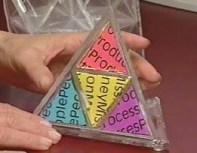
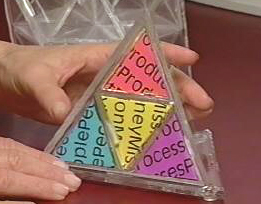
tetrahedronWe all should know the object very well. Some adults may be a little familiar with the object, but generally it has no particular importance. It should. It is the one of the most basic building block of the sciences. Children should play with tetrahedrons and octahedrons as well as other kinds of building blocks. Now here is a postulate; it is also one of the most basic building blocks of epistemology and heuristics.

This image comes from our Small Business School television series back in 1997 when we were trying to model “People, Products, and Processes” of business. Look at the tetrahedron just above. There are four tetrahedrons within each corner. The center face is one of the four exterior faces of an octahedron. The other four faces of the octahedron are interior.

Fact #2: Most adults cannot tell you what is perfectly enclosed within the tetrahedron.

Attribution: I, Jonathunder

This is not just a lack of insight into geometry, it is a lack of insight into the basic structures of biology, chemistry and physics.  It all starts with the sphere; connect the center points of just four spheres and you have begun the simple process of making a tetrahedron.

From Wikipedia:  An animation of close-packing lattice generation. This image file (right) is licensed under the Creative Commons Share-Alike 2.5 Generic license.

Fact #3: The octahedron is is magical.  It is also a most basic three-dimensional object.
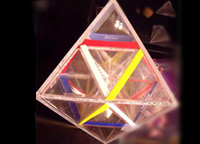
OctohedronFrom the octahedron we start seeing squares for the first time. Yes, the ubiquitous square is derivative. Now most scientists, logicians, and geometers cannot tell you what is perfectly enclosed within the octahedron.

That is a profound educational oversight.

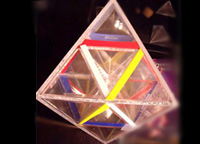
Within each corner there is an octahedron. There are six corners. With each face is a tetrahedron. There are eight faces. The tape inside defines four hexagonal plates that share a common center point. Notice the tape comes in four different colors, red, white, blue, and yellow.

The internal structure of the octahedron is simple but opens the way to complexity quickly. By making it a practice to look inside basic structure, the mind gets exercised in very special ways. Quickly, this simplicity-that-is-complexity becomes metaphorical. The mind begins seeing similarities, analogies, and metaphors everywhere. The mind begins making the strange familiar and the familiar strange. By going inside the octahedron one learns basic order, then basic relations that become functions that move the mind further within the interior world.

Fact #4: The Big Board – little universe. BigBoard8

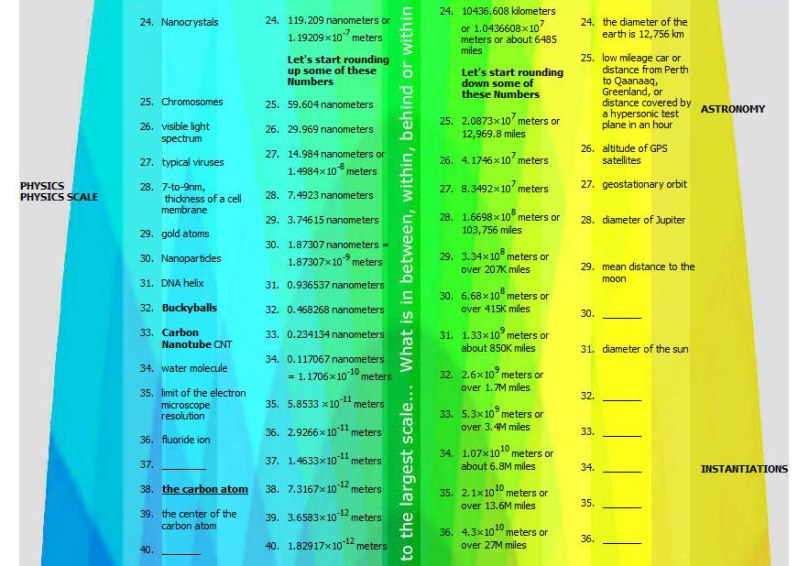
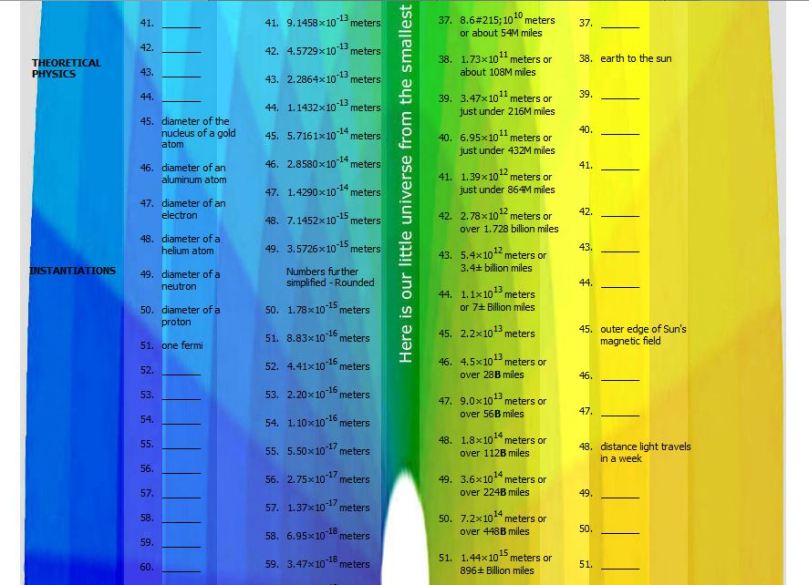
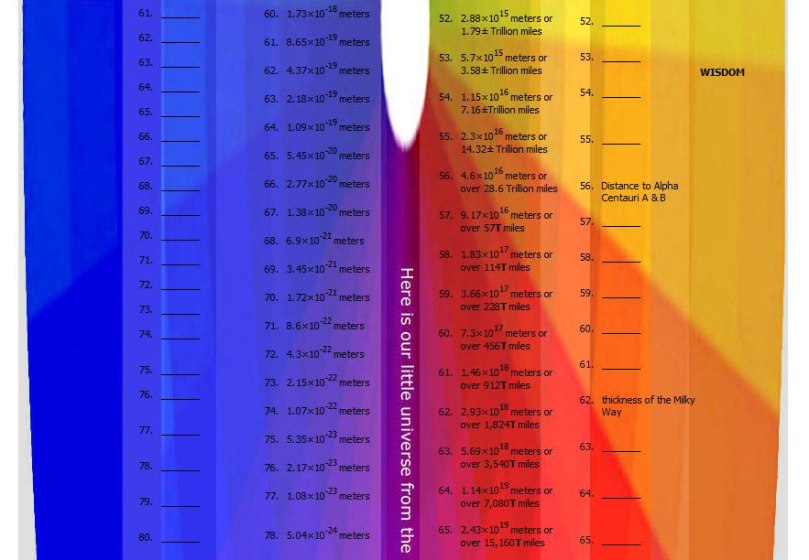
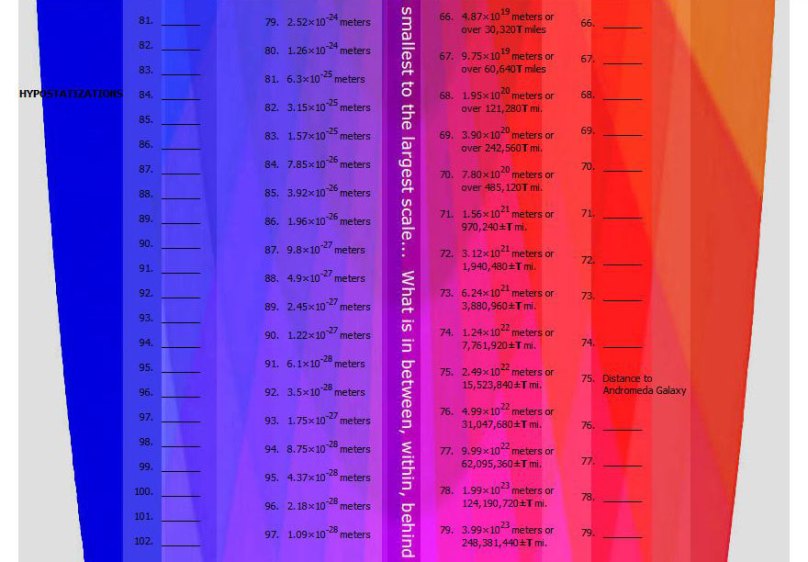
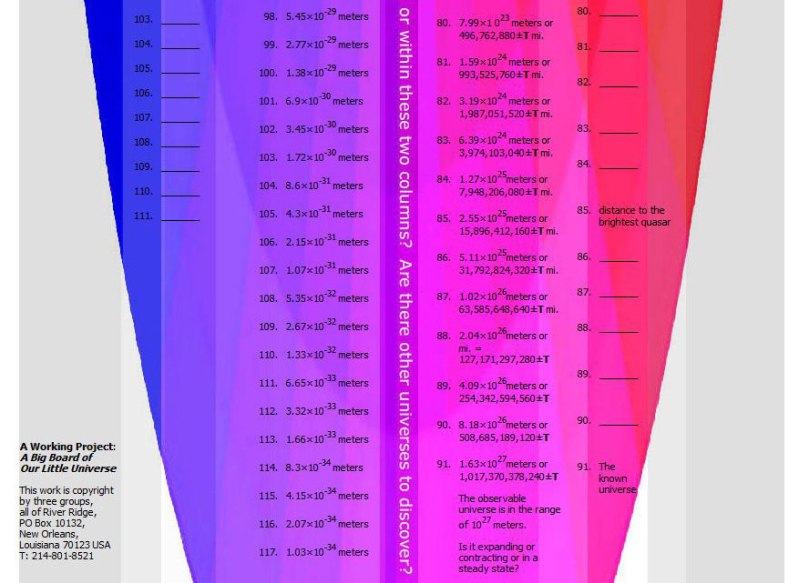
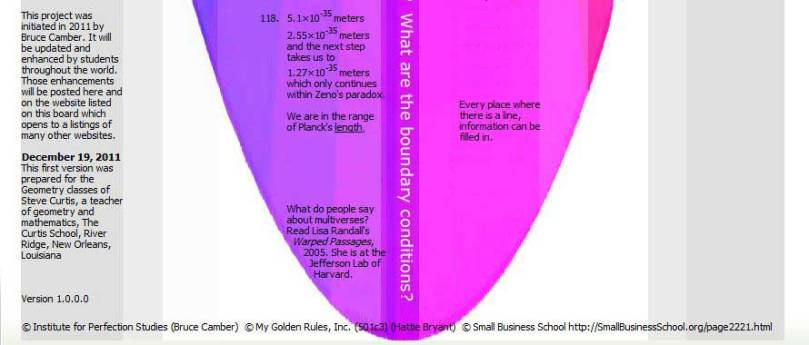
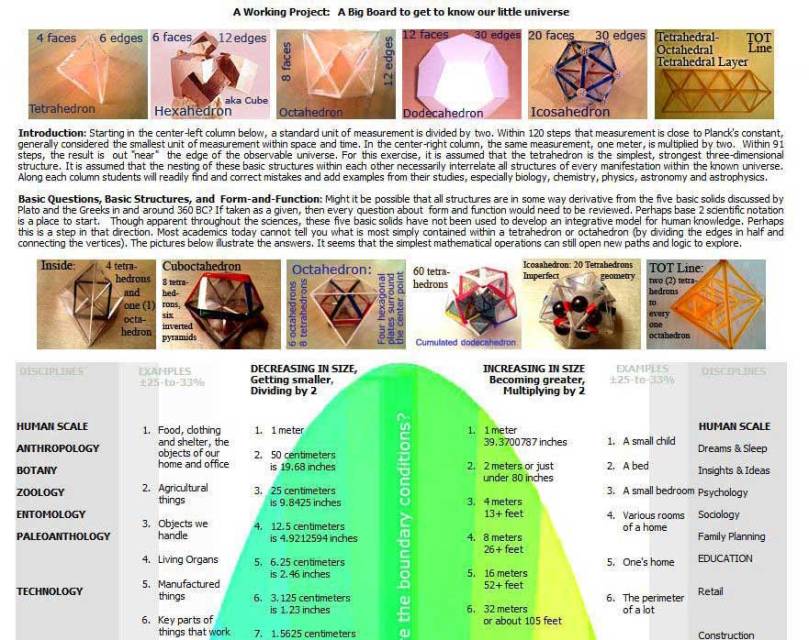
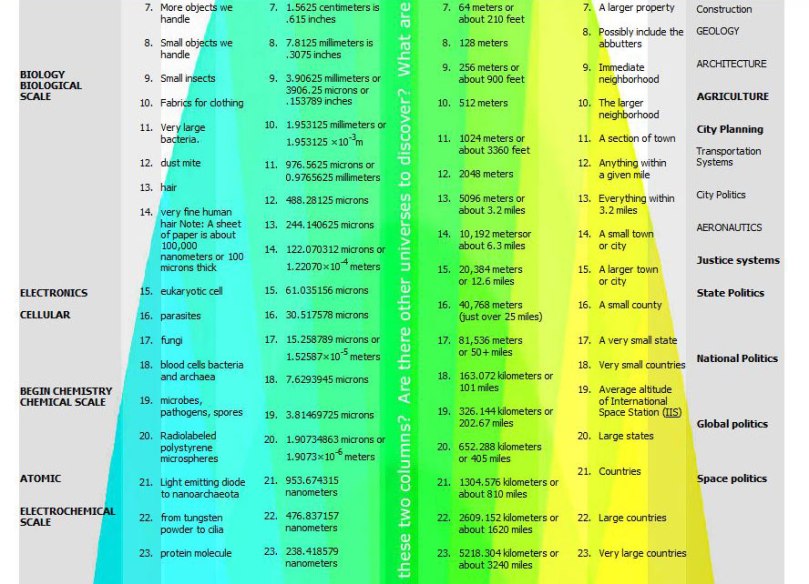
Using base-2 exponential notation, take the smallest measurement, called the Planck length (PL), and multiply it by two.  There are 101 steps (“doublings”) to reach the width of a human hair and 101+ additional steps to reach the edges of the observable universe. It begs the question, “Is this a meaningful way to organize data?” And, it inherently asks another question using the five platonic solids: “Is there a basic structural support created by nesting objects within all 202+ steps?” At the very least, it helps to organize data. In the smallest scale, there is conceptual richness. From step 1 to 65, the sum of the distances is equal to one-Planck-Length-less-than-the–diameter-of-a-proton, yet there are over 36 quintillion primary points to make every conceivable model, of any object or thing in existence. Now that opens up an interesting thought experiment. More…
Background Story: Big Board-little universe

Why you should say “Yes” when asked to do a favor…

Date:          December 28, 2011  (with small updates, March 24, 2013 )
From:         Bruce Camber
To:              Friends and family
Subject:     Big Board – little universe using base-2 exponential notation

Strange things can happen when invited to be a “guest lecturer” (essentially just an assistant for students) within five high school geometry classes and for the teacher who is part of the extended family.

Have you ever seen the entire universe mathematically related and notated on one chart? In studying the platonic solids and base-2 notation, it seemed to be an interesting task to do the simple base-2 math to create the picture on the far right of this page. That one was first printed at the Office Max in Harahan, Louisiana on December 17. It measured 24″ by 120″ but that was too big and awkward. Two smaller charts, 12″ by 60″ were created the next day, December 18, 2011 for the classroom discussions on December 19.

The ten foot board was cut about in half and the top section was put in the front of the class and the bottom section in the back. On the walls on the left and right were the two five foot charts. It seemed a bit enchanting.

There were five high school geometry classes that were challenged to see the universe using Plato’s five building blocks to visualize it all.  We used base-2 exponential  notation.  It was clearly more granular than base-ten.  One divides by 2 or multiplies by 2 instead  of by 10. There is a huge history of work done within the orders of magnitude that we could readily use. At first, we used an imaginary tetrahedron that was 1 meter on its side. Our actual models were 2.5 inches.  We divided that tetrahedron in half over and over again until we reached a measurement within the range of the Planck length, considered the smallest possible measurement. We then multiplied by two until that number was somewhere in the range of  “the edges of the observable universe.”  Where we expected thousands of steps in either direction, on our first pass we found as few as 105 notations (and as many as 118) going smaller and 91 going larger. We reduced it to a chart with a color wheel as the background, printed it up, and called it, Big Board – little universe  (Version 2.0.0.1 displayed).

Not too much later, we decided to start at the Planck length and just multiply by two.  It worked out pretty well and kind of, sort of confirmed our earlier work.

It all started with Plato’s five basic solids and thoughts about  basic structure. Though most people do not give it much thought, it has been studied throughout time, probably starting with Pythagoras and picked up later by Plato.

For many of the students, this encounter was our second time to explore these five basic solids.  The very first time together in March 2011,  the students explored models using clear plastic tetrahedrons and octahedrons.  Both are pictured in the right column under the headings “…simplest parts.”  To go inside these models, essentially dividing them in half, requires a little finesse.  Simply divide each edge in half and that point becomes a new vertex. With the tetrahedron there are six edges and within the octahedron there are eight edges. Connect all the new vertices and you have the simplest internal structure.  Within the tetrahedron are four half-sized tetrahedra in each corner and an octahedron in the middle. Within the octahedron there are six half-sized octahedrons in each corner and a tetrahedron in each of the eight faces.

The students also made icosahedra out of 12 tetrahedrons.  It was quite a lot of fun.

The second time with these kids would be more of a challenge.  It would be the day just prior to their Christmas break.

The universe in 202.34 -to- 206 steps.   When we began finding simple math errors,  the number of notations increased from 206 to 215 (it became our fudge factor). Then a leading astrophysicist said, “There are 206 notations.”  Then on May 2, 2012, a NASA physicist made the calculation based on the results of the Baryon Oscillation Spectroscopic Survey (BOSS).  He reported 202.34 notations.  Looking under scientific notation and orders of magnitude,  we could only find bits and pieces of this work on the web.

An earlier history began with the study of perfected states in space time.
Sometime around 2002, at Princeton with geometer, John Conway, the discussion focused on the work of David Bohm, once a physicist from Birbeck College, University of London. “What is a point?  What is a line?  What is a plane vis-a-vis the triangle?  What is a tetrahedron?”   Bohm’s book, Fragmentation & Wholeness, raised key questions about the nature of structure and thought.  It occurred to me that I did not know what was perfectly and most simply enclosed by the tetrahedron.  What were its most simple number of internal parts?  Of course, John Conway, was amused by my simplicity.  We talked about the four tetrahedrons and the octahedron in the center.

I said, “We all should know these things as easily as we know 2 times 2.  The kids should be playing with tetrahedrons and octahedrons, not just blocks.”

“What is most simply and perfectly enclosed within the octahedron?” There are six octahedrons in each corner and the eight tetrahedrons within each face. Known by many,  it was not in our geometry textbook.  Professor Conway asked, “Now, why are you so hung up on the octahedron?”  Of course, I was at the beginning of this discovery process, talking to a person who had studied and developed conceptual richness throughout his lifetime.  I was taking baby steps, and was still surprised and delighted to find so much within both objects.  Also, at that time I had asked thousands of professionals — teachers, including geometry teachers,  architects, biologists, and chemists — and no one knew the answer that John Conway so  easily articulated.  It was not long thereafter that we began discovering communities of people in virtually every academic discipline who easily knew that answer and were shaping new discussions about facets of geometry we never imagined existed.

Of course, I blamed myself for getting hung up on the two most simple structures…  “You’re just too simple and easily get hung up on simple things.”

My family knows about this curious hang up of mine.  They have seen these models on my desk.  We made a pseudo-Rubik’s cube type of game out of the octahedron.  One of younger ones in the family is the geometry teacher in the family’s small private high school.  “Come in and introduce the kids to Plato’s five basic solids.”   That’s about my level.  In so many ways, those kids were actually more advanced than me.

During one of my days with them, we made icosahedrons with twenty tetrahedrons.  I called it squishy geometry, but told them that I have yet to find a good discussion about it under quantum geometry or imperfect geometries, “…but when I find it, I’ll, report in.”

At first, our dodecahedron was a simple paper thing.  We were trying to think of its simplest number of parts… “Could it be twelve odd objects coming into a center point, each with a pentagonal face and three triangular sides?”  It didn’t seem like it would readily be extensible.  On my desk was a “Chrysler logo”  made using five tetrahedrons.  There was always a gap — squishy geometry — but thought, “What would a pseudo-dodecahedron look like if it were made of twelve of those pentagonals (each made up of five tetrahedrons)?”  Very quickly we had  a model.  A few hours later we were filling it with Play Doh to see what was within it.  And just within, we found an icosahedron waiting.

Now that was fascinating to us, but, is it?  Is it common knowledge among all  the best-of-the-best within mathematics, chemistry, and physics?  We are still not sure.

In thinking about a sequel class to that earlier time together, we began focusing on exponential notation. Having learned a little about Base 2 notation  — my first time over these grounds — we put these pages up on this website to begin to share it with a wider audience:  http://bblu.org

If you find it of some interest, there are links to more background pages from both.

Can Plato’s five most basic objects in some way hold each progression together in a mathematical relation? Is it meaningful in any way?  We would all enjoy hearing from you.
Please drop us a note!  – BEC

202 base-2 notations from the Planck scale render a highly-integrated model of the universe

The Big Board–Little Universe Project, part of Center for Perfection StudiesUSA

Last update: 8 August 2017

IntroductionBig Board-little universe
In December 2011 two teachers and about 80 high school students rather naïvely began to explore a geometric progression that first went down in size to the Planck Length then reversed to go back up all the way to the Observable Universe (most links open a tab or window and go to an in-depth Wikipedia page).

The first chart to be developed, pictured on the left, measures 60×11 inches. It is a view of the entire universe and has just over 200 base-2 exponential notations (dividing or multiplying by 2, over and over again). Thinking that this simple math was already part of academic work, they began asking friends and family, “What is right or wrong within our logic for this model?” A two-year search did not uncover any references to base-2 and the Planck Length.* In that time, asking around locally and then globally, many people were puzzled and asked, “Why haven’t we seen a base-2 scale of the universe before now?”

An Integrated Universe View
Dubbed Big Board – little universe, this project started as a curiosity; today, it is an on-going study to analyze and develop the logic and potential links from their simple mathematics to all the current mathematics that define the universe, all its parts, everything from everywhere, and from the beginning of time to this very moment in time. Their hope is that this simple logic has simple links to real realities. Their standing invitation is, Open To Everyone, to help. This chart follows the progressions from the smallest to the largest possible measurement of a length. Subsequent charts engage the other Planck base units. With more questions than answers, this group is trying to grasp the logic flows in light of current academic-scientific research. Progress is slow.

____________

Yes, on December 19, 2011 the geometry classes in a New Orleans high school were introduced to the chart on the left (Planck Length to the Observable Universe). In December 2014 they began to track Planck Time to the Age of the Universe. When they added the other the Planck base units to each maximum value, it seemed to call out for a horizontally-scrolled chart to follow each line of data more easily. Natural inflation becomes self-evident. And, that opened the way to question the big bang theory, especially the first four epochs — the Planck Epoch, the Grand Unification Epoch, the Inflationary Epoch, and Electroweak Epoch. In their search for answers about this model, questions abound.

This first chart is very early work.
Click on it, then click on it again to enlarge it
.

What’s next?
They ask, “Where are the informed critics to tell us where we are going wrong?” One rather brilliant, young physicist told them that the concept for this project is idiosyncratic. They quickly learned how right he was. Nobel laureates and scholars of the highest caliber were asked, “What is wrong with our picture? Where is our fallacy of misplaced concreteness?” The group is slowly analyzing the logic and developing their thoughts as web postings with the hope that somebody will say, “That’s wrong” and be able to tell them in what ways they have failed logically and mathematically.

The first 36 of 200+ notations of the horizontally-scrolled chartIf not wrong, the extension of their basic logic could begin to yield rather far-reaching results. For example, the Big Bang theory could get a special addendum, the first 67 notations. That would make it simple, symmetric (entirely relational), predictive, and totally other. The entire universe could get an infrastructure of geometries whereby many issues in physics, chemistry and biology could be redressed. The finite-infinite relation is opened for new inquiries. In this model of the universe, time-and-space are derivative of two quantitative qualities of infinity: continuity-and-symmetry. As a result, these derivative relations begin to have an inherent qualitative or value structure. If so, ethics and the studies of the Mind (the discernment of qualities) just might, for the first time in history, become part of a scientific-mathematical continuum. A trifurcated definition of the individual may emerge whereby people are simultaneously within the small scale, human scale, and large scale universe. Embracing a different sense of the nature of space and time by which both are localized by notation is surely enough; yet there will always be more. There are many working postings that have been written since their first chart; all of it needs constant updating. Many can be found through the top navigation bar option, INDEX.

Notes, lesson plans and posts (and all new posts) are being consolidated and linked from this homepage. Now called, The Big Board – little universe Project, it is a Science-Technology-Engineering-Mathematics (STEM) application. Secondary schools from around the world are being invited to join the exploration. Daily work on the topic is being researched, developed, and communicated through a sister website, http://81018.com.

The earliest postings and blogs were done by Bruce Camber within a section of his website — SmallBusinessSchool.org. That site supports a television series, Small Business School, that he and his wife, Hattie Bryant, started. It aired for 50 seasons on most PBS-TV stations throughout the USA and on thousands around the world via the Voice of America-TV affiliates.

Articles and blogs have been posted on WordPress, LinkedIn, Blogger, and Facebook (often those links open in new windows). An April 2012 article, formatted for and displayed within Wikipedia for a few weeks, was deleted on May 2, 2012 as “original research” by highly-specialized Wikipedia editors. Only then did this little group of teachers and students finally begin to believe that base-2 notation had not already been applied to the Planck base units. And, as they have grown in their analyses, it has become increasingly clear that this area of simple math and simple logic is a relatively new exploration and that notations 1-to-67 may be a key to unlock a new understanding of the nature of physical reality.

The challenge is to study the logic flow within their many charts, all based on the Planck base units, both up and down and across, to build on the question, “Is this logic simple and consistent? What does it imply about the nature of the universe?”

So, even now, there is much more to come. At the end of the year, 2015, a Lettermanesque Top Ten was added. In January 2016 an article, Constructing the Universe from Scratch, emerged. In April 2016 the horizontally-scrolled chart provided a better sense of the flow and of phase transitions. Still a “rough draft” this project has a long way to go! Bruce Camber says, “You are most welcome to add your comments, questions, ideas and insights!

*****

* Footnote: In 1957 Kees Boeke did a very limited base-10 progression of just 40 steps. It became quite popular. In July 2014, physicists, Gerard ‘t Hooft and Stefan Vandoren wrote a scholarly update using base-10. Notwithstanding, base-2 is 3.3333+ times more granular than base-10 plus it mimics cellular reproduction and other naturally bifurcating processes in mathematics, physics, chemistry, biology, topology, botany, architecture, cellular automaton and information theory; it has a geometry; it has the Planck base units, and, it has a simple logic and so much more.

Twitter

If you would like to contribute content to this site, please contact Bruce Camber
at camber – (at) – bblu.org or click here for more contact information. Thank you.

Foundations Within Foundations – Just Common Sense

What makes us human? …ethical? What gives us hope, depth, perspective?

Deep within the fabric of life there is an energy, an abiding thrust to make things better, more perfect.  That is the cornerstone of business, but much more.

Simple logic tells us that there are three forms within functions that define an increasingly perfected state within an experience:

  • The first form that defines our humanity is order  and its most basic function, a simple perfection, creates continuity.
  • The second form is a relation and its function creates symmetry.
  • The third form is dynamics and its perfection, a complex function, is harmony.

All scientific and religious assertions that seek to understand and define the universal, begin with the same first principle and evolve within their own understanding and language to the second and third. Yet, the starting point -continuity- necessarily tells us that everything is necessarily related.

This is also the basis of the value chain. The more perfect a moment or an experience is, OR the more perfected a thing or system is, the more valuable it becomes.  And, in the deepest sense of the word,  it also becomes an expression or manifestation of love.

Thus, we have the beginnings of business (and economics), ethics and morality.

Any assertion that counters life’s evolving perfections is not religion (at best, it’s a cult*);  it is also not business  (it’s exploitation or a bad company); certainly it is not good government; and most often, it is not even good science.

There are scientific endeavors that observe, quantify and qualify that which is fundamentally based on discontinuities or chaos, but these studies require the inherent continuities of mathematics and constants-and-universal  to grasp the nature of that discontinuity.  –BEC

Building Bridges… even between atheists and believers

Perhaps all it comes down to is an answer to the question, “Whose metaphor is more meaningful?” You will not find many atheists who deny science.  They do not deny the constants and universals that are always in the back of the science textbooks.

There are three constants within the sciences that remain clear, in spite of quantum mechanics.  The first is that there is order and continuity in the world. It is the basis of knowing. In every discipline there are multiple parameter sets where this is true. Beginning in mathematics, a rather pure form of thought, abstraction and representation, we then move into physics. It has multiple parameter sets as well. There is one for Newtonian mechanics, another for General Relativity and Special Relativity and yet another for quantum mechanics. Then chemistry and biology have their own parameter sets. All these parameters simply establish the boundary conditions of what is being measured within them.

Each has a formalized language. And, each has a metaphorical language that pushes into the edges of the unknown.

The sciences all embrace varying definitions of relations yet all of these definitions are understood by a symmetry function.

Specialized disciplines with each of the sciences hypothesize about the nature of the unknown, just beyond their limits of knowledge, and all these hypotheses are a study of the deepest dynamics of their discipline. The experience of insight, the “ah-ha” of the creative surge, is experienced as a concrescence of symmetries or harmony.

The atheists mostly object to the use of specialized language. They understand rules, mores, and societal law and order  even though many are nihilistic, others narcissistic, and many both.

Yet, change will come. Some of these folks will begin to realize that time is not a fundamental frame of reference and that there are qualities of life that permeate everything in every way, and that these qualities empower order, relations, and dynamics, and that these three scientific functions with the faces of continuity, symmetry and harmony just might also be understood with very personal language.  When and if they do, they are on their way to create a personal bridge to religion and some of the brave among them just may cross it.   More

Integrative studies:

1.  A focus on the universe, universals and constants, and the meaning and value of life.

2.  A possible step toward a Theory of Everything Similar

3.  What is the path to economic independence?

4.  Innovate. Make the world a better place

5.  Simple facts can open our creativity

6.  Transform the very nature of television

7.  Get creative. Listen to every idea. Cultivate ideas.  Cultivate your genius

8.  Stretch. Here is the beginning of a new revolution
9
.   Students:  High School More….

On building bridges between all things divisive…

Is it possible to extend our first principles for those who harbor hostility?

Taking our very first statement (this link goes to it) used for the first principles of the television series, Small Business School, we attempt to extend it here to engage all things divisive, especially religious language and those who oppose religious language.

Divisiveness in business, family life, culture and ethics,, political life, religion, and even the sciences actually hurts all business.  Divisiveness includes lying, stealing and cheating as well as waste, greed, and corruption.

What makes us human? … ethical? What gives us hope, depth,  perspective?

Deep within the fabric of life there is an abiding thrust to make things better, more perfect.  Though a cornerstone of business (value creation and exchange), there is much more.

There are three forms within functions that define an increasingly perfected state within every experience:

•    The first form that defines our humanity is continuity, and its most basic function, a simple perfection, is to create order.  In the traditions of the Abrahamic faiths — Judaism, Christianity, and Islam — this is the Creator-Sustainer God.  Any order, that creates continuity, is a metaphor as well as a direct expression for the Creator-Sustainer God.

•    The second form is symmetry and in its perfection functions to create relations. In the  Abrahamic tradition the perfection of that symmetry is the love doctrine, i.e., to love God with all one’s heart, soul, mind and strength, and one’s neighbor as oneself.  Any symmetry that creates real relations is a metaphor and a direct expression of the presence of the Love of God.

•    The third form is dynamics and its perfection, a complex symmetry extended within time, is harmony.  Again, in the Abrahamic tradition, the gift of the Holy Spirit is God transcending a moment in space and time to create a profound joy, deep insight, compelling love… simply a moment of perfection.  Any dynamic experienced as a harmony is a metaphor, albeit the real presence, of God’s Holy Spirit within that moment.

Every scientific and religious assertion, both seeking to understand and define the universal, begins with the same first principle and evolves within its own understanding to the second and third.  Therefore we have a diversity of faith statements which includes all of the sciences.

This is also the basis of the value chain. The more perfect a moment or an experience is, OR the more perfected a thing or system is, the more valuable it becomes.  Thus, we have the beginnings of business. Here is the baseline beginning of value and values.

Any assertion that counters life’s evolving perfections is not religion (at best, it’s a cult*); it is also not business (it’s exploitation or a bad company); certainly it is not good government; and most often, it is not even good science.

There are scientific endeavors that observe, quantify and qualify that which is fundamentally based on discontinuities or chaos, but these studies require the inherent continuities of mathematics and other universal-and-constants to even grasp the nature of that discontinuity.  –BEC
* Extremism (also, a radical elitism) in any form is not religion; it is a cult.  Those groups that condone killing could readily be labeled a cult of death that respects only their own, self-defined principles of continuity that inherently create discontinuities.  Although there is a lot of attention being focused on the extremists within all religions, Islamic extremists demand the most attention.  These people have not grasped the fullness of  Allah, and the distinction between the historic revelations and the universal revelations.  They also fail to grasp and integrate the necessary universals that extend from the sciences through Allah.  And for those of us who do not know Arabic, Allah is the Arabic word for God, yet without question the many different “takes” on God could be more readily integrated if all religions were to ask, “What is God’s perfection?  How can we know anything about it?”

Simple facts for children – really for all of us – to keep opening conduits to a deeper creativity.

Background: This page was first posted in 2001 within our television series which ran from 1994-2012. It was our first public foray into geometry. The article was introduced:

“There are obvious facts – not just ideas  –  that could stimulate a child’s natural creativity simply because these facts exercise part of the brain that engages spatial-temporal relations in basic ways.  These all seem to be “basic-basics” that do not have much currency within education today. – Bruce Camber”

We all want the best for our children.  What if we were missing a few key steps in their education?  What if we missed a few key steps within our own education?  Perhaps engaging the following three simple facts are a little like listening to Beethoven before one learns how to speak.  All of us might benefit by exercising one’s brain in ways that  expand one’s commonsense logic structure.  More

tetrahedron.jpg
Fact #1:  A most-basic, three-dimensional object in space-and-time is the tetrahedron.
We all should know the object very well. Some adults may be a little familiar with the object, but generally it has no particular importance. It should. It is one of the most basic building block of the sciences.

Children should play with tetrahedrons and octahedrons as well as other kinds of building blocks and balls.

Now here is a postulate; it is also one of the most basic building block of epistemology and heuristics.

Fact #2Most adults cannot tell you what is perfectly enclosed within the tetrahedron.
This is not just a lack of insight into geometry, it is a lack of insight into the basic structures of biology, chemistry and physics. Look at the tetrahedron on the left. There are four tetrahedrons within each corner. The center face (yellow) is one of the four exterior faces of an octahedron. Its other four faces are interior. This image comes from the television series back in 1997 when we were trying to model “People, Products, and Processes” of business.  Now about that object identified in the center, the octahedron, it is magical.

Octohedron.jpgFact #3:  The octahedron is another most basic three-dimensional object, needs more attention.
From the octahedron we start seeing squares for the first time.  Yes, the ubiquitous square is derivative.  Now most scientists, logicians, and geometers cannot tell you what is perfectly enclosed within the octahedron.

That is a profound educational oversight.

Within each corner there is an octahedron.  There are six corners.  With each face is a tetrahedron.  There are eight faces.  The tape inside define four hexagonal plates that share a common center point.  Notice the tape comes in four different colors.

The internal structure of the octahedron is simple but opens the way to complexity quickly.  By making it a practice to look inside basic structure,  the mind gets exercised in very special ways.  Quickly, this simplicity-that-is-complexity becomes metaphorical.  The mind begins seeing similarities, analogies, and metaphors everywhere.  The mind begins making the strange familiar and the familiar strange. By going inside the octahedron one learns basic order, then basic relations that become functions that move the mind further within the interior world. More…

Foundations within foundations – it’s just common sense.

What makes us human? …ethical? What gives us hope, depth, perspective?

Deep within the fabric of life there is an energy, an abiding thrust to make things better, more perfect.  That is the cornerstone of business, but much more.

Simple logic tells us that there are three forms within functions that define an increasingly perfected state within an experience:

  • The first form that defines our humanity is order  and its most basic function, a simple perfection, creates continuity.
  • The second form is a relation and its function creates symmetry.
  • The third form is dynamics and its perfection, a complex function, is harmony.

All scientific and religious assertions that seek to understand and define the universal, begin with the same first principle and evolve within their own understanding and language to the second and third. Yet, the starting point -continuity- necessarily tells us that everything is necessarily related.

This is also the basis of the value chain. The more perfect a moment or an experience is, OR the more perfected a thing or system is, the more valuable it becomes.  And, in the deepest sense of the word,  it also becomes an expression or manifestation of love.

Thus, we have the beginnings of business (and economics), ethics and morality.

Any assertion that counters life’s evolving perfections is not religion (at best, it’s a cult*);
it is also not business  (it’s exploitation or a bad company); certainly it is not good government;
and most often, it is not even good science.

There are scientific endeavors that observe, quantify and qualify that which is fundamentally based on discontinuities or chaos, but these studies require the inherent continuities of mathematics and constants-and-universal  to grasp the nature of that discontinuity.  –BEC

These principles in action  encapsulated within the logo  Application by Ben Franklin
*For a review of this language applied to religions   More

Please NoteThis simple description of the nature of life evolves from work in 1979 when Camber worked with 77 of the world’s leading, living scholars who all addressed the questions.  The initial focus was on the question, “What is life?” which was based on Erwin Schrödinger’s book of the same title.  Camber’s research was of the foundations — the hypostases — that define life, i.e. learning, memory, and space-timeMore…  and more

We Are Family

Elitists of every kind are caught up in the fallacy of misplaced concreteness.  The  abstract thought they treat as real, is “I am more important than you and my insights about life are better than yours.”  They hold that their beliefs, attitudes, and sense of self  are a proper basis for making judgments about “really-real”  realities. In spirit and in fact, we are all more alike than different and we all don’t know what we doapronn’t know. Here is a simple example.

We are family whether we like it or not.  Mathematics provides a simple logic.

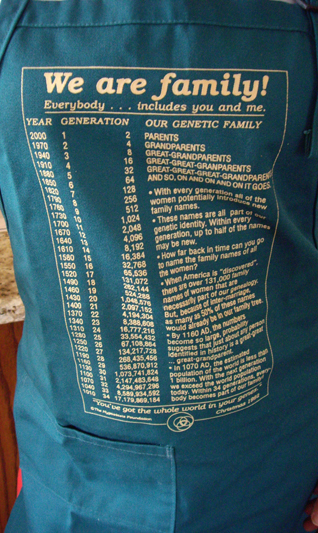
Back in 1992, I had a special apron made to give as a Christmas gift for everyone in my immediate family and some of the extended family. As you can see, this apron (as pictured on the right) proclaims, “We are family! Everybody …includes you and me.”

Below that heading was a progression of our gene pool as we go back each generation. With a 20-year average spread for each generation, it didn’t take long to see how richly diverse we necessarily would become within 1000 years. Even with all the inter-marriage within relatively small villages and towns, diversity is quickly introduced with the unknowns.

The final conclusion was simply, “You’ve got the whole world in your genes.”

Let us see.  Take a look at the picture on the right. Consider each of those four columns:

On far left are the years going back in time. It uses 30 years per generation. Many would argue that 20-year average might be more appropriate. It has only been in the last few generations that the average has climbed up over 20 years. In the USA in 2007, the average was 25.2 years (U.S. Census Bureau 2007, November 30, 2007).

The next column is the successive number of generations as we go back in time. Just imagine if everyone in your family throughout the last 400 years magically came alive and were present at your birth.  How many people would be there to greet you? Most people do not have a clue.

In the fourth column there is a discussion.  The challenge is to grasp the simple concept that you have the entire world in your genes… that everyone on earth is related.

The First Thousand Years

1st  = Your immediate family  = There is your Mom’s side & your Dad’s side.
2nd = Just 20 years ago  = Four grandparents – two more uniques
3rd = About 40 years ago  = Eight great-grandparents;  four more uniques
4th = 60± years ago  = 16 great-great grandparents; 8 more uniques
5th = 80± years ago  = 32 great, greats; 16 more possibilities
6th = 100±  = 64 Great-Greats; up to 32 more possibilities
7th  = 120±  = 128 Great-Greats
8th  = 140±  = 256 Great-Greats
9th  = 160±  = 512 Great-Greats
10th  = 180±  = 1024 Great-Greats
11th  = 200±  = 2048 Great-Greats
12th  = 220±  = 4096 Great-Greats
13th  = 240±  = 8192 Great-Greats
14th  = 260±  = 16,384 Great-Greats
15th  = 280±  = 32,768 Great-Greats
16th  = 300±  = 65,536 Great-Greats
17th  = 320±  = 131,072 Great-Greats
18th  = 340±  = 262,144 Great-Greats
19th  = 360±  = 524,288 Great-Greats
20th  = 400±  = 1,048,576 Great-Greats
400 + years ago. You can easily calculate the year. In just just 20 big generations we all have over 1±  million genetic strands and many, many unique family names.
21st  = 420±  =  2,097,152 Great-Greats
22nd  = 440±  = 4,194,304 Great-Greats
23rd  = 480±  = 8,388,608 Great-Greats
24th  = 500±  = 16,777,216 Great-Greats
25th  = 520±  = 33,554,432 Great-Greats
500 years ago – do a quick calculation of the date – what would you guess the world’s population is?  Estimates are right in the range 500 million people.
26th  = 540±  = 65,108,864 Great-Greats
27th  = 560±  = 130,217,728 Great-Greats
28th  = 580±  = 260,433,556 Great-Greats
29th  = 600±  = 520,867,112 Great-Greats
30th  = 620±  = 1,041,734,224 Great-Greats
31st  = 640±  = 2,083,568,448 Great-Greats
32nd  = 680±  =  4,167,136,496 Great-Greats
33rd  = 700±  = 8,334,272,992 Great-Greats

In relatively short order we have more genetics — 8,334,272,992 — than the total world’s population today.

That is over 8 billion genetic recombinations within 33 generations.  That is in as few as 700 years and perhaps as many as 1000 years.  What happens with another 1000 years by going back another 1000 years is staggering.

As we go back our genetic richness increases greatly, yet the world’s population decreases. Similar to the idea that there are only six degrees of separation, here we learn there is hardly a degree of separation.

No wonder there are so many people descendant from that little group on the Mayflower! About 1000 years ago we would all have over 15 billion women within our genetic pool. Given that there are so many overlapping genetic pools, it is a powerful thought that we are all in some manner related.

Of course, we recognize that not too long ago there was not today’s mobility and we were marrying not-so-distant cousins, yet with the introduction of one wandering troubadour, genetic diversity is guaranteed.