Scholars Selected For The Display Project at MIT, An Architecture for Integrative Systems

This page evolves from a 1979 global dialogue between scholars in the natural sciences, the humanities and theology. It was originally formulated to provide discussion materials for a conference at MIT entitled, Faith, Science and the Human Future.   It is re-created here as a template for the Big Board – little universe.

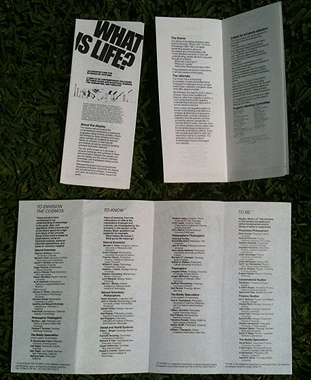
The purpose of this project was to summarize those comprehensive worldviews and powerfully suggestive ideas of living scholars (bold equals the “still living” the last time we checked!).  All vetted back in 1979 within their community as leading thinkers, the hope was that there might be a dynamic exchange and synthesis of ideas and information that would open new and deeper insights and wisdom. Based on their experiences, observations, historical analysis, hypotheses and testing, informed speculations, and even visionary insights, each person’s  work was placed within one of three perspectives: The Small-Scale Universe, The Human-Scale Universe, and The Large-Scale Universe.  And then, with each perspective, there were three groups of scholars: (1) Natural Scientists, (2) Philosophers/Theologians and (3) The Boldly Speculative.

Small-Scale Universe To Be – Reality. What is it?
Scholars seek to define fundamental units of reality, experience and/or being.
Human Scale Universe
To Know – Ways of Knowing
.
Scholars seek to understand basic interactions from cells to populations of people. What makes life human?
What gives life meaning?
Large-Scale Universe
To Envision the Cosmos
Scholars seek to understand cosmology — the parts, laws, and operations of the universe. They seek to know the origin and nature of the universe.
1979 : – All Living Scholars. Selected by their peers Listings are alphabetical listings of
Scientists, Philosophers and Theologians.  Each listings is followed by a school designation and links go to published work.
•  Ian Barbour, Carleton, Northfield (MN)
Issues in Science and Religion
•  Michael Arbib, Massachusetts, UCLA
Brains, Machines and Mathematics
•  Hannes Alfven, Uppsala, Stockholm
Cosmic Plasma
•  Ted Bastin, Cambridge
Quantum Theory & Beyond
•  Peter Berger, Boston College
The Sacred Canopy
•  Hermann Bondi, London
The cosmological scene
 •  Charles Birch, Sydney
Biology and the Riddle of Life
•  Percy Brand Blanshard, Yale
The Nature of Thought
•  Margaret & Geoffrey Burbidge, UCSD (CA)
The Abundances of the Elements
•  David Bohm, Birbeck, London
Fragmentation & Wholeness
•  Kenneth Boulding, Colorado
The World as a Total System
•  Buckminster Fuller, Pennsylvania
Synergetics I & II
•  Mario Bunge, McGill, Montreal
Treatise on Basic Philosophy
•  Erwin Chargaff,Columbia
Heraclitean Fire
•  Stephen Hawking, Cambridge
On the Shoulders of Giants
•  Fritjof Capra, Lawrence Berkeley
The Tao of Physics
•  Noam Chomsky, MIT
Language and Mind
•  Fred Hoyle, Cambridge, Cal Tech
Ten Faces of the Universe
•  John Cobb, Claremont (CA)
Process Studies
•  Freeman Dyson, Princeton
Disturbing the Universe
•  Stanley Jaki, Seton Hall (NJ)
Science and Creation
•  Richard Feynman, Cal Tech
Theory of Fundamental Processes
•  John Eccles, SUNY-Buffalo
Understanding of the Brain
•  Bernard Lovell, Manchester, JBO
Emerging Cosmology: Convergence
•  Lewis Ford, Old Dominion, Norfolk (VA)
Lure of God
•  Richard Falk, Princeton
A Study of Future Worlds
•  Roger Penrose
The Emperor’s New Mind
•  Sheldon Glashow, Harvard
The charm of physics
•  Paul K. Feyerabend, Berkeley
Science in a Free Society
•  Arno Penzias,  Bell Labs (NJ)
The Origin of the Elements
•  David Griffin, Claremont (CA)
Archetypal Process
•  John N. Findlay, Oxford, Boston
Plato: The Written and Unwritten
•  Carl Sagan, Cornell
Contact  and  Cosmos
•  Charles Hartshorne, Chicago
The Zero Fallacy
•  Hans-Georg Gadamer, Heidelberg
Truth and Method
•  Fred A. Wolf
The Dreaming Universe
•  Krishnamurti, California
The First and Last Freedom
•  Langdon Gilkey, Chicago
Maker of Heaven and Earth
•  Tarthang Tulku (Berkeley, CA)
Time, Space, and Knowledge
•  H. Pierre Noyes, Stanford
Bit-String Physics
•  Steven Grossberg, Boston
Studies of Mind and Brain
•  Steven Weinberg, Harvard, Texas
The First Three Minutes
•  Shubert Ogden, SMU, Dallas (TX)
On Theology
•  Jürgen Habermas, Max Planck, Starnberg
The Fear of Freedom
•  Yakov B. Zel’dovich
Creation of particles in cosmology
•  Harold Oliver, Boston
A Relational Metaphysic
Gerald Holton, Harvard
Scientific Imagination

Living Scholars Today

Who shall we add in each
category?   Who are today’s
leading living scholars?

•  Gian-Carlo Rota,  MIT
Foundations of Combinatorics
•  William Johnston, Sophia, Japan
Still Point
•  Julian Schwinger, UCLA
Einstein’s Legacy
•  Gustavo Lagos, Chile
(in process)
•  John Baez, UCR (CA)
Knots and quantum gravity
•  Henry P. Stapp, Lawrence Berkeley
Mindful Universe
•  Erwin Laszlo, UN
Systems View of the World
•  Lisa Randall, Harvard
Warped Passages
•  Victor Weisskopf, MIT
The Joy of Insight
•  Bernard Lonergan, Regis
Insight: A Study of Human Understanding
•  Richard Dawkins, Oxford
The Magic of Reality
•  Carl F. von Weizsäcker, Max-Planck (Starnberg)
The Structure of Physics
•  Lynn Margulis, Massachusetts (Amherst)
Early Life
•  Daniel Shechtman, Technion
Icosahedral Quasiperiodic Phase
•  John Wheeler, Princeton, Texas
Spacetime Physics
•  Ali A. Mazrui, Michigan, SUNY-Binghamton
A World Federation of Cultures
•  Jim Yong Kim, World Bank,
Dartmouth, Toward a Golden Age
•  Eugene Wigner, Princeton
Symmetries & Reflections
 Marvin Minsky, MIT
The Society of Mind
•  Ben J. Green, Cambridge
On arithmetic structures…
•  Jürgen Moltmann, Tübingen
The Spirit of Life
•  Brian Green, Columbia (NYC)
The Elegant Universe

The selection committee

Included Marx Wartofsky,
J. Robert Nelson, Alan Olson, and Bill Henneman, all of Boston University.

•  Wolfhart Pannenburg, Munich
Theology and the Philosophy of Science
Agnieszka Zalewska, Krakow, CERN
Large Hadron Collider
•  Karl Popper, London
All Life Is Problem Solving
 

Every scholar selected was also invited to nominate others.

•  Karl Pribam, Stanford
The End of Certainty
 

Every scholar was also invited to critique the selections.

•  Ilya Prigogine, Brussels
The End of Certainty
Bruce Camber initiated and
coordinated this effort.
• Karl Rahner
Theological Investigations
A back story of its development is linked here. • Theodore Roszak, San Francisco State
The Making of a Counter Culture.

Huston Smith, Syracuse
The World’s Religions
• William I. Thomson, Lindisfarne
Passages about Earth

An Architecture for Integrative Systems

A speculative conceptual frame of reference

Who would disagree with the observation that our world has deep and seemingly unsolvable problems? It is obvious there is something missing. So, what is it? Is it ethics, morality, common sense, patience, virtues like charity, hope and love?  We have hundreds of thousands of books, organizations and thoughtful people who extol all of these and more.  The lists are robust.  The work is compelling, but obviously it is not quite compelling enough.

Everybody seems to have their own unique spin to solve the world’s problems. Yet, we have discovered that one person’s spin does not easily integrate with another. Listen to those with their finger on nuclear triggers and those who are trying to be among them.  Thoughtful people in every part of the globe are deeply concerned.

MIT.gif

In 1977 I was smitten with some of the insights of a theoretical physicist, David Bohm. He gathered a group of graduate students together to be like a child to examine everything we knew about points, lines, triangles and tetrahedrons. We were trying to discern what makes for fragmentation and what makes for wholeness.

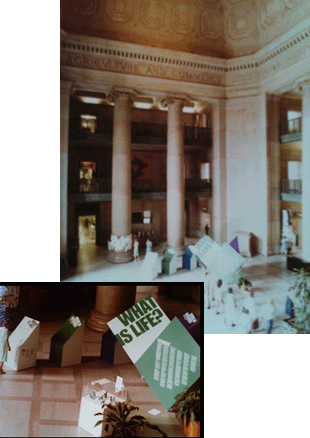
In 1979 I proposed and developed a display project at MIT to focus on first principles within the major academic disciplines. For that project, I wrote, “The human future is becoming increasingly complex and problematical.  Proposals for redirecting human energies toward basic, realizable, and global values appear simplistic. Nevertheless, the need for such a vision is obvious.”

WhatIsLife

The focus was on cross-disciplinary scholarship of leading thinkers around the world who were attempting to define a more integrative and comprehensive understanding of physical nature and of human nature.  There were 77 scholars selected.

***

That was 1979.  Progress has been slow.  There is an obvious bottleneck somewhere. And, that is what this next posting seeks to address.

***

“There’s a bottleneck somewhere, Houston.”

May 2007.  I believe a simple conceptual bottleneck that has been starring at us for many, many centuries exists in pure geometry.  I may be totally mistaken, but  I do not believe our best scholars throughout time and around the world have answered  three very simple, basic questions:

1.  What are the simplest three-dimensional structures?

2.  What is most simply and perfectly enclosed within those structures?

3.  What is most simply and perfectly enclosed within each of those parts?

When David Bohm died in 1992, I took down his little book, Fragmentation & Wholeness, he had given me in class and I started reading just one more time.  Then, it hit me. “What is perfectly enclosed within the tetrahedron?” I did not know.  “Four half-sized tetrahedrons and an octahedron.”  Discovering what was inside the octahedron was a major breakthrough for me.  Since 1994 I have asked literally hundreds of people those three questions. Chemists, biologists, architects, mathematicians, physicists, crystallographers, geologists, and geometers — few had quick answers.  Only one, John Conway,  had an answer to the third question.

The tetrahedron.  The answer to the first question is the basic building block of biology, chemistry, geometry and physics.  The answer is the tetrahedron. Many, many people answered that question.  The tetrahedron has four sides and is made of four equilateral triangles.  It is not a pyramid  (that has a square base and it is half of an octahedron).

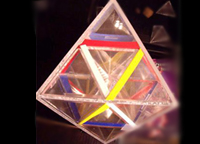
What is perfectly enclosed within the tetrahedron? The answer to this second question eluded most people.  To figure out the simple answer,  divide each of the six edges of the tetrahedron in half and connect the points.  You will quickly see a tetrahedron in each of the four corners, but there is a middle object and it often requires a model to see it.

You will discover the octahedron, four of its faces are the “middle”  face of the tetrahedron, and four are interior.

The octahedron. The answer to that third question requires a quick analysis of the octahedron. Only one person knew the answer to the question, “What is perfectly enclosed within an octahedron?” Yet, he hesitated and said, “Let’s figure it out.”  That was Princeton professor, John Conway, who invented surreal numbers and is one of the most renown geometers living in the world today.

Octohedron

Within each corner there is an octahedron. There are six corners. With each face is a tetrahedron. There are eight faces. The tape inside define four hexagonal plates that share a common center point. Notice the tape comes in four different colors.

Here are two of our most basic structures in the physical world and most people do not know what objects are most simply enclosed by each. Yet, these are simple exercises. School children should have quick answers to all three questions. We should know how both are generated from the simple sphere. Most of us haven’t a clue.

When questioned about my focus on this gateway to interior space, my standard answer is, “…because we do not know.”  And, as I look through the history of knowledge, I do not know why it hasn’t been part of our education. It is too simple.

This simplicity became the basis for my first principles.

Why pursue this domain of information?

First, it is there to be examined. It is what is. This is not speculative. It just is. Second, it is truly rich with more information. Third, and here I’ll be speculative, it just may open a door to some of the most basic, unanswered academic questions that, if answered, might build bridges and open new ways to an integrative understanding of life (this link goes to such a door that opened on December 19, 2011).

I will predict that once more of the complexity-yet-simplicity of these basic interior relations are discerned, the mathematics will follow and these forms will beget new functions as we discovered within nanotechnologies, i.e. nanoparticles   (buckyballs  or fullerenes) and quasiparticles (Dan Shechtman’s work).  I believe the results will impact every major discipline, including religion, ethics, ontology, epistemology and cosmology.

In physics we’ll have a new look at the weak and strong interactions,  gravity and polarity or electromagnetism, and  deep internal symmetry transformations.

In chemistry, the four hexagonal plates crisscrossing the center point should open a new understanding of bonding.  I even believe there will be a new science of “cross-dimensional bonding” in quantum chemistries.

Within biology, the sciences of RNA/DNA sequencing, genomics, applied biosystems, and even quantum biology will go deeper and become more cohesive.

In psychology, learning, memory, and even identity can be more richly addressed.

This apparent intellectual oversight does not seem to know any physical, cultural, religious or political boundaries.  I have not been able to find references to the interiority of simple structures in any culture to date.

Surely my friends who have worked with R. Buckminster Fuller and Arthur Loeb, would take exception to the comment.  Yet,  Bucky’s two volumes, Synergetics I and Synergetics II, are virtually impermeable to the average person and neither work has been widely used for common tasks or applied sciences.  Buckyballs or fullerenes are now being used widely within nanotechnologies, but that is all in its earliest stages of development as a reduction-to-practice.

The answer to the question about the octahedron renders a model with a profound complexity and simplicity.  Again, if you can picture an eight-sided object, essentially the two square bases of the pyramid pushed together, you’ll have an image of an  octahedron.

Divide each of the edges in half and connect the points.  You will find an octahedron in each of the four corners of the base square and an octahedron on the top and bottom.  In each of the eight faces is a tetrahedron.

There are very few models of the parts and whole relation.  There are fewer still that describe the interior relations of these objects.

Let us take a look.

This third picture from the top in the right column is of a tetrahedron.  There is a tetrahedron in each of the four corners and an octahedron in the middle.

The fourth picture is the octahedron.  Again, there is an octahedron in each of the six corners and a tetrahedron in each face.

TOT.jpg

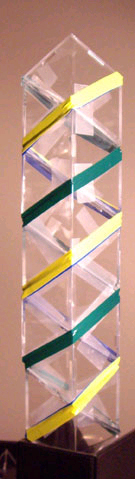
The TOT.  Th picture on the right is a tetrahedral-octahedral-tetrahedral truss or chain. I dubbed it a TOT line. The first time I thought I was observing it in action as a trusss system to support the undulating roof system of the Kansai Airport in Japan. In February 2007, I realized that truss was actually just half a TOT when I actually made the model pictured here. It is a simple parallelogram that can be found in many basic geometry textbooks. However, I have not yet found this tetrahedral-octahedral chain examined in depth.

Geologists have been studying natural tetrahedral-octahedral layers within nature that is known as a TOT layer.  We will look extensively at the natural occurrences of TOT formations much later in this work.

In the photograph, it is two tetrahedrons facing on an edge with an octahedron in the middle.  Each face of the TOT is an equilateral triangle on the surface which, of course, opens to the inner cavity of either an octahedron  or a tetrahedron.

These are simple models that have been largely unexamined by the academic communities.

Towards a Theory of Everything Similar

With the TOT line, I believe we are looking at the structure of perfection.  Pure geometry.  And, I believe that geometry once expressed in the physical world, manifested within space and time, becomes rather randomly quantized and infinitely variegated.

I believe our chemists should look into chemical bonding that goes beyond  the usual two-dimensional diagrams to these these three-dimensional interactions and then to the multi-dimensional complexity when correlated within the necessary plates of an internal tetrahedron or octahedron.

Here we open the very nature of chemical bonding to new possibilities. The bonding (the function) is interior to a pure structure (the form).

It is simple complexity.  If you were to keep going deeper within each octahedron and tetrahedron, as you might guess, the number of cells or objects expands quickly. By the tenth step within, there are 131,323,456 tetrahedrons and 10,730,656 octahedrons for a total of 142 million objects.

At the eleventh step there are over a billion tetrahedrons and 63,859,648 octahedrons within.  The total, just taking 11 steps within, are 1,110,412,992 objects.

At the twelfth step there are over 8 billion tetrahedrons and 381 million octahedrons. That level of complexity within such simplicity allows for a wide range of diversity.

It has now been reduced to first principles.

A footnote and timeline:  Yes, this particular document was written in May 2007.  The first iterations that lead up to this document were written in 1994.

The precursor to it all was that display project pictured in the top right.  That was simply called, “A Display Project of First Principles.” It began as a list of some of the most-speculative, integrative thinkers within the major academic disciplines.

I wanted to invite them to a conference in July 1979 at MIT for the World Council of Churches.  Over 4000 people would gather to discuss, Faith, Science, and the Future.  Being on the organizing committee, it seemed to me that the ideas of the finest scholars from the area, and then from the world, should be part of that discussion.

At that time, those leading scholars were not invited.  The committee thought they would dominate and possibly overwhelm the discussions; so as a consolation, they allowed me to organize this display project.

The display project was titled What is Life? after Erwin Schrödinger’s book of the same title.  This work is being renewed.  Early stages of it can be found on other pages within this website.  BEC