Why Religion? Which Religion? |
| To you who call yourself religious, you may call yourself by a particular name, Christian, Jew, or Muslim (Abrahamic faiths), or Bahá’í, Buddhist, Hindu, Jain, Sikh (Indo-European religions) or Confucian, Taoist, or one of many different specially-defined, local groups of believers: Though my focus is on the first three groups because the tensions between them are so high and they are influencing the character of our little world, I write to all who have faith in God or many Gods.Here the literal interpretation of your religious texts will be questioned and challenged. Yes, the literal interpretation, whether it is of the Bible, the Qur’an, or the Tanakh or any other Religious Writings (and all the other associated religious documents with each), is limiting our depth of thought. Fundamentalism and literalism make the same mistake no matter what the belief system. The frameworks for interpretation are limited. Terrorists and warriors take the historic writings within their holy books and use-and-abuse them to justify the most ungodly behavior. The universal writings of the these books reflect God. The historic writings reflect humanity. Within the Abrahamic traditions, there is Allah, Jehovah, and Yahweh. For those of us from non-Arab-speaking countries, Allah is the Arabic word for God. To discern which writing is historic (finite) and which is universal (infinite) is the work for scholars. It is hard work, called exegesis, and the discipline is called hermeneutics. There are many ways to know your God, also known as the Infinite, the Perfect, the One, the Creator, the Sustainer, the Imminent, the Transcendent, the Omnipotent, the Omnipresent, Omnibenevolent… All of the historic documents, especially all those lines-and-paragraphs within your Religious Writings that reflect the tensions of their unique times within which the words were written, need to be set aside as the history of a particular time. The universal writings, all the lines-and-paragraphs within your Religious Writings that are timeless, not in any way time-stamped, must be developed as a basis for a working faith.* To discern between the historic and the universal is the key to our global future. There are many groups and movements within Abrahamic faiths that have not done exegetical and hermeneutical work. Within Christianity there is the KKK, the Christian Identity Movement, the Arayan Nations, and many more. Within Islam that includes movements like Salafism, the Muslim Brotherhood, al-Qaida, Hezbollah, Taliban, ISIL, Boko Haram, Al-Shabaab and any others who believe, “Allah is our objective… death for the sake of Allah is our wish.” Within Judaism there is the Jewish Underground which includes informal groups like Price Tag, and more formal groups like Kach, Kahane Chai, and the Bat Ayin Underground. To know about your God, one must read sacred texts. To know the face of God, one must study those elements within the sciences and mathematics that are universal and constant. And, those texts with no time stamp within our Religious Writings truly reveal the very nature of the God who creates and sustains. Here is a guide: • The second form is symmetry and in its perfection functions to create relations. In the Abrahamic tradition the perfection of that symmetry is the love doctrine, i.e., to love God with all one’s heart, soul, mind and strength, and one’s neighbor as oneself. Any symmetry that creates real relations is a metaphor and a direct expression of the presence of the Love of God. Anything that breaks relations is from man. • The third form is dynamics and its perfection, a complex symmetry extended within time, is harmony. Again, in the Abrahamic tradition, the gift of God’s Spirit transcending a moment in space and time to create a profound joy, deep insight, compelling love… simply a moment of perfection. Any dynamic experienced as a harmony is a metaphor, albeit the real presence, of God’s Spirit within that moment. Every scientific and religious assertion, both seeking to understand and define the universal, begins with the same first principle and evolves within its own understanding to the second and third. Therefore we have a diversity of faith statements which includes all of the sciences. This is also the basis of the value chain. The more perfect a moment or an experience is, OR the more perfected a thing or system is, the more valuable it becomes. Thus, we have the beginnings of business. Here is the baseline beginning of value and values. Any assertion that counters life’s evolving perfections is not religion (at best, it’s a cult*); it is also not business (it’s exploitation or a bad company); certainly it is not good government; and most often, it is not even good science. My bottom line conclusion is simple, “Let us open another front within this epic battle with any and all people who cause the death of another.” Thank you. – Bruce Camber For more, please consider these pages:
Editor’s note: An early form of this post was a letter, originally written on the 3rd of March 2015 to Barack Hussein Obama, President, USA, and Benjamin Netanyahu, Prime Minister, Israel. It was then updated on Monday, December 28, 2015 to include Ali Khamanei, Ayatollah Seyyed, Iran. It was sent via those links embedded within their names (on that page) on February 10, 2016. |
Category: Scholars
Perhaps the early beginnings of a more-simple, more-integrative model of our Universe
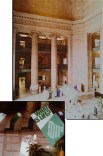 The roots of this project go back to 1979 in the main entrance of MIT, Lobby 7, where the works of 77 key, living scholars were placed within either the small-scale, human-scale, or large-scale universe. At that time quarks and strings were the smallest things considered.
- Could it be that our small scale was not small enough?
- Are the Planck base units the right place to begin an analysis of the universe?
In March 2012 I initiated an article for Wikipedia about our work within a local high school. A few months earlier we had started to explore a very simple model where the small scale started with the Planck units, used base-2 exponential notation, and went up to the fermion. It then continued on to the Observable Universe for a total of just over 201 notations. Actually published in Wikipedia early in April, that article was deleted on May 2, 2012. In the course of online discussions with an MIT mathematics professor, a major Wikipedia editor, he said it was “original research.” There was no history within scholarship where the universe was defined by 201+ base-2 exponential notations which used the Planck base units and the simplest Platonic geometries to define an infrastructure for the entire universe.
So, what is wrong with that starting point for a model of the universe?
You are here reading this posting for a purpose. I hope it is to think about its veracity and cogency, or to give it a critical review, or to share it with someone else. A simple “Thumbs Up” to encourage us to go forward would be helpful. An insightful comment would be highly appreciated. Sharing this posting with another is encouraged. Becoming associated with this research effort would be most uplifting. You are always invited and most welcomed.
It was with that 1979 project at MIT that I began to see the universe in terms of the small scale, human scale, and large scale (ontology, epistemology, and cosmology). With the Big Board-little universe project that early work has been re-birthed. On December 20, 2012, in response to an email, Frank Wilczek, MIT physics professor and Nobel laureate, said, “I should emphasize that the Planck length is not a substance or law, just a rough concept. So, for example, twice or half the Planck length would be just as good as the Planck length itself, as a concept — it’s basically a matter of convention which you use.”
Yet, within those charts that slowly emerged from our work, there are many, many numbers that should be analyzed and discussed. That has sparked these three conclusions:
1. We will always need your critical review of the our posts. Take, for example, On Constructing the Universe from Scratch. That post resulted in an extended LinkedIn commentary (https://www.linkedin.com/pulse/constructing-universe-from-scratch-bruce-camber) in part based on series of comments at the end of the original article. Comments are helpful!
2. At the end of the year, 2015, I attempted to define our first principles and basic assumptions for this project, Top Ten Reasons to give up those little worldviews for a much bigger and more inclusive UniverseView. That posting is now being revisited to begin to tighten it up: https://bblu.org/ten/ Again, comments are needed. Assumptions and first principles are keys to sharing our understanding of the nature of reality.
3. Your critical review of any posting in the Index is encouraged. Or, you could help with the current work focused on the best guesses of scholars regarding the expansion of the universe within the first seconds, years, millennium, and then million-year cycles. Please pass along any helpful references you have (such as Wikipedia’s Chronology of the universe and Timeline of the formation of the Universe). Of course, if there is any parity with the notations within the 201+ doublings, a much deeper analysis will commence!
Again, you are always invited and most welcomed to help. Thank you.
Scholars Selected For The Display Project at MIT, An Architecture for Integrative Systems
This page evolves from a 1979 global dialogue between scholars in the natural sciences, the humanities and theology. It was originally formulated to provide discussion materials for a conference at MIT entitled, Faith, Science and the Human Future. It is re-created here as a template for the Big Board – little universe.
The purpose of this project was to summarize those comprehensive worldviews and powerfully suggestive ideas of living scholars (bold equals the “still living” the last time we checked!). All vetted back in 1979 within their community as leading thinkers, the hope was that there might be a dynamic exchange and synthesis of ideas and information that would open new and deeper insights and wisdom. Based on their experiences, observations, historical analysis, hypotheses and testing, informed speculations, and even visionary insights, each person’s work was placed within one of three perspectives: The Small-Scale Universe, The Human-Scale Universe, and The Large-Scale Universe. And then, with each perspective, there were three groups of scholars: (1) Natural Scientists, (2) Philosophers/Theologians and (3) The Boldly Speculative.
| Small-Scale Universe To Be – Reality. What is it? Scholars seek to define fundamental units of reality, experience and/or being. |
Human Scale Universe To Know – Ways of Knowing. Scholars seek to understand basic interactions from cells to populations of people. What makes life human? What gives life meaning? |
Large-Scale Universe To Envision the Cosmos Scholars seek to understand cosmology — the parts, laws, and operations of the universe. They seek to know the origin and nature of the universe. |
| 1979 : – All Living Scholars. Selected by their peers Listings are alphabetical listings of Scientists, Philosophers and Theologians. Each listings is followed by a school designation and links go to published work. |
||
| • Ian Barbour, Carleton, Northfield (MN) Issues in Science and Religion |
• Michael Arbib, Massachusetts, UCLA Brains, Machines and Mathematics |
• Hannes Alfven, Uppsala, Stockholm Cosmic Plasma |
| • Ted Bastin, Cambridge Quantum Theory & Beyond |
• Peter Berger, Boston College The Sacred Canopy |
• Hermann Bondi, London The cosmological scene |
| • Charles Birch, Sydney Biology and the Riddle of Life |
• Percy Brand Blanshard, Yale The Nature of Thought |
• Margaret & Geoffrey Burbidge, UCSD (CA) The Abundances of the Elements |
| • David Bohm, Birbeck, London Fragmentation & Wholeness |
• Kenneth Boulding, Colorado The World as a Total System |
• Buckminster Fuller, Pennsylvania Synergetics I & II |
| • Mario Bunge, McGill, Montreal Treatise on Basic Philosophy |
• Erwin Chargaff,Columbia Heraclitean Fire |
• Stephen Hawking, Cambridge On the Shoulders of Giants |
| • Fritjof Capra, Lawrence Berkeley The Tao of Physics |
• Noam Chomsky, MIT Language and Mind |
• Fred Hoyle, Cambridge, Cal Tech Ten Faces of the Universe |
| • John Cobb, Claremont (CA) Process Studies |
• Freeman Dyson, Princeton Disturbing the Universe |
• Stanley Jaki, Seton Hall (NJ) Science and Creation |
| • Richard Feynman, Cal Tech Theory of Fundamental Processes |
• John Eccles, SUNY-Buffalo Understanding of the Brain |
• Bernard Lovell, Manchester, JBO Emerging Cosmology: Convergence |
| • Lewis Ford, Old Dominion, Norfolk (VA) Lure of God |
• Richard Falk, Princeton A Study of Future Worlds |
• Roger Penrose The Emperor’s New Mind |
| • Sheldon Glashow, Harvard The charm of physics |
• Paul K. Feyerabend, Berkeley Science in a Free Society |
• Arno Penzias, Bell Labs (NJ) The Origin of the Elements |
| • David Griffin, Claremont (CA) Archetypal Process |
• John N. Findlay, Oxford, Boston Plato: The Written and Unwritten |
• Carl Sagan, Cornell Contact and Cosmos |
| • Charles Hartshorne, Chicago The Zero Fallacy |
• Hans-Georg Gadamer, Heidelberg Truth and Method |
• Fred A. Wolf The Dreaming Universe |
| • Krishnamurti, California The First and Last Freedom |
• Langdon Gilkey, Chicago Maker of Heaven and Earth |
• Tarthang Tulku (Berkeley, CA) Time, Space, and Knowledge |
| • H. Pierre Noyes, Stanford Bit-String Physics |
• Steven Grossberg, Boston Studies of Mind and Brain |
• Steven Weinberg, Harvard, Texas The First Three Minutes |
| • Shubert Ogden, SMU, Dallas (TX) On Theology |
• Jürgen Habermas, Max Planck, Starnberg The Fear of Freedom |
• Yakov B. Zel’dovich Creation of particles in cosmology |
| • Harold Oliver, Boston A Relational Metaphysic |
• Gerald Holton, Harvard Scientific Imagination |
Living Scholars Today Who shall we add in each |
| • Gian-Carlo Rota, MIT Foundations of Combinatorics |
• William Johnston, Sophia, Japan Still Point |
|
| • Julian Schwinger, UCLA Einstein’s Legacy |
• Gustavo Lagos, Chile (in process) |
• John Baez, UCR (CA) Knots and quantum gravity |
| • Henry P. Stapp, Lawrence Berkeley Mindful Universe |
• Erwin Laszlo, UN Systems View of the World |
• Lisa Randall, Harvard Warped Passages |
| • Victor Weisskopf, MIT The Joy of Insight |
• Bernard Lonergan, Regis Insight: A Study of Human Understanding |
• Richard Dawkins, Oxford The Magic of Reality |
| • Carl F. von Weizsäcker, Max-Planck (Starnberg) The Structure of Physics |
• Lynn Margulis, Massachusetts (Amherst) Early Life |
• Daniel Shechtman, Technion Icosahedral Quasiperiodic Phase |
| • John Wheeler, Princeton, Texas Spacetime Physics |
• Ali A. Mazrui, Michigan, SUNY-Binghamton A World Federation of Cultures |
• Jim Yong Kim, World Bank, Dartmouth, Toward a Golden Age |
| • Eugene Wigner, Princeton Symmetries & Reflections |
• Marvin Minsky, MIT The Society of Mind |
• Ben J. Green, Cambridge On arithmetic structures… |
| • Jürgen Moltmann, Tübingen The Spirit of Life |
• Brian Green, Columbia (NYC) The Elegant Universe |
|
|
The selection committee Included Marx Wartofsky, |
• Wolfhart Pannenburg, Munich Theology and the Philosophy of Science |
• Agnieszka Zalewska, Krakow, CERN Large Hadron Collider |
| • Karl Popper, London All Life Is Problem Solving |
||
|
Every scholar selected was also invited to nominate others. |
• Karl Pribam, Stanford The End of Certainty |
|
|
Every scholar was also invited to critique the selections. |
• Ilya Prigogine, Brussels The End of Certainty |
|
| Bruce Camber initiated and coordinated this effort. |
• Karl Rahner Theological Investigations |
|
| A back story of its development is linked here. | • Theodore Roszak, San Francisco State The Making of a Counter Culture. |
|
| • Huston Smith, Syracuse The World’s Religions |
||
| • William I. Thomson, Lindisfarne Passages about Earth |
||
 Big Board-little universe