Please note: Reviewed, January 14, 2016 at 1:01 AM GMT.
Abstract: Key embryonic insights from within high school geometry classes back in December 2011 are postulated as a most simple, logical, hypostatic structure of the universe, a base-2 progression from the Planck Length to the Observable Universe. In September 2014 the naive question was asked, “Could the universe be based on a quiet expansion not a Big Bang?” When the numbers from Planck Time to the Age of the Universe were added in December 2014, this concept of a quiet expansion seemed less speculative. In February 2015 the remaining Planck base units were added to the chart. By August 2015 extensive questions were raised primary among them, “Can this chart be integrated with the Lambda-CDM model (the parameterized cosmological model)?” The immediate task of this paper is to explore those questions in light of the numbers at each doubling to help to discern reasons why this simple model warrants the attention of the academic community.
Simple facts, figures, and logic in search of a theory. The chart with five columns for each of the base Planck units and 204 notations down, 1020 boxes, provides real data to examine the logic flows both across and up-and-down. The goal of this article is to examine no less than 10 boxes. Looking across would be 50 boxes; adding two or three boxes up and down would total over 150 boxes. Ten percent should be enough to learn if a simple logic actually flows through the numbers. If it does… well, perhaps we have a new science in the making.
201+ Notations Begin With The Planck Length. The simple mathematical progression that rendered the 201+ base-2 exponential notations was the result of following embedded geometries going smaller and smaller until in the range of the Planck Length. Going in the other direction, larger and larger, was achieved by multiplying by 2 until in the range of the Observable Universe. The total, just over 201 doublings, could not be found within the writings of the academic community. The base-10 work done back in the 1957 by Kees Boeke and his high school classes in Holland was abundantly indexed; there were no references to a base-2 progression from the Planck Length to the Observable Universe, especially as a result of following embedded geometries within the tetrahedron and the primary octahedron within that tetrahedron.
Planck Time to the Age of the Universe is applied. There is general scientific concurrence regarding the estimates of the age of the universe. That figure provides a better framework for the doublings of Planck Time, from the beginning of time to this moment, right now, our current time, which always defines the endpoint. Planck Time and Planck Length track together in informative ways. For example, the notation that defines one second is between 142nd notation (.6011 seconds) and the 143rd (1.2023 seconds). The doublings of the Planck Length are 180,212.316 kilometers at Notation 142 and 360,424.632 kilometers at Notation 143. As one might have expected, the speed of light is confirmed in between the two at 299,792,458 meters for one second. At this point in time the other three Planck base units have become quite large, larger than any common number within human experience.
This Quiet Expansion begins at the first doubling. Quite literally, there is no room for sound until out to the 108th doubling (the beginning of sound waves) and on out to the 119th (the full spectrum of sound ranges from Notation 108 to Notation 119). There is something quite helpful within a visceral sense of the number and parameter. Examining groups of numbers associated with a common human experience is more than helpful; it provides the infrastructure of logic. Yet, there is no point where simple logic flows across all five Planck units. Yet, as demonstrated, it is quite informative when even two such numbers correspond.
For example, one of the very smallest notations with an experiential human equation is Notation 93 where observable light begins to manifest. Notation 101 is within the range of the thickness of human hair. This, of course, is where a large group within Planck Length and Planck Time correspond. This is the human scale universe. And, within that group there is one place where length and temperature correspond.
Planck Length and Planck Temperature. First, it was a leap of faith to hold to our working premise, “Everything starts simply” and to place the extremely hot Planck Temperature at the top of the chart. That put a very common number between Notation 103 and 104 where the temperature has cooled to 98.6 degrees Fahrenheit. Here we find among many other common things, the human egg cell. At Notation 105 the temperature has risen to 894 Kelvin or a very hot 1149.53° Fahrenheit and at Notation 102 it has dropped to a very cool –58° Fahrenehit.
Planck Mass. The very smallest notation with a common figure is the 31st doubling (Notation 31) where we find 103 pounds (46.74 kilograms). For many people, it is a key weight threshold signifying our coming of age, quickly approaching being an adult. Within this doubling the other four figures are so small, it causes one to ponder. So much seems to be happening with each of these doubling, that 103 pounds encourages some speculation. How about this? Perhaps the 103 pounds is the sum total weight of this notation! At the top end of this column are the outrageously large numbers that come very close to estimates by some of the more speculative within the scientific community, especially if each number in this column is the sum total weight of that notation. In some peculiar ways, this just may be a measurable concept.
The Human Scale Universe. Within the human and large scale universe, there are many familiar things within the Planck Length notations, yet the other Planck figures remain largely remote.
Planck Time. Although we cannot meaningfully perceive much smaller than a tenth of a second (Notation 140), in 2010 machines at the Max Born Institute in Berlin measured down to 100 attoseconds (Notation 87). Perhaps each notation with the Planck Time column describes a range in which relations are defined. Some elements of that statement may be measurable.
What Is Is? If looked to discern any special logic, one’s conclusion might be that each notation, with its vast array of vertices and multiples of the Planck base units, define the terms and conditions by which that notation-qua-notation is. That is, these numbers define the “isness” of the notation.
So, let us look in depth at one second between Notation 143 and 144. The total mass ranges from 2.4268×1034 kilograms to 4.8537×1034 kg. It defines a range, “no greater than twice that amount, and not less than half that amount.” In a similar manner, the total energy has a range, 2.0913×1025 coulombs but not greater than twice this amount and no less than half that amount. The total of heat within the notation, a huge stretch of the imagination, is 2.4578×10¹⁴ K to 4.9156×10¹⁴ K. Though an unimaginable amount of heat to be spread out throughout this single Notation 142, it just may be a measurable concept.
Planck Charge. Let’s look at which notations Planck Charge becomes a common number. For example, a lightning bolt is typically around 15 C, large bolts up to 350 C. That is quite visceral, yet on the chart it is in the range of Notations 63 to 67, the run up to the transfer from the small-scale to the human scale universe. If it represents the sum total charges within each notation, it certainly provides us with something to ponder.
These five Planck base units create very large continuity equations. Though imputed, remember that this schema is also based on the simplest geometries. Taking the entire chart and the weight of its simple logic, it suggests that the symmetries of these imputed geometries and these continuity functions are infinite, and that length (space), time, mass, charge and temperature are finite. These 201+ notations seem to define a finite universe and each notation defines a range in which particular subjects and objects are bounded by their Planck base units doubling, thereby each notation has a certain functional uniformity which provides a range within which particular groups or sets of things work.
Questions are asked, “Is this model the abiding, on-going, current structure of things as they are? How?”
201+ notations, divided by three, renders a small-scale, human scale, and large scale universe. The application of scaling laws and dimensional analysis to the first 60 notations resulted in learning about the power of base-8 expansion. By the 20th notation there are plenty of vertices with which to build structures; that is 1,152,921,504,606,846,976 or 1.152 quintillion vertices. By the 60th notation, add 36 more places (zeros). That is a robust infrastructure with 1152921504606846976000000000000000000000000000000000000 vertices (perhaps point-free vertices).
There is what would appear to be an infinite number of possible constructions. Add in the 131 better-known dimensionless constants and the fundamental physical constants, there should be enough variables to accommodate the Standard Model in physics as well as the science that has resulted from the standard model in cosmology. Please note that at the 60th notation, the size of the Planck Length doubling is not yet large enough to accommodate a fermion. From the 1st doubling to at least the 60th doubling, all the “structure” may best be described as hypostatic, which means in this instance, the essence or underlying reality.
Humanity doesn’t physically appear within the Planck Time column until well into the 201st notation. There has been a dispersion of length (space) mass, charge and temperature throughout an ever-expanding universe. Obviously there is a lot of science to learn between Notation 101 to Notation 202, and it will all be in relation to the deeper dynamics between Notation 1 and 101.
Reflections and Projections. Our base-2 chart of the Planck Base Units was first published in February 2015. This is its first review. It is an introduction that requires many more years of work and analysis. It frames a detective story whose final chapter could be written in many different ways. To expand the grounds of the analysis will require going deeply inside the simple geometries within the first 60 notations to discern how these geometries extend undetected, but measurably present throughout the entire universe. The assumed universals — order and continuity, multiple grids of relations with symmetries as well as asymmetries, and dynamics that seem to conjure up transformative instants of harmony, degrees of perfection and the darkest forms of chaos within degrees of imperfection — will be studied in light of duality, finite and infinite sets, group theory, and set theory. That study will focus on the correlations with advanced combinatorics, matroids, amplituhedrons, and the Buckingham pi theorem.
All the questions raised within A Simple View of The Universe will now begin to be addressed.
Much more editing and perhaps a little more writing to come.
Working notes: When this page is ready to be declared “a working first-draft,” I will post an index of related articles; and as a working first draft, this post will be the first in that list. -BEC
Editorial note: Our world seems increasingly crazy. This model just might help to open new insights that might mitigate some forms of that craziness. So though still quite rough, it’s being brought into the light of the public rather early. Also, by working on it in public, perhaps others will have comments and suggestions to shape its potential.
This post is a continuation of a prior work, A Simple View of the Universe. There are more observations to make about the Planck Time progression and many more to make about the progressions of the other Planck base units. So, to say the least, this document is very much in process and will be updated frequently throughout the day and throughout the month of September.
 This project is bigger than the people currently working within it. To move this project into high gear, we tried doing a Kickstarter program (December 2015) to raise awareness, to build a larger team and support structure, and to initiate pilot programs in 100 high schools across the USA.
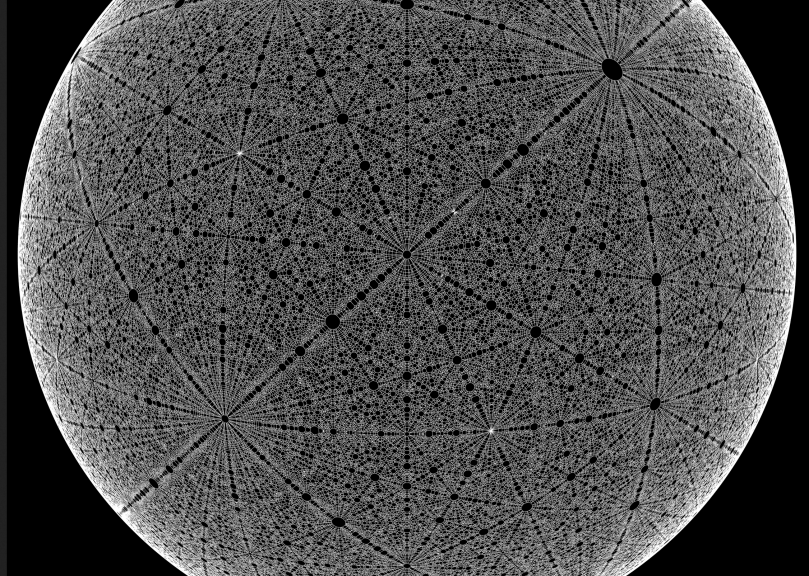 “Behind it all is surely an idea so simple, so beautiful, that when we grasp it — in a decade, a century, or a millennium – we will all say to each other, how could it have been otherwise?” by John Archibald Wheeler, 1911-2008, physicist, How Come the Quantum? from New Techniques and Ideas in Quantum Measurement Theory, Annals of the New York Academy of Sciences, Vol. 480, Dec. 1986 (p. 304, 304–316), DOI: 10.1111/j.1749-6632.1986.tb12434.x
 Big Board-little universe