Foundations Within Foundations – Just Common Sense

What makes us human? …ethical? What gives us hope, depth, perspective?

Deep within the fabric of life there is an energy, an abiding thrust to make things better, more perfect.  That is the cornerstone of business, but much more.

Simple logic tells us that there are three forms within functions that define an increasingly perfected state within an experience:

  • The first form that defines our humanity is order  and its most basic function, a simple perfection, creates continuity.
  • The second form is a relation and its function creates symmetry.
  • The third form is dynamics and its perfection, a complex function, is harmony.

All scientific and religious assertions that seek to understand and define the universal, begin with the same first principle and evolve within their own understanding and language to the second and third. Yet, the starting point -continuity- necessarily tells us that everything is necessarily related.

This is also the basis of the value chain. The more perfect a moment or an experience is, OR the more perfected a thing or system is, the more valuable it becomes.  And, in the deepest sense of the word,  it also becomes an expression or manifestation of love.

Thus, we have the beginnings of business (and economics), ethics and morality.

Any assertion that counters life’s evolving perfections is not religion (at best, it’s a cult*);  it is also not business  (it’s exploitation or a bad company); certainly it is not good government; and most often, it is not even good science.

There are scientific endeavors that observe, quantify and qualify that which is fundamentally based on discontinuities or chaos, but these studies require the inherent continuities of mathematics and constants-and-universal  to grasp the nature of that discontinuity.  –BEC

Simple facts for children – really for all of us – to keep opening conduits to a deeper creativity.

Background: This page was first posted in 2001 within our television series which ran from 1994-2012. It was our first public foray into geometry. The article was introduced:

“There are obvious facts – not just ideas  –  that could stimulate a child’s natural creativity simply because these facts exercise part of the brain that engages spatial-temporal relations in basic ways.  These all seem to be “basic-basics” that do not have much currency within education today. – Bruce Camber”

We all want the best for our children.  What if we were missing a few key steps in their education?  What if we missed a few key steps within our own education?  Perhaps engaging the following three simple facts are a little like listening to Beethoven before one learns how to speak.  All of us might benefit by exercising one’s brain in ways that  expand one’s commonsense logic structure.  More

tetrahedron.jpg
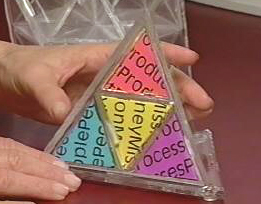
Fact #1:  A most-basic, three-dimensional object in space-and-time is the tetrahedron.
We all should know the object very well. Some adults may be a little familiar with the object, but generally it has no particular importance. It should. It is one of the most basic building block of the sciences.

Children should play with tetrahedrons and octahedrons as well as other kinds of building blocks and balls.

Now here is a postulate; it is also one of the most basic building block of epistemology and heuristics.

Fact #2Most adults cannot tell you what is perfectly enclosed within the tetrahedron.
This is not just a lack of insight into geometry, it is a lack of insight into the basic structures of biology, chemistry and physics. Look at the tetrahedron on the left. There are four tetrahedrons within each corner. The center face (yellow) is one of the four exterior faces of an octahedron. Its other four faces are interior. This image comes from the television series back in 1997 when we were trying to model “People, Products, and Processes” of business.  Now about that object identified in the center, the octahedron, it is magical.

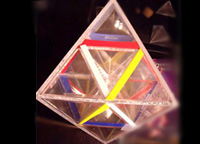
Octohedron.jpgFact #3:  The octahedron is another most basic three-dimensional object, needs more attention.
From the octahedron we start seeing squares for the first time.  Yes, the ubiquitous square is derivative.  Now most scientists, logicians, and geometers cannot tell you what is perfectly enclosed within the octahedron.

That is a profound educational oversight.

Within each corner there is an octahedron.  There are six corners.  With each face is a tetrahedron.  There are eight faces.  The tape inside define four hexagonal plates that share a common center point.  Notice the tape comes in four different colors.

The internal structure of the octahedron is simple but opens the way to complexity quickly.  By making it a practice to look inside basic structure,  the mind gets exercised in very special ways.  Quickly, this simplicity-that-is-complexity becomes metaphorical.  The mind begins seeing similarities, analogies, and metaphors everywhere.  The mind begins making the strange familiar and the familiar strange. By going inside the octahedron one learns basic order, then basic relations that become functions that move the mind further within the interior world. More…

Scholars Selected For The Display Project at MIT, An Architecture for Integrative Systems

This page evolves from a 1979 global dialogue between scholars in the natural sciences, the humanities and theology. It was originally formulated to provide discussion materials for a conference at MIT entitled, Faith, Science and the Human Future.   It is re-created here as a template for the Big Board – little universe.

The purpose of this project was to summarize those comprehensive worldviews and powerfully suggestive ideas of living scholars (bold equals the “still living” the last time we checked!).  All vetted back in 1979 within their community as leading thinkers, the hope was that there might be a dynamic exchange and synthesis of ideas and information that would open new and deeper insights and wisdom. Based on their experiences, observations, historical analysis, hypotheses and testing, informed speculations, and even visionary insights, each person’s  work was placed within one of three perspectives: The Small-Scale Universe, The Human-Scale Universe, and The Large-Scale Universe.  And then, with each perspective, there were three groups of scholars: (1) Natural Scientists, (2) Philosophers/Theologians and (3) The Boldly Speculative.

Small-Scale Universe To Be – Reality. What is it?
Scholars seek to define fundamental units of reality, experience and/or being.
Human Scale Universe
To Know – Ways of Knowing
.
Scholars seek to understand basic interactions from cells to populations of people. What makes life human?
What gives life meaning?
Large-Scale Universe
To Envision the Cosmos
Scholars seek to understand cosmology — the parts, laws, and operations of the universe. They seek to know the origin and nature of the universe.
1979 : – All Living Scholars. Selected by their peers Listings are alphabetical listings of
Scientists, Philosophers and Theologians.  Each listings is followed by a school designation and links go to published work.
•  Ian Barbour, Carleton, Northfield (MN)
Issues in Science and Religion
•  Michael Arbib, Massachusetts, UCLA
Brains, Machines and Mathematics
•  Hannes Alfven, Uppsala, Stockholm
Cosmic Plasma
•  Ted Bastin, Cambridge
Quantum Theory & Beyond
•  Peter Berger, Boston College
The Sacred Canopy
•  Hermann Bondi, London
The cosmological scene
 •  Charles Birch, Sydney
Biology and the Riddle of Life
•  Percy Brand Blanshard, Yale
The Nature of Thought
•  Margaret & Geoffrey Burbidge, UCSD (CA)
The Abundances of the Elements
•  David Bohm, Birbeck, London
Fragmentation & Wholeness
•  Kenneth Boulding, Colorado
The World as a Total System
•  Buckminster Fuller, Pennsylvania
Synergetics I & II
•  Mario Bunge, McGill, Montreal
Treatise on Basic Philosophy
•  Erwin Chargaff,Columbia
Heraclitean Fire
•  Stephen Hawking, Cambridge
On the Shoulders of Giants
•  Fritjof Capra, Lawrence Berkeley
The Tao of Physics
•  Noam Chomsky, MIT
Language and Mind
•  Fred Hoyle, Cambridge, Cal Tech
Ten Faces of the Universe
•  John Cobb, Claremont (CA)
Process Studies
•  Freeman Dyson, Princeton
Disturbing the Universe
•  Stanley Jaki, Seton Hall (NJ)
Science and Creation
•  Richard Feynman, Cal Tech
Theory of Fundamental Processes
•  John Eccles, SUNY-Buffalo
Understanding of the Brain
•  Bernard Lovell, Manchester, JBO
Emerging Cosmology: Convergence
•  Lewis Ford, Old Dominion, Norfolk (VA)
Lure of God
•  Richard Falk, Princeton
A Study of Future Worlds
•  Roger Penrose
The Emperor’s New Mind
•  Sheldon Glashow, Harvard
The charm of physics
•  Paul K. Feyerabend, Berkeley
Science in a Free Society
•  Arno Penzias,  Bell Labs (NJ)
The Origin of the Elements
•  David Griffin, Claremont (CA)
Archetypal Process
•  John N. Findlay, Oxford, Boston
Plato: The Written and Unwritten
•  Carl Sagan, Cornell
Contact  and  Cosmos
•  Charles Hartshorne, Chicago
The Zero Fallacy
•  Hans-Georg Gadamer, Heidelberg
Truth and Method
•  Fred A. Wolf
The Dreaming Universe
•  Krishnamurti, California
The First and Last Freedom
•  Langdon Gilkey, Chicago
Maker of Heaven and Earth
•  Tarthang Tulku (Berkeley, CA)
Time, Space, and Knowledge
•  H. Pierre Noyes, Stanford
Bit-String Physics
•  Steven Grossberg, Boston
Studies of Mind and Brain
•  Steven Weinberg, Harvard, Texas
The First Three Minutes
•  Shubert Ogden, SMU, Dallas (TX)
On Theology
•  Jürgen Habermas, Max Planck, Starnberg
The Fear of Freedom
•  Yakov B. Zel’dovich
Creation of particles in cosmology
•  Harold Oliver, Boston
A Relational Metaphysic
Gerald Holton, Harvard
Scientific Imagination

Living Scholars Today

Who shall we add in each
category?   Who are today’s
leading living scholars?

•  Gian-Carlo Rota,  MIT
Foundations of Combinatorics
•  William Johnston, Sophia, Japan
Still Point
•  Julian Schwinger, UCLA
Einstein’s Legacy
•  Gustavo Lagos, Chile
(in process)
•  John Baez, UCR (CA)
Knots and quantum gravity
•  Henry P. Stapp, Lawrence Berkeley
Mindful Universe
•  Erwin Laszlo, UN
Systems View of the World
•  Lisa Randall, Harvard
Warped Passages
•  Victor Weisskopf, MIT
The Joy of Insight
•  Bernard Lonergan, Regis
Insight: A Study of Human Understanding
•  Richard Dawkins, Oxford
The Magic of Reality
•  Carl F. von Weizsäcker, Max-Planck (Starnberg)
The Structure of Physics
•  Lynn Margulis, Massachusetts (Amherst)
Early Life
•  Daniel Shechtman, Technion
Icosahedral Quasiperiodic Phase
•  John Wheeler, Princeton, Texas
Spacetime Physics
•  Ali A. Mazrui, Michigan, SUNY-Binghamton
A World Federation of Cultures
•  Jim Yong Kim, World Bank,
Dartmouth, Toward a Golden Age
•  Eugene Wigner, Princeton
Symmetries & Reflections
 Marvin Minsky, MIT
The Society of Mind
•  Ben J. Green, Cambridge
On arithmetic structures…
•  Jürgen Moltmann, Tübingen
The Spirit of Life
•  Brian Green, Columbia (NYC)
The Elegant Universe

The selection committee

Included Marx Wartofsky,
J. Robert Nelson, Alan Olson, and Bill Henneman, all of Boston University.

•  Wolfhart Pannenburg, Munich
Theology and the Philosophy of Science
Agnieszka Zalewska, Krakow, CERN
Large Hadron Collider
•  Karl Popper, London
All Life Is Problem Solving
 

Every scholar selected was also invited to nominate others.

•  Karl Pribam, Stanford
The End of Certainty
 

Every scholar was also invited to critique the selections.

•  Ilya Prigogine, Brussels
The End of Certainty
Bruce Camber initiated and
coordinated this effort.
• Karl Rahner
Theological Investigations
A back story of its development is linked here. • Theodore Roszak, San Francisco State
The Making of a Counter Culture.

Huston Smith, Syracuse
The World’s Religions
• William I. Thomson, Lindisfarne
Passages about Earth